Freud and Dawkins: God is an Illusion
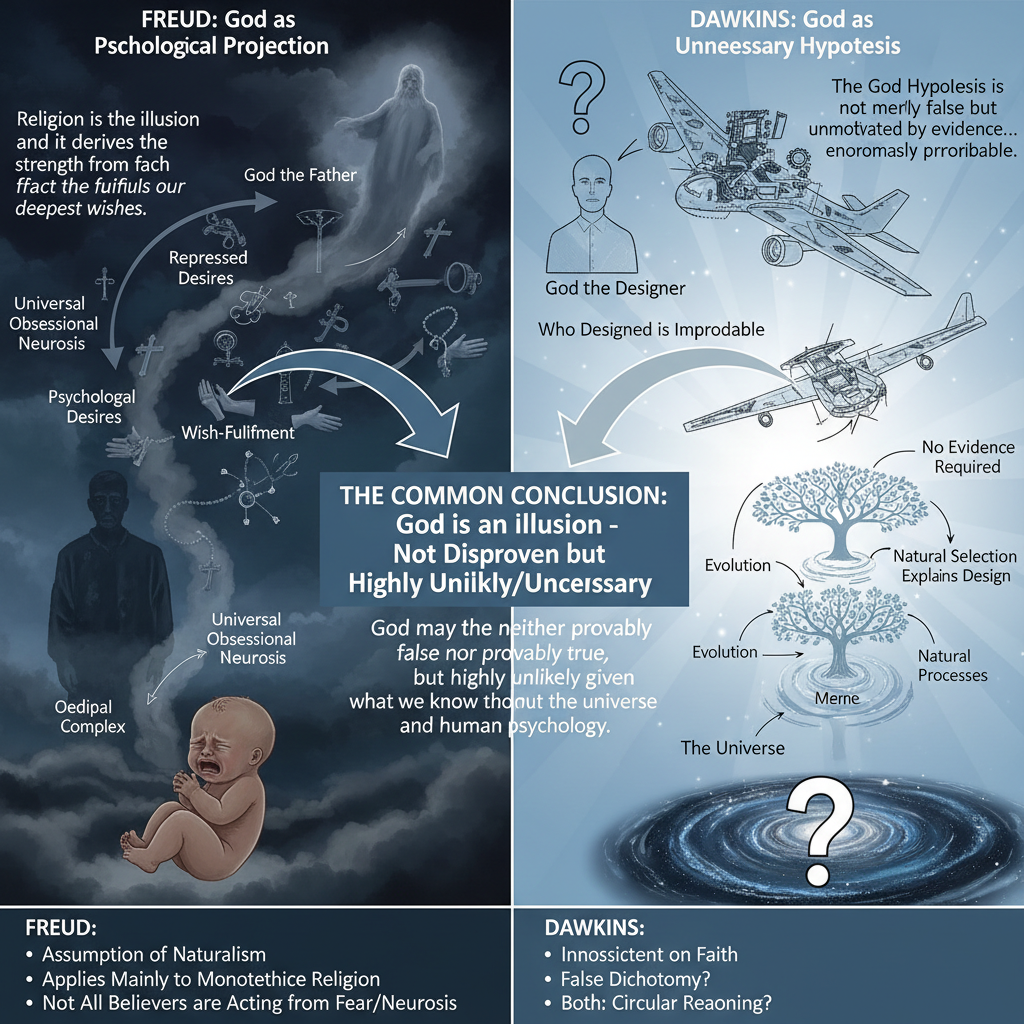
Freud and Dawkins on God as Illusion: Freud argues God is a psychological projection arising from childhood helplessness and wish-fulfillment (projecting the need for a father onto the cosmos). Dawkins argues God is an unnecessary, improbable hypothesis contradicted by natural selection and evolution. Despite different methodologies (psychology vs. evolutionary biology), both conclude God is highly unlikely and illusory. However, both assume naturalism/materialism from the start, which predetermines their conclusions against the supernatural. This illustration contrasts Freud's psychological argument (left) with Dawkins' evolutionary argument (right), both reaching the conclusion that God is an illusion. Freud's path shows a child's fear and vulnerability being projected upward into the image of a cosmic father figure (God), demonstrating how religion satisfies unconscious wishes for protection and meaning. Dawkins' path shows the problem of complexity: if God is the designer of the complex universe, who designed God? Natural selection is presented as the real explanation for apparent design. Both conclude that God is highly unlikely and unnecessary, though they reach this through different reasoning. The bottom section highlights critiques of both positions: Freud assumes that all human experience must be natural/psychological; Dawkins assumes that only empirical science reveals truth. Together, the illustration shows how both represent "programmatic secularism"—not merely personal skepticism but an active opposition to religious belief as socially harmful.
Summary
Sigmund Freud (1856-1939) and Richard Dawkins (born 1941) both argue that God is an illusion, though through different reasoning.
Freud's Argument: Psychological Projection
- God is a psychological projection based on wish-fulfillment
- Humans unconsciously create God to satisfy the deepest childhood need: for a protective father figure
- Religion is a "universal obsessional neurosis"—a collective mental illness similar to individual neurotic behaviors
- Once humans mature intellectually (through science), we should outgrow this childish need
Dawkins' Argument: Scientific Improbability
- God is an unnecessary and improbable hypothesis
- The "God explanation" for design doesn't explain anything; it just pushes the problem back: Who designed the designer?
- Natural selection and evolution fully explain the appearance of design without requiring God
- God cannot be empirically tested or falsified, making it scientifically worthless
The Common Conclusion:
Both argue that God is not necessarily provably false, but highly unlikely and unnecessary.
The Challenge to Christianity:
Both Freud and Dawkins represent programmatic secularism—the view that religion is not just personally mistaken but socially harmful and should be actively opposed.
Freud: God as Psychological Illusion
The Context: Psychoanalysis and the Unconscious Mind
Freud developed psychoanalysis to treat psychological disorders by uncovering unconscious drives and conflicts.
His Key Insight:
Mental disorders (neuroses) arise from:
- Repressed desires (especially sexual and aggressive impulses)
- Childhood conflicts (especially the Oedipal complex)
- Unconscious guilt and fear
The Oedipal Complex and God
The Oedipal Complex Explained
In childhood, a male child unconsciously:
- Fears his father (as a rival for mother's affection)
- Desires his mother (sexually/romantically)
- Experiences guilt for these forbidden desires
- Internalizes the father's authority as a superego (conscience)
How This Relates to God:
Freud argues that this childhood pattern is projected onto the universe:
- The fear of the father becomes fear of God
- The desire for the father's protection becomes seeking God's protection
- The guilt before the father becomes guilt before God
- The father's internalized authority becomes the voice of God/conscience
The Theory of Religion as Wish-Fulfillment
What is "Wish-Fulfillment"?
When the human mind unconsciously creates a belief because it desperately wants it to be true, regardless of evidence.
Examples:
- A middle-class woman who dreams of marrying a prince (possible but highly unlikely)
- A lonely person who imagines a friend who cares for them (comforting but false)
- A child who believes in Santa Claus (fulfills wish for gift-giver and magic)
How Religion is Wish-Fulfillment:
Humans face three fundamental terrors:
- The chaos of nature: Storms, disease, earthquakes
- Mortality and death: The inevitable ending of existence
- Suffering and injustice: Why do innocent people suffer?
The Solution Religion Offers (But Falsely):
- A protective Father God who controls nature
- Belief in an afterlife that compensates for earthly suffering
- Moral reassurance that good is rewarded and evil punished
- A cosmic plan that gives life meaning and purpose
Freud's Claim:
"Religious beliefs are not the result of evidence or reasoning. They are illusions—fulfillments of the oldest, strongest and most urgent wishes of mankind. The secret of their strength lies in the strength of those wishes."
Religion as "Universal Obsessional Neurosis"
What is Obsessional Neurosis?
A mental disorder characterized by:
- Compulsive rituals performed to manage anxiety
- Obsessive thoughts that won't go away
- Guilt and fear as motivators
- Repetitive behaviors meant to control/contain suffering
Religious Parallels:
Freud argues that religious practices mirror neurotic symptoms:
- Prayer/confession: Repetitive ritualistic behaviors aimed at managing guilt
- Moral rules: Obsessive adherence to arbitrary restrictions (e.g., dietary laws)
- Faith against evidence: Obsessive belief despite contradictory reality
- Hell/divine punishment: Obsessive fear driving compulsive obedience
Freud's Conclusion:
"Religion is a universal obsessional neurosis... If one attempts to represent the manifestations of this neurosis as of a religious order, the characterization shows signs of being a kind of system."
What This Means:
Just as a person with a hand-washing compulsion realizes through therapy that the behavior is irrational, humanity could realize through science that religious behavior is irrational.
Freud's Conclusion: Science Over Religion
The Future of an Illusion (1927)
Freud argued that civilization must move beyond religion:
- Science is the only reliable path to truth
- Religion must be abandoned as humanity matures
- Rational thought and empirical evidence should replace faith and hope
Freud's Quote:
"No, our science is not an illusion. But an illusion it would be to suppose that what science cannot give us we can get elsewhere."
Dawkins: God as an Unnecessary Hypothesis
Richard Dawkins (born 1941): The Evolutionary Biologist
A leading evolutionary biologist and atheist who argues that Darwinian evolution eliminates the need for a God hypothesis.
The Central Problem: Design and Complexity
Traditional argument: "The universe is complex and ordered, therefore it must have a designer (God)"
Dawkins' Response:
- If the universe requires a designer, what designed the designer?
- God would need to be even more complex than the universe
- A more complex God makes the problem worse, not better
The "Ultimate Boeing 747" Argument
Dawkins' Metaphor
Dawkins uses this metaphor to show the absurdity of the God hypothesis:
Claim:
Even a Boeing 747 airplane couldn't assemble itself randomly
Analogy:
Therefore, the universe (far more complex) needs a designer
Problem:
But who designed this incredibly complex designer? This infinite regress shows the argument fails
The Solution: Natural Selection
- Complex life forms appear designed but are actually products of natural selection
- Natural selection explains apparent design without requiring a designer
- Gradual evolution from simple to complex requires no initial intelligence
- Therefore: No God hypothesis is needed
Quote from Dawkins:
"However statistically improbable the entity you seek to explain by invoking a designer, the designer himself has got to be at least as improbable."
Dawkins' Scientific Critique of God
God is Not a Scientific Hypothesis:
- Scientific claims must be testable and falsifiable
- God cannot be tested in a lab or disproven by evidence
- Therefore, God is not a proper scientific hypothesis
The Burden of Proof:
- If God is claimed to exist, the burden of proof lies with the theist
- God is an extraordinary claim requiring extraordinary evidence
- The evidence for God is not empirically compelling
God of the Gaps Problem:
- Historically, God has been invoked to explain what science hadn't yet explained
- But as science advances, God shrinks into the remaining gaps
- Eventually, there are no gaps left, and God becomes unnecessary
Dawkins on Religion as Socially Harmful
Religion Obstructs Progress:
- Religion promotes belief without evidence (which is intellectually dishonest)
- Religion creates unnecessary guilt and fear (Freud's point too)
- Religion interferes with politics, science education, and moral thinking
The Problem of Religious Education:
- Dawkins argues children indoctrinated into religion are harmed
- Religion teaches children to accept claims without evidence
- This creates habitual irrationality extending beyond religion
Common Ground: Programmatic Secularism
Pragmatic Secularism:
The state should be neutral on religion; people can believe what they want
Programmatic Secularism (Freud and Dawkins):
Religion is fundamentally harmful and should be actively opposed
Freud and Dawkins both adopt Programmatic Secularism:
- Not only is God unlikely; religion should be discouraged
- Rational education should replace religious indoctrination
- A secular society is better for human flourishing
Criticisms of Freud and Dawkins
Criticisms of Freud:
- Assumption of Naturalism: Freud assumes all mental states are reducible to natural/psychological causes—this predetermines his conclusion
- Applies Mainly to Monotheistic Religion: His theory fits Christianity/Judaism but not Buddhism, Hinduism, or animism
- Not All Believers Act from Fear/Neurosis: Many religious people are psychologically healthy and motivated by love, not fear
- Genetic Fallacy: Even if religion originated from psychological need, that doesn't make it false
Criticisms of Dawkins:
- Inconsistent on Faith: Dawkins defines faith as "belief without evidence" but this is a strawman—theologians define faith differently
- False Dichotomy?: Science vs. religion may be a false choice; many scientists are religious
- Both: Circular Reasoning?: Both assume naturalism/materialism from the start, which predetermines their conclusion against the supernatural
Scholarly Perspectives
Quote 1 (Freud: Wish-Fulfillment):
"Religious beliefs are illusions, fulfillments of the oldest, strongest and most urgent wishes of mankind. The secret of their strength lies in the strength of those wishes. Religion arises from humanity's helplessness in childhood, when the infant's sense of fear and dependence created the need for a protective father figure. This projection onto a cosmic father—God—persists into adulthood, constituting a universal obsessional neurosis. Although religion has provided social cohesion and moral restraint, civilization has now matured beyond the need for such psychological crutches."
Source: Sigmund Freud, The Future of an Illusion (1927)
Quote 2 (Dawkins: Scientific Improbability):
"The God Hypothesis—the claim that the universe was designed and created by an omnipotent, omniscient being—is an extraordinary hypothesis that requires extraordinary empirical evidence. However, the God Hypothesis is not only unsupported by evidence; it is deeply problematic. A designer would need to be at least as complex as the universe it designed. But complexity requires explanation. The designer must be even more improbable than the thing it's supposed to explain. Natural selection, by contrast, explains apparent design without requiring a designer. Therefore, God is an unnecessary hypothesis—not definitively disproven but highly improbable and unwarranted by evidence."
Source: Richard Dawkins, The God Delusion (2006)
Key Takeaways for Your Exam
Two Independent Arguments:
Freud (psychology) and Dawkins (evolutionary biology) reach the same conclusion through completely different methodologies
Freud: Psychological Explanation:
God is a projection satisfying childhood needs for protection and meaning. Religion is a "universal obsessional neurosis"
Dawkins: Scientific Explanation:
God is an unnecessary, improbable hypothesis. Natural selection explains design without God
Illusion vs. False:
Freud doesn't say God is provably false, just unlikely (like the woman marrying a prince)
Both are "Programmatic":
Neither accepts religious belief as harmless; both see religion as socially harmful
Shared Assumption:
Both assume materialism/naturalism—that only natural/physical causes are real. This predetermines their conclusion against the supernatural
Evaluate:
Do Freud and Dawkins prove God is illusion, or do they merely assume it from the start?
Key Concepts Reference
Wish-Fulfillment
Creating a belief because one desperately wants it to be true, regardless of evidence
Psychological Projection
Unconsciously attributing an internal mental state to external reality (e.g., projecting father-need onto God)
Oedipal Complex
Freud's theory of unconscious childhood conflict: fear of father, desire for mother, internalized guilt
Universal Obsessional Neurosis
Freud's claim that religion is a collective mental illness mirroring individual neurotic symptoms
Illusion
For Freud: A belief that is unlikely true (not necessarily provably false)
Natural Selection
Dawkins' evolutionary mechanism that explains apparent design without a designer
Ultimate Boeing 747
Dawkins' argument: a complex God cannot explain complexity because the God itself needs explanation
Empirical Testability
For Dawkins: a hypothesis must be testable by evidence; God fails this criterion
God of the Gaps
The pattern of invoking God to explain what science hasn't yet explained
Programmatic Secularism
The view that religion is harmful and should be actively opposed by society
Memes
Dawkins' concept of ideas that replicate/spread through culture like genes