Humanists: Christianity Should Play No Part in Public Life
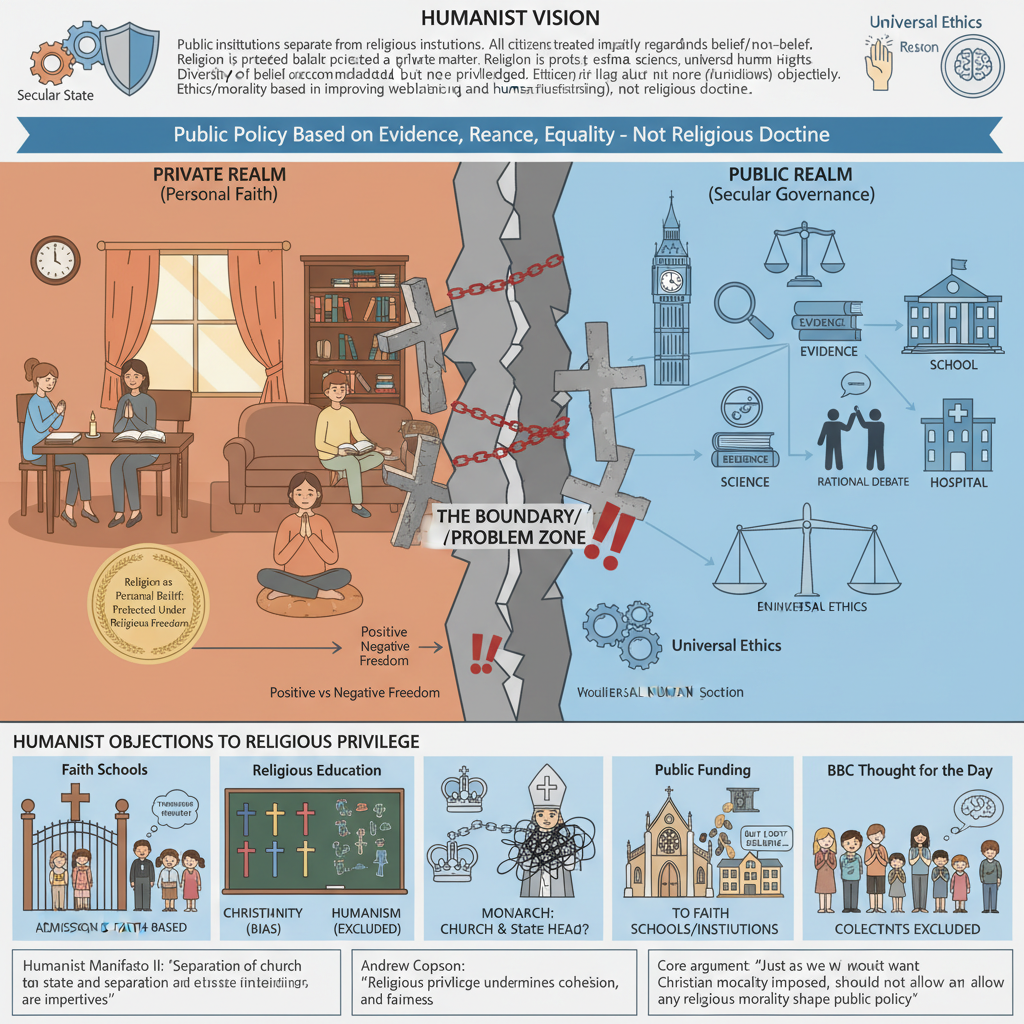
Humanist View: Christianity Should Play No Part in Public Life. Private realm (left): religion as personal faith is protected and respected. Public realm (right): government, schools, law, and public policy should be based on reason, evidence, and universal secular principles, not religious doctrine. Humanists object to religious privilege (established church, faith schools, religious education bias, public funding of religion). A secular state treats all citizens impartially regardless of belief, protecting religious freedom while keeping public institutions separate from religious influence. This illustration contrasts private and public spheres in relation to religion. Left side (Private): Religion is personal, protected, and respected—prayer, faith communities, spiritual practice occur freely in homes and churches. Right side (Public): Government, schools, courts, and public policy should operate on secular principles (reason, evidence, science, universal values) to serve all citizens equally, regardless of belief. Center (The Problem): Examples of religious intrusion into public life that humanists oppose—established church status, bishops in Parliament, faith school admissions, compulsory religious education. Top: Humanist vision of a secular state where religious freedom is protected while public institutions are neutral and impartial. The illustration emphasizes that humanists don't oppose religion itself but rather its influence on public institutions and policy.
Summary
Humanists argue that Christianity (and all religion) should be strictly private and should not influence public policy, law, education, or governance.
Core Argument:
- Religion is a personal matter of conscience, not a basis for public policy
- Public institutions (government, schools, courts, laws) should be secular and based on reason, evidence, and universal human values—not religious doctrine
- Religious privilege in public life violates equality and fairness for non-believers
Key Humanist Principle: Secular State
"The separation of church and state and the separation of ideology and state are imperatives. The state should encourage maximum freedom for different moral, political, religious, and social values in society. It should NOT favor any particular religious bodies through the use of public monies."
What This Means:
- Citizens can practice their faith privately
- But religious organizations should not receive public funding
- Religious doctrines should not shape laws or education
- Public policy should be based on secular reasoning that all citizens can access
What is Humanism?
Definition
Humanism is a non-religious worldview based on:
- Reason and evidence as guides to understanding reality
- Science as the best method for understanding the natural world
- Secular ethics—morality based on improving wellbeing and human flourishing, not religious doctrine
- Human autonomy and responsibility—we must "save ourselves," not rely on divine salvation
Key Characteristics:
- No belief in the supernatural—the world is natural/physical
- This life only—there is no afterlife, heaven, or hell
- Human-centered values—human dignity, freedom, and flourishing are paramount
- Universal ethics—morality based on reason, empathy, and concern for all sentient beings
Not the Same As:
- Atheism: Just "not believing in God." A person can be atheist but not humanist (e.g., nihilist atheist)
- Agnosticism: The view that we can't know whether God exists. But agnostics can still be humanists
- Secularism: Support for separating church and state. Religious people can be secularists too
The Case for Secular Public Life
The Fundamental Argument
If we want public institutions to serve all citizens fairly, they must be based on principles that all citizens can access and debate, regardless of their personal religious beliefs.
Why Religion Cannot Be the Basis for Public Policy:
- Religious claims are not universally shared: Some citizens believe in God; others don't. Some are Christian; others are Muslim, Jewish, Hindu, or atheist
- Religious truths are not empirically verifiable: Whether God exists is not something that can be tested in a lab
- Religious doctrines are authoritarian: They ask people to believe things "on faith" rather than through reasoning and evidence
- Religious disagreement is intractable: Religious groups disagree profoundly and cannot be empirically resolved
The Solution: Secular Public Policy Based on Reason and Evidence
- Public policy should appeal to reasons and evidence that all rational citizens can evaluate
- Laws should serve the common good based on empirical understanding of human wellbeing
- Education should teach science and critical thinking, not religious doctrine
- Public institutions should be neutral on religion—neither promoting nor opposing it
Example: Same-Sex Marriage
- Religious argument against: "The Bible says homosexuality is sinful"
- Humanist argument for: "Adult consent, human dignity, and equal treatment under law justify same-sex marriage"
The Humanist Point: Only the secular argument can convince all citizens regardless of their religious beliefs
The Problem of Religious Privilege in the UK
The Established Church (Church of England):
- The monarch is both Head of State and Supreme Governor of the Church of England
- This is a unique constitutional arrangement among modern democracies
- Humanist Objection: The state should be neutral on religion; this arrangement privileges Christianity
Bishops in the House of Lords:
- 26 bishops have reserved seats in the House of Lords (the upper house of Parliament)
- They vote on laws affecting all British citizens
- Humanist Objection: Religious views should not determine secular laws. Non-Christian and non-religious citizens have no comparable representation
Faith Schools and Religious Admissions:
- Faith schools (particularly Catholic and Anglican) receive public funding but can select students based on religion
- The 50% cap (introduced 2007) limits religious selection to 50% of pupils
- Humanist Campaign: Remove the 50% cap entirely—all state schools should have secular admissions
Why? Faith-based selection divides communities and creates segregation. It disadvantages non-religious families and families of the "wrong" religion. Public funding should not support religious discrimination.
Religious Education and Bias:
- Compulsory Religious Education (RE) has historically been biased toward Christianity
- Humanism is not routinely taught as an alternative worldview
- Humanist Campaign: Make RE "Objective, Fair and Balanced"; include non-religious worldviews equally
Compulsory Collective Worship:
- Schools are required to have a daily "act of collective worship"
- This is typically Christian worship even in multi-faith schools
- Humanist Objection: This imposes religious practice on non-believing students
BBC's "Thought for the Day":
- A regular 3-minute slot on BBC Radio 4's Today programme
- Historically, only religious speakers were allowed (Christian, Jewish, Muslim, etc.)
- Humanist Campaign: This is discriminatory; humanist speakers should also have access
- Breakthrough (2009): Andrew Copson (Humanists UK Chief Executive) was eventually invited to participate
Humanist Principles for a Secular State
The Humanist Manifesto II (1973) on Church-State Separation:
"The separation of church and state and the separation of ideology and state are imperatives. The state should encourage maximum freedom for different moral, political, religious, and social values in society. It should not favor any particular religious bodies through the use of public monies, nor espouse a single ideology."
What This Means in Practice:
- No Public Funding for Religion: Religious organizations should not receive taxpayer money
- Secular Laws: Laws should be based on reason and evidence, not religious doctrine
- Neutral Education: Schools should teach about religions (comparative study) but not promote any religion
- Secular Ethics: Morality should be based on improving wellbeing, not religious commands
Humanist Campaign Goals:
- Disestablish the Church of England
- Remove bishops from House of Lords
- Create a single secular admissions system for all state schools
- Make Religious Education objective and include non-religious worldviews
- End compulsory collective worship in schools
Secular Ethics: Can Morality Exist Without Religion?
The Humanist Claim:
Yes. Morality is based on reason, empathy, and understanding of human flourishing—not on religious authority.
The Problem Religion Addresses (and How Humanism Addresses It):
- Religious answer: "Be moral because God commands it; disobedience leads to hell"
- Humanist answer: "Be moral because we have empathy for suffering; causing harm reduces wellbeing; cooperation enables flourishing"
Secular Moral Reasoning:
- Empirical understanding: What actually improves human wellbeing? (Science can inform this)
- Reason: Given what improves wellbeing, what policies/behaviors should we adopt?
- Empathy: Understanding the suffering of others and using reason to reduce it
- Impartiality: Treating all persons with equal concern regardless of race, gender, religion, nationality
Example: Euthanasia
- Religious argument against: "Life is sacred; only God can take life"
- Humanist argument for: "Personal autonomy is valuable; terminal suffering is harmful; compassionate end-of-life care respects human dignity"
The Humanist Point: This reasoning appeals to universal human values (autonomy, dignity) not religious doctrine
Critique of Religion's Role in Public Life
Religion Opposes Equality and Justice:
- Religious doctrines have justified slavery, patriarchy, homophobia, and inequality
- Modern secular law, based on reason and human rights, has corrected these injustices despite religious opposition
Examples:
- Abortion legalization (1967): Religious opposition, but secular argument won on bodily autonomy
- Same-sex marriage (2014): Religious opposition, but secular argument won on equality
- Contraception/Family Planning: Religious opposition, but secular public health approach won
Religious Privilege Creates Inequality:
- When the state privileges some religions over others (or religion over non-religion), it treats citizens unequally
- Faith schools with public funding effectively use taxpayer money to advance religious selection
- Bishops in Parliament give religious institutions disproportionate political power
Religion Can Hinder Progress:
- Religious education sometimes teaches creationism alongside evolution
- Religious opposition can slow scientific advancement (e.g., stem cell research)
- Religious influence in politics can override evidence-based policymaking
The Distinction: Private vs. Public Religion
Humanist Position is NOT Anti-Religion:
- Humanists support religious freedom—people should be able to practice faith privately
- Humanists object to religious privilege and influence in public institutions
Private Religion (Protected):
- Worship services in churches, synagogues, mosques
- Religious education for children within faith communities
- Personal prayer and spiritual practice
- Religious publications and media
Public Life (Should Be Secular):
- Government and law: Based on reason and evidence, not religious doctrine
- State schools: Teach science, critical thinking, about religions (not promoting one)
- Public policy: Address common good based on empirical understanding
- Governance: All citizens treated equally regardless of belief
The Humanist Analogy:
Just as we wouldn't want Christian sexual ethics imposed on Muslims, or Islamic banking rules imposed on Christians, we shouldn't allow any religious morality to shape public policy.
Humanist Views on Moral Education
The Problem with Religious Moral Education:
- Teaching morality through religious authority creates uncritical thinking
- Children learn to obey rules because "God/Scripture says so," not because they understand the reasoning
- This habit of accepting unquestioned authority can extend beyond religion
Secular Moral Education Should Teach:
- Understanding of human flourishing: What conditions enable people to thrive?
- Empathy: Understanding others' experiences and feelings
- Critical reasoning: Why are certain actions right/wrong? What are the consequences?
- Virtue development: How do we cultivate good character (honesty, courage, compassion)?
- Respect for diversity: Understanding different worldviews without endorsing religious doctrine
Christian Responses to Humanist Critiques
Christian Position (Catholic and Traditional Christian):
- Religion should not rule over the state (separation principle accepted)
- But the state needs citizens with moral character, which religion provides
- Religion offers resources for the common good that pure secularism cannot match
- Citizens should be free to advocate for their faith-inspired values in public debate
The Christian Counter-Argument:
"The state needs religion because religion provides citizens who care about the common good. Without religious motivation, citizens pursue only self-interest. Religion and state are separate but interdependent."
Humanist Response:
- Secular humanism also motivates altruism through empathy and reason
- Non-religious citizens can be highly moral without divine sanction
- The question is whether public policy should be based on religious doctrine—not whether religion can be personally meaningful
Scholarly Perspectives
Quote 1 (Humanist Manifesto II, 1973):
"The separation of church and state and the separation of ideology and state are imperatives. The state should encourage maximum freedom for different moral, political, religious, and social values in society. It should not favor any particular religious bodies through the use of public monies, nor espouse a single ideology. Public institutions must be neutral on religion, treating all citizens impartially regardless of their beliefs. This ensures that public policy serves the common good based on reason, evidence, and universal human values—not on religious doctrine that only some citizens share."
Quote 2 (Andrew Copson, Humanists UK):
"Religious privilege in public life undermines equality and fairness. When faith schools receive public funding while practicing religious selection in admissions, and when bishops hold reserved seats in Parliament, religious institutions gain disproportionate power at the expense of citizens who do not share their beliefs. Secular education, based on science and reason, better serves all students. A truly secular state protects religious freedom as a private matter while ensuring public institutions treat all citizens equally, regardless of belief."
Key Takeaways
- Humanists accept religious freedom: They support people's right to practice faith privately
- But oppose religious influence on public policy: Public institutions must be secular and serve all citizens equally
- The distinction is key: Private (personal faith) vs. Public (secular governance)
- Specific UK Examples Matter: Established Church status, bishops in Parliament, faith schools, compulsory RE—these are humanist targets
- Universal vs. Particular: Humanist point is that secular reasoning appeals to all citizens; religious doctrine doesn't
- Secular Ethics is Real: Humanists argue morality doesn't require God; it's based on reason, empathy, and human flourishing
- Not Anti-Religious: Humanists protect religious freedom while opposing religious privilege
- Evaluate: Is the secular state truly "neutral," or does it assume a secular worldview that disadvantages religious citizens?