Marx's Teaching on Alienation and Exploitation
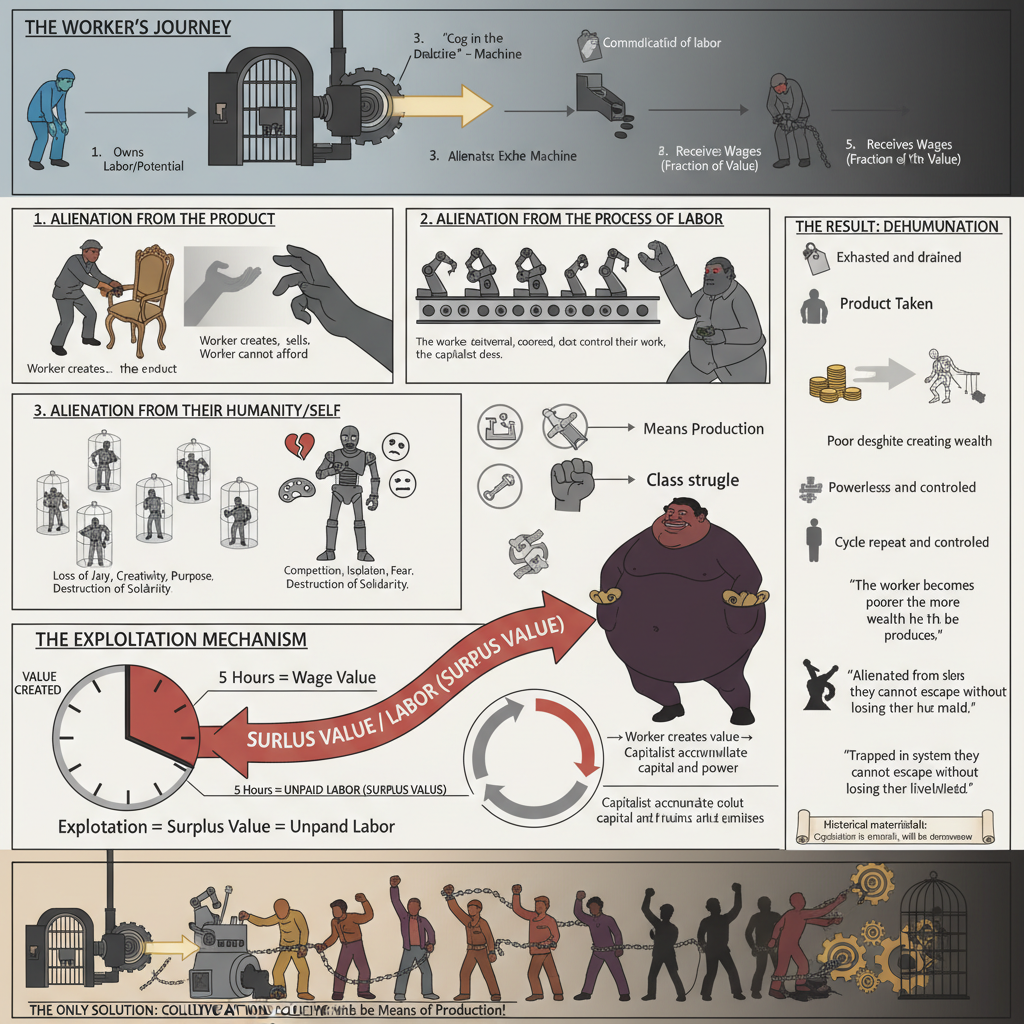
Marx's Alienation and Exploitation Under Capitalism: Workers create valuable products but are alienated from (1) the product (taken away and sold by capitalist), (2) the labor process (mechanical, controlled, non-creative), (3) their humanity (dehumanized into replaceable parts), and (4) other workers (competition destroys solidarity). The capitalist extracts surplus value—the unpaid labor that becomes profit. The worker becomes progressively poorer and more powerless despite creating all the wealth. Only revolution—workers controlling the means of production—can overcome this fundamental exploitation and alienation. This illustration depicts Marx's theory of alienation and exploitation: Workers move through the capitalist production system, becoming progressively alienated across four dimensions. On the left, workers create valuable products but have them taken away (alienation from product). In the center, workers perform mechanical, controlled labor (alienation from labor process) that dehumanizes them into replaceable parts (alienation from self). On the right, workers are isolated and competing, unable to form solidarity (alienation from others). The bottom section shows the exploitation mechanism: a 10-hour workday where the first 5 hours create value equal to the worker's wage, and the remaining 5 hours create surplus value that the capitalist pockets as profit. The entire system traps workers in a vicious cycle: they create wealth but receive only subsistence wages, while the capitalist accumulates power and capital. Only collective action and revolution—workers seizing the means of production—can break this cycle and overcome alienation and exploitation.
Summary
Karl Marx (1818-1883) developed a comprehensive critique of capitalism centered on two interconnected concepts: alienation and exploitation.
Alienation (the Human Problem):
Workers under capitalism become estranged from themselves and their work. Marx identifies four dimensions of alienation:
- From the product: Workers create valuable goods but have no claim to them; the capitalist owns and sells them
- From the process of labor: Work is mechanical, repetitive, and controlled; not creative or fulfilling
- From their humanity: Workers become dehumanized—treated as replaceable "cogs in the machine" rather than as human beings
- From other workers: Competition for jobs destroys solidarity; workers see each other as rivals, not comrades
Exploitation (the Economic Problem):
Capitalists extract surplus value from workers' labor.
How It Works:
- A worker labors for 10 hours
- The value created in the first 5 hours is enough to pay the worker's wage (subsistence)
- The value created in the remaining 5 hours is unpaid labor that becomes the capitalist's profit
- This unpaid labor is exploitation—the capitalist steals the product of the worker's labor
The Result:
"The worker becomes poorer the more wealth he produces. His labour produces wonders for the rich, but destitution for the poor."
Marx's Solution:
Revolution. Workers must overthrow capitalism and build a communist society where they own the means of production and receive the full value of their labor.
Dimension 1: Alienation from the Product of Labor
The Problem
In pre-capitalist economies, a craftsperson (blacksmith, weaver, mason):
- Made the entire product from start to finish
- Owned what they made
- Could be proud of their work
Under Capitalism:
- The capitalist owns the means of production (factories, tools, materials)
- The worker produces only one component on an assembly line
- The capitalist owns the entire product and sells it for profit
- The worker cannot afford to buy what they made
Marx's Analysis:
"The worker relates to the product of his labor as to an alien object. The objects of his labor are presented as alien property confronting him. What the worker produces becomes the property of another and dominates the worker. The product of labor is capital—accumulated wealth that enslaves the worker."
The Psychological Effect:
- The worker feels disconnected from the product
- The product feels like someone else's property, even though the worker created it
- The worker cannot identify with what they made
- This produces powerlessness and meaninglessness
Dimension 2: Alienation from the Process of Labor
Pre-Capitalist Work:
- Work was directed by the worker themselves (self-determined)
- Work developed skills and allowed for creativity
- Work was meaningful—producing something useful and valued
Capitalist Work:
- Work is directed and controlled by the capitalist
- Workers perform repetitive, mechanical, unskilled tasks
- The capitalist decides what to make, how to make it, and how fast
- The worker has no input or creativity
Marx's Description of Capitalist Labor:
"Labor is external to the worker, i.e. it does not belong to his intrinsic nature. In his work, therefore, he does not affirm himself but denies himself, does not feel content but unhappy, does not develop freely his physical and mental energy but mortifies his body and ruins his mind."
The Compulsion:
- The worker is not physically forced to work
- But they are economically forced—without wages, they cannot eat or pay rent
- This makes labor non-voluntary coercion: "If I don't work, my family starves"
- The worker becomes a passive object, not an active agent
Dimension 3: Alienation from One's Humanity / The Self
What Makes Us Human:
According to Marx, humans are distinguished from animals by:
- Conscious, purposeful activity—the ability to imagine something and create it
- Shaping nature and society through our labor
- Developing our capacities and talents
- Creating meaning and identity through our work
Under Capitalism:
- Workers become passive instruments in someone else's production process
- Workers are treated as objects, not subjects
- Workers' unique talents and potential are wasted on repetitive, degrading tasks
- Workers become interchangeable parts—if one worker dies or quits, another replaces them immediately
The Dehumanization:
"The worker becomes a beast of burden, a thing, not a person. The product made by the worker's hands masters and enslaves the worker. The capitalist has mechanized and automatized the worker, turning human beings into machines."
Existential Alienation:
- Work should be where humans express themselves and develop their humanity
- Under capitalism, work is the place where humans are most dehumanized
- Workers feel empty, exhausted, and meaningless after work
- The worker only feels alive outside work, but must spend most of their life working
Dimension 4: Alienation from Other Workers / Society
Capitalism Breeds Competition, Not Community:
- Pre-capitalist societies (feudalism, ancient communities) had organic social bonds
- Capitalism destroys these bonds by pitting workers against each other
How Alienation from Others Happens:
- Wage competition: Workers compete for limited jobs
- Fear of unemployment: Each worker fears being replaced
- Alienation breeds isolation: Workers can't trust each other—the coworker is a potential rival
- No class consciousness: Workers don't see themselves as a class with shared interests
Marx's Analysis:
"Under capitalism, each man views the other in accordance with the standard and relationship in which he finds himself as a worker. The competitive struggle alienates workers from one another. The worker sees his neighbor not as a comrade but as an enemy competing for the same scarce wages."
The Result:
- Workers feel isolated and lonely despite being surrounded by others
- Genuine friendships and solidarity are rare
- Workers are too exhausted by work to build meaningful relationships
- The working class remains politically fragmented and unable to mount resistance
Exploitation: The Economic Mechanism
Definition:
Exploitation is the extraction of surplus value—the profit the capitalist makes by paying workers less than the value of what they produce.
How Surplus Value Works:
Example: A Factory Worker
- The capitalist hires a worker for 8 hours/day
- The worker's wage is $60/day (enough to subsist)
- The value the worker produces in 8 hours is $120
- The capitalist pockets the difference: $120 - $60 = $60 profit
- This $60 is surplus value = the value of unpaid labor
Key Insight:
"The worker works for free the second half of the day. Only labor time is unpaid; the capitalist does not pay for the value produced in this time. All profit comes from this unpaid labor."
The Rate of Exploitation:
Marx defines the rate of exploitation as:
- Surplus value divided by the wage
- In the example above: $60 profit / $60 wage = 100% exploitation rate
- This means the worker is exploited at 100%—they work for free half the day
Why Workers Accept This:
- Workers need wages to survive
- Capitalists own the means of production—workers own nothing
- Workers have no choice but to accept whatever wage is offered
- If one worker refuses, another will accept—there's always a "reserve army of labor"
The Relationship Between Alienation and Exploitation
They Are Two Sides of the Same Coin:
- Alienation is the human/psychological consequence of capitalism
- Exploitation is the economic mechanism that produces alienation
How They Work Together:
- The capitalist owns the means of production
- The capitalist extracts surplus value (exploitation)
- This extraction separates the worker from the product (alienation from product)
- The capitalist controls the production process to maximize profit (alienation from labor)
- The worker becomes dehumanized and powerless (alienation from self)
- Workers are pitted against each other in competition for survival (alienation from others)
The Vicious Cycle:
Exploitation → Alienation → Isolation → Lack of class consciousness → Workers can't unite → Capitalist power increases → Exploitation intensifies
Religion's Role in Perpetuating Alienation
Marx on Religion as "Opiate of the Masses":
Marx argued that religion reinforces alienation rather than challenging it.
How Religion Aids Exploitation:
- Religion teaches acceptance of suffering as God's will
- Religion promises rewards in heaven for enduring earthly oppression
- Religion teaches obedience to authority (priests, kings, capitalists)
- Religion justifies inequality as divinely ordained
- Religion distracts from real material grievances
Marx's Critique:
"Religion is a socio-economic role independent of religion being 'the opiate of the masses.' Religion is an illusion that alienates workers from their own humanity and from the real conditions of their oppression."
Marx's Point:
- Religion creates another dimension of alienation: alienation from reality
- By focusing on spiritual salvation, workers ignore their material exploitation
- This ideological alienation makes workers less likely to revolt
The Path to Revolution: Overcoming Alienation
Marx's Historical Materialism:
Every mode of production eventually contains contradictions that lead to its overthrow:
- Capitalism creates a working class
- Workers become concentrated in cities/factories
- This concentration enables organization—workers form unions, political parties
- Class consciousness develops—workers recognize their shared exploitation
- Revolution becomes possible—workers overthrow capitalists and create a communist society
What Comes After Capitalism:
In a communist society:
- Workers own the means of production collectively
- There is no surplus value extraction (no capitalism)
- Labor becomes self-directed and meaningful
- Alienation is overcome—humans work to develop themselves, not for profit
- No class division means no alienation from others
Marx's Vision:
"In a communist society, each person can be a hunter in the morning, a fisherman in the afternoon, and a critic in the evening, according to their talents and interests. Labor becomes a means of human development, not a means of survival under coercion."
Scholarly Perspectives
Quote 1 (The Four Dimensions of Alienation):
"The worker becomes alienated from the product of his labor—what he produces becomes the property of another and dominates him. He becomes alienated from the labor process itself—his work is external, coerced, mechanical, and does not develop his capacities but mortifies his body and ruins his mind. He becomes alienated from his own humanity—he is treated as a replaceable thing, not as a human being capable of defining his value through purposeful activity. Finally, he becomes alienated from other workers—capitalism breeds competition and isolation rather than community and solidarity. These four dimensions of alienation constitute the total dehumanization of the worker under capitalism."
Source: Karl Marx, Economic and Philosophical Manuscripts of 1844 (1844)
Quote 2 (Exploitation and Surplus Value):
"All profits come from unpaid labor. The capitalist purchases the worker's labor power at its value—enough to subsist—but the worker produces more value than they are paid. This surplus value is theft. The worker works for free a portion of each day, and the capitalist pockets the product of this unpaid labor. The rate of exploitation is therefore an exact expression of how much of the worker's time is stolen. Only when workers recognize this theft and collectively seize the means of production can they overcome exploitation and alienation."
Source: Karl Marx, Capital (1867) and Communist Manifesto (1848)
Key Takeaways
Four Dimensions Matter:
Be able to explain each separately (product, process, self, other workers) but show how they interconnect
Alienation ≠ Just Unhappiness:
Marx means a structural separation built into capitalism, not just bad feelings
Exploitation is Economic/Measurable:
Marx provides the concept of surplus value to quantify how much workers are stolen from
They Work Together:
Exploitation creates alienation; alienation prevents workers from recognizing and resisting exploitation
Religion Reinforces Both:
Marx argues religion makes workers accept alienation and exploitation as divinely ordained
Revolutionary Solution:
Marx is not just a critic but a revolutionary—he believes workers must overthrow capitalism to overcome alienation