Liberation Theology's Use of Marx to Analyse Social Sin
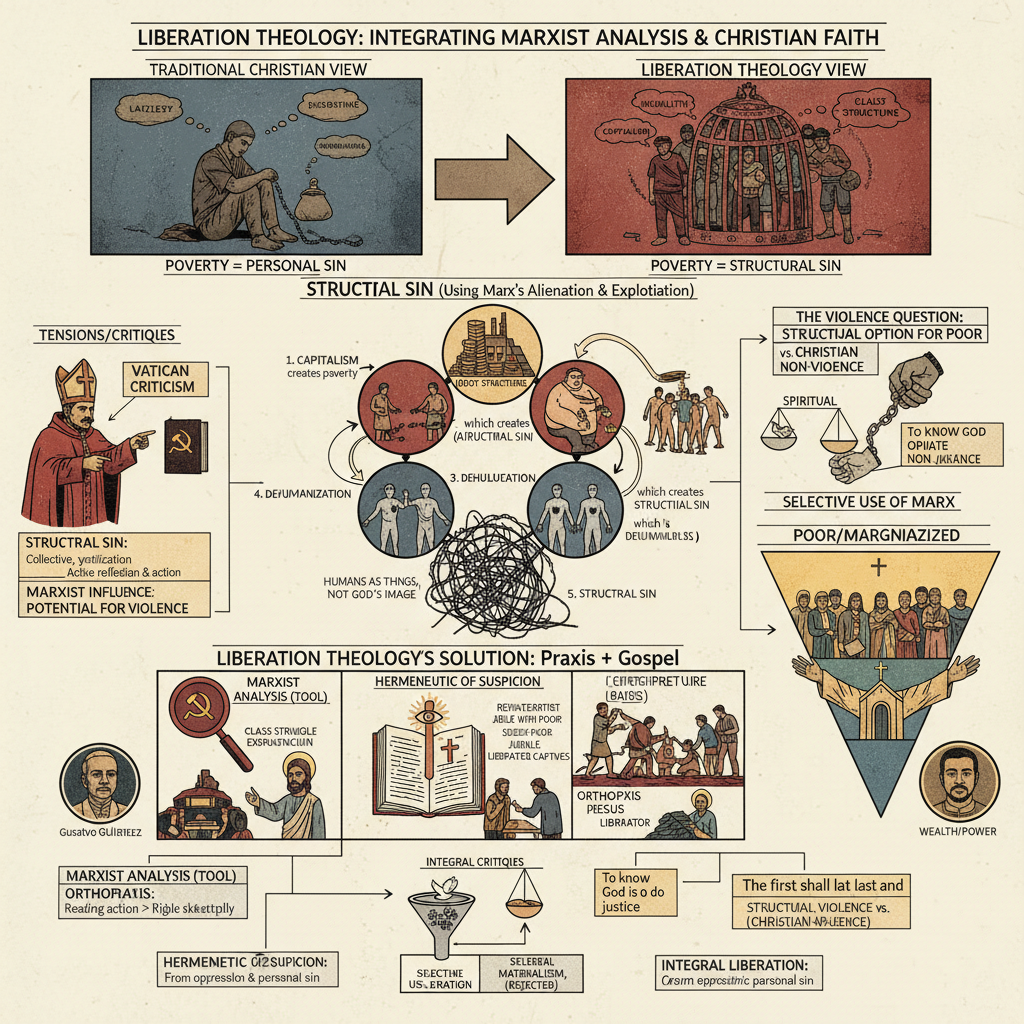
Liberation Theology's Use of Marx to Analyze Social Sin: Structural sin is collective dehumanization built into capitalist systems, understood through Marx's concepts of alienation and exploitation. But Liberation Theology reinterprets this through Christ's liberatory gospel—Jesus sided with the poor, proclaimed reversal, called for justice. Praxis (reflection + action) uses Marxist analysis as a tool to address structural causes of poverty, not just individual charity. "Preferential option for the poor" centers the marginalized in the Church's mission, integrating Marx's class analysis with Jesus' command to "do justice." Yet tensions remain: Marx's atheism vs. Christian faith, revolutionary violence vs. Jesus' non-violence, and Vatican concerns about politicization. This illustration depicts Liberation Theology's Integration of Marxist Analysis with Christian Faith. The left side shows traditional Christianity focusing on individual sin and personal morality. The right side shows Liberation Theology using Marx's concepts of alienation, exploitation, and class struggle to analyze structural sin—oppressive systems that dehumanize people. The center shows the integration: Marxist analysis helps Christians understand HOW oppressive systems work, while the Gospel provides the motivation and goal (justice, dignity, preferential option for the poor). The illustration shows Jesus as liberator standing with the poor, and emphasizes praxis (reflection + action) as central to the approach. The bottom section shows tensions: Vatican concerns about Marxist influence, the question of violence vs. non-violence, and the challenge of being both Christian and using class analysis. The overall message: Liberation Theology represents a valid Christian response to Marx's critique of religion—if Christianity aligns itself with the poor against oppressive structures, it refutes Marx's claim that religion is merely an opiate for the masses.
Summary
Liberation Theology is a Christian movement that emerged in Latin America (1960s-1970s), arguing that Christianity must actively liberate the poor from oppression.
The Central Insight: Social Sin (Not Just Personal Sin)
- Traditional Christianity: Focuses on personal sin (individual moral failures)
- Liberation Theology: Focuses on structural sin—oppressive systems built into society itself
How Marx Helps Understand Structural Sin:
Liberation theologians use Marx's analysis of capitalism, alienation, and exploitation to show HOW oppressive systems work.
- Alienation: Workers are dehumanized by capitalist systems; they don't recognize each other as humans
- Exploitation: Capitalists extract surplus value (unpaid labor) from workers
- Structural Analysis: Economic systems (not individual choices) cause poverty
- Class Struggle: Justice requires confronting the conflict between oppressors and oppressed
The Christian Response: Praxis + Gospel
- Praxis: Reflection + action. Theology must lead to action against injustice
- Preferential Option for the Poor: Christians must prioritize the needs and liberation of the poor
- Orthopraxis: Right action matters more than right belief
Key Claim:
"Jesus sided with the poor and called for structural reversal. Using Marx's analytical tools, Christians can understand and challenge the oppressive structures that keep millions impoverished and dehumanized. 'To know God is to do justice.'"
Important Caveat:
Liberation theologians use Marx's economic analysis but reject his atheism. They argue that Christianity can coexist with Marxist class analysis because Marx's critique of capitalism is valuable even if his rejection of God is not.
The Context: Latin America and Oppression
Why Liberation Theology Emerged in Latin America
- Colonial history: Latin America was colonized by Spain and Portugal; indigenous peoples were enslaved
- Land inequality: The latifundia system meant huge estates were owned by a wealthy few who exploited landless workers
- Economic dependence: Latin America was economically dependent on wealthy nations; resources extracted, profits went elsewhere
- Church complicity: The Catholic Church often sided with the wealthy and powerful, not the poor
- Poverty and violence: Despite Christian leadership and professed Christian values, poverty and violence were endemic
The Question That Sparked Liberation Theology:
"If Latin America is a Christian continent, why is it so oppressed and impoverished? What is Christianity doing to address systematic oppression?"
The Answer:
The Church needed a new theology that would actively liberate the poor, not just spiritually comfort them.
Structural Sin: The Core Concept
What is Structural Sin?
Structural sin is collective, systemic oppression built into society's institutions—not just individual wrongdoing.
Key Definition:
"When humans sin, they create structures of sin, which in their turn, make human beings sin."
How It Works
- Economic structures (capitalism) are built on exploitation and alienation
- These structures dehumanize people, treating them as objects not as beings created in God's image
- People trapped in these structures are forced to become oppressors or oppressed
- Even good-hearted individuals become complicit in oppression
- The system itself is sinful, not just individuals
Example: Mexico City Earthquake
After an earthquake in Mexico City, wealthy building owners saved their machinery from the rubble before rescuing their trapped workers.
Why? Not because these individuals were evil, but because capitalism trains people to see machinery as more valuable than human life. The structure produces immoral behavior.
How Liberation Theology Uses Marx's Alienation and Exploitation
Marx's Analysis of Capitalism:
Marx showed that capitalism:
- Alienates workers from themselves, their labor, and each other
- Exploits workers by paying them less than the value they produce
- Creates class conflict between capitalists and workers
How Liberation Theology Applies This to Understand Sin
1. Alienation as Dehumanization = Structural Sin
- In capitalism, workers are treated as things (machines/commodities), not as humans created in God's image
- This treats people as means to an end (profit), not as ends in themselves (sacred beings)
- This violates the fundamental Christian principle that every person has infinite dignity
- This is sin—the dehumanization of God's creation
2. Exploitation as Theft = Structural Sin
- Workers create value but don't receive the full value of their labor
- Capitalists steal surplus value (the unpaid labor)
- This is sin—taking what belongs to another
- This creates poverty—workers can't afford basic needs despite creating wealth
3. Class Struggle as Oppression = Structural Sin
- Capitalism necessarily creates oppressors and oppressed
- The capitalist class maintains power through violence and coercion (police, military, laws)
- The poor are systematically excluded from power, education, and resources
- This is sin—violence, injustice, and systemic oppression
Gustavo Gutierrez (Founder of Liberation Theology):
"Structural sin is when poverty and oppression are built into society's institutions and economic systems. Marx helps us understand that capitalism 'condemns the poor to a subhuman existence.' As Christians, we cannot accept such structures as God's will."
Praxis: Theology Must Lead to Action
What is Praxis?
Praxis is the integration of reflection and action—thinking about injustice combined with doing something to address it.
Traditional Approach:
- Theology is theoretical—abstract thinking about God
- Action is separate—charity, personal morality
Liberation Theology Approach:
- Theology must emerge from the struggles of oppressed people
- Theology must guide action for justice
- Action then informs theology—a continuing cycle of reflection and action
Example: Oscar Romero
- As Archbishop of San Salvador, Romero initially was a conservative theologian
- But witnessing the assassination of a priest by military death squads, his theology changed
- He became a prophetic voice for the poor, speaking out against government violence
- He was murdered for his activism, making his praxis ultimate sacrifice
Marx's Influence on Praxis:
Marx famously said: "Philosophers have only interpreted the world...the point is to change it". Liberation theologians adopted this principle: Theology is not merely to understand the world but to change it.
Hermeneutic of Suspicion: Rereading the Bible
What is a "Hermeneutic of Suspicion"?
A method of reading that questions traditional interpretations, asking: "Whose interests does this interpretation serve?"
Traditional Reading of a Biblical Story:
Example: Jesus and the Rich Young Man (Mark 10:17-31)
- Traditional interpretation: The young man is morally good but materially wealthy. His personal sin is not the wealth itself but his attachment to it
- Message: Wealth is not inherently wrong; how you use it matters
- Result: This interpretation justifies wealth inequality
Liberation Theology's Hermeneutic of Suspicion:
- Question: Why do traditional readings always protect the wealthy?
- Suspicion: Perhaps traditional readings serve the interests of the wealthy and powerful
- Alternative interpretation: Jesus is calling for structural economic reversal. Wealth itself is the problem—it necessarily involves exploitation
- Message: The system of wealth and poverty itself is sinful
- Result: This interpretation challenges wealth inequality
How This Uses Marx:
Marx taught the analysis of ideology—how ruling classes use ideas (including religious ideas) to maintain power. Liberation theologians apply this: Traditional Church teachings often reflect the interests of the wealthy and powerful. A true Christian reading must recover Jesus's voice on behalf of the poor and oppressed.
The Preferential Option for the Poor
What Does It Mean?
The preferential option for the poor means that Christians must prioritize the needs and liberation of the poor.
What It's NOT:
- It's not about favoring the poor unfairly
- It's not about sentimental compassion
- It's not about charity alone
What It IS:
- Righting an imbalance: Society systematically favors the rich; Christians must counter this
- Structural solidarity: Standing WITH the poor against oppressive structures
- Justice orientation: Pursuing justice for those whom society marginalizes
Biblical Foundation:
- Jesus's example: Jesus spent time with the poor, the marginalized, and the oppressed
- The Beatitudes: "Blessed are you who are poor"
- Parable of the Sheep and Goats: "Whatever you did for the least of these...you did for me" (Matthew 25)
- Eschatological: God will judge us based on how we treated the poor
Gustavo Gutierrez's Famous Quote:
"When I gave food to the poor, they called me a saint. When I asked why the poor have no food, they called me a communist."
What this means: Simply feeding the poor is acceptable (even praised). But asking why poverty exists and working to change structures is seen as radical/Marxist.
Orthopraxis over Orthodoxy
Orthodoxy:
Right belief, right doctrine
Orthopraxis:
Right action, right practice
Traditional Christianity:
Emphasizes right belief—you must believe correct doctrines about God, Christ, salvation
Liberation Theology:
Emphasizes right action—you must do justice and stand with the poor
Not Either/Or But Both/And:
Liberation theology doesn't reject right belief; it prioritizes right action.
Why This Matters:
- A theologian might believe correctly about Jesus but do nothing to address poverty
- A poor person might not know formal theology but live justly in their community
- Action demonstrates faith; belief without action is empty
Tensions and Criticisms
Tension 1: Marx's Atheism vs. Christian Faith
- Marx explicitly rejected religion as an "opiate"
- Liberation Theologians insist: We can use Marx's economic analysis without accepting his atheistic materialism
- Their claim: Marx's critique of capitalism is valid even if his rejection of God is not
Tension 2: Revolutionary Violence vs. Christian Non-Violence
- Marx advocated violent revolution—workers must forcefully overthrow capitalists
- Jesus taught forgiveness and non-violence
- Liberation Theologians' Response:
- Acknowledge the structural violence already being done to the poor
- But emphasize Jesus's way of non-violent resistance
- Gutierrez did not promote violence but did not entirely reject it in extreme circumstances
Tension 3: Vatican Opposition
- The Vatican criticized Liberation Theology for being too political and Marxist
- Pope John Paul II and Cardinal Ratzinger (later Pope Benedict XVI) warned against excessive politicization
- They feared: Liberation Theology would become a tool for communist revolution, not genuine Christianity
- Liberation Theologians' Response:
- This is a selective use of Marx, not wholesale adoption of Marxism
- They are faithful Christians using analytical tools for understanding poverty
- The Church should side with the poor, as Jesus did
Tension 4: Spiritual vs. Material Liberation
- Some Christians argue: The focus on material/structural liberation neglects spiritual liberation (from sin, reconciliation with God)
- Liberation Theologians respond: Both are essential; "integral liberation" includes freedom from both structural oppression AND personal sin
Tension 5: Class Struggle and Violence
- Accepting Marx's class struggle analysis can seem to require accepting revolutionary violence
- Liberation Theologians insist: One can accept the analysis of class conflict without accepting Marx's violent solution
Scholarly Perspectives
Quote 1 (Structural Sin and Marxist Analysis):
"Structural sin is the way oppressive economic systems create a society in which oppression becomes ordinary and embedded in institutions. Using Marx's concepts of alienation and exploitation, liberation theology shows that capitalism dehumanizes the poor by treating them as objects rather than as beings created in God's image. Structural sin means that even good-hearted individuals become complicit in oppression; the system itself produces immoral behavior. This is why Christians cannot merely address poverty through individual charity. They must challenge and transform the unjust structures themselves. As Gustavo Gutierrez teaches, 'To know God is to do justice'—theology must lead to action against oppressive systems."
Source: Gustavo Gutierrez, A Theology of Liberation (1971)
Quote 2 (The Integration of Marx and Gospel):
"Liberation theologians do not accept Marx's atheism or his vision of violent revolution. However, they do accept Marx's crucial insight that poverty is not primarily caused by individual moral failures but by oppressive economic structures. The Gospel demands what Marx taught—that justice requires analyzing and challenging these structures. The preferential option for the poor and Jesus's solidarity with the oppressed are clarified and deepened by Marx's analysis of class struggle and exploitation. Thus, one can be both a committed Christian and use Marxist analysis as a tool for understanding how to authentically live out the Gospel's call to liberate the poor."
Source: Leonardo Boff and Liberation Theology scholarship
Key Takeaways
| Concept | Meaning |
|---|---|
| Structural Sin | Collective, systemic oppression built into society's institutions, not just individual wrongdoing |
| Alienation | Marx's concept: workers separated from their products, labor, humanity, and each other |
| Exploitation | Marx's concept: extraction of surplus value; workers paid less than the value they produce |
| Praxis | Integration of reflection and action; theology must emerge from and guide struggle for justice |
| Hermeneutic of Suspicion | Method of reading that questions whose interests traditional interpretations serve |
| Preferential Option for the Poor | Christians must prioritize the liberation and dignity of the poor and marginalized |
| Orthopraxis | Right action/practice; prioritized over orthodoxy (right belief) in addressing injustice |
| Integral Liberation | Freedom from both structural oppression (material) AND personal sin (spiritual) |
Key Exam Points:
- Structural Sin is Central: Not just individual moral failure but systems that dehumanize people. Marx helps explain HOW
- Marx's Tools, Not His Ideology: Liberation theologians use Marx's analysis of capitalism but reject his atheism and violent revolution
- Jesus + Marx: The combination isn't contradictory; Jesus's solidarity with the poor is clarified through Marx's class analysis
- Praxis over Theory: Theology must lead to action; right action matters more than right belief in addressing injustice
- Hermeneutic of Suspicion: Traditional Biblical readings often protect the wealthy; liberation theology reads from the poor's perspective
- Preferential Option for the Poor: Christians must put the poor at the center, which requires challenging oppressive structures
- The Vatican Tension: The Church was deeply skeptical of Liberation Theology's Marxist influence and political activism
- Evaluate: Can you be both Christian and use Marxist analysis? Is structural sin adequately addressed through non-violent means?