Preferential Option for the Poor
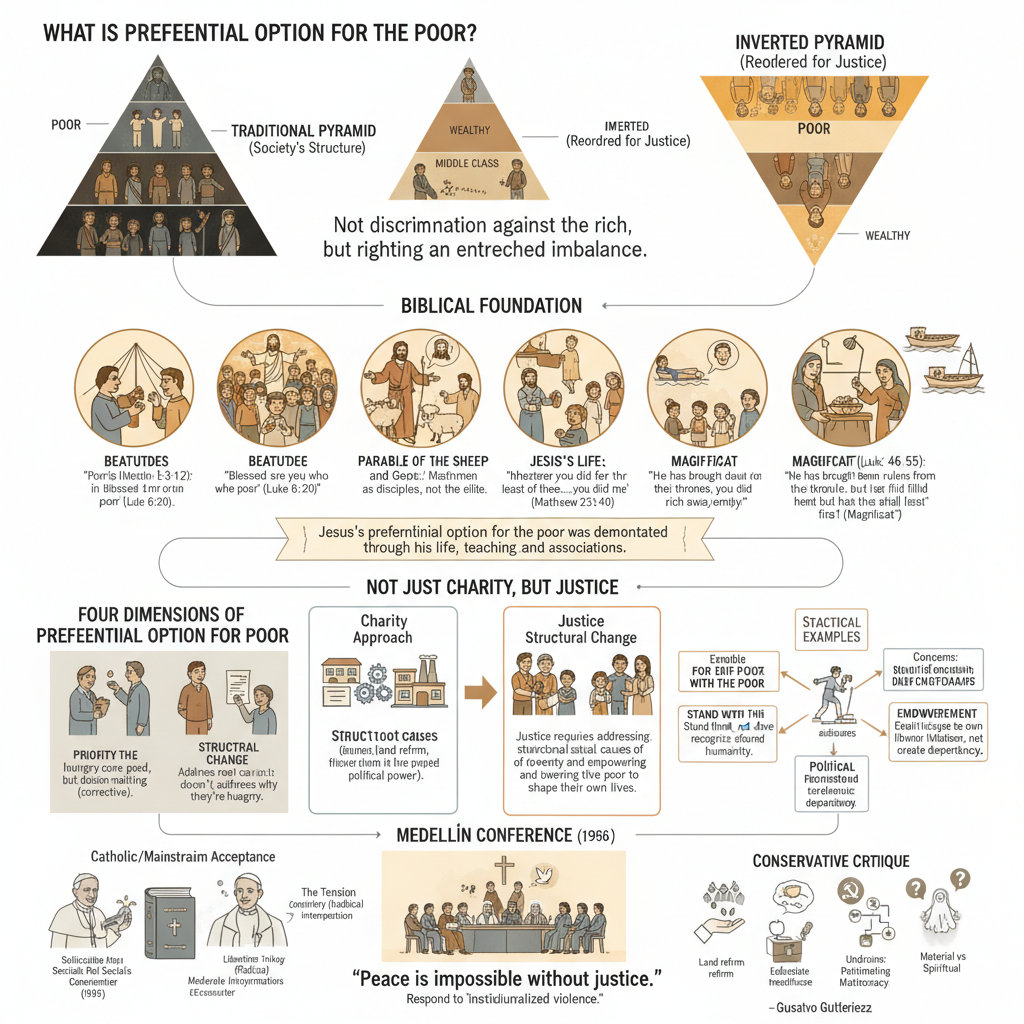
What is Preferential Option for the Poor? This illustration depicts the inverted pyramid concept: traditional society places the wealthy at the top and the poor at the bottom, while the Christian vision reorders this for justice, placing the poor at the center. The biblical foundation shows the Beatitudes ("Blessed are the poor"), the Parable of the Sheep and Goats, Jesus's life with the marginalized, and Mary's Magnificat. The four dimensions of preferential option are shown: priority for the poor, structural change, solidarity, and empowerment. The Medellin Conference (1968) is depicted as a turning point, along with both Catholic/mainstream acceptance and conservative critique.
Summary
The Preferential Option for the Poor is a theological principle asserting that Christians must prioritize the needs and liberation of the poor and marginalized in society.
What It Means:
- The poor should be at the center of Christian concern and action
- Their needs and dignity should be prioritized in economic, social, and political decisions
- This is not discrimination against the rich but correcting an entrenched imbalance
What It Is NOT:
- Not simple charity: Charity is good but doesn't address structural causes
- Not discrimination: Not about unfairly favoring the poor over the rich
- Not welfare dependency: It's about empowering the poor, not creating dependency
What It IS:
- Justice, not just charity: Addressing root causes of poverty through structural change
- Solidarity: Standing WITH the poor, recognizing their dignity as equals
- Empowerment: Enabling the poor to participate in their own liberation
- Action: Moving from belief to orthopraxis (right action)
Biblical Foundation
The Beatitudes (Matthew 5:3-12, Luke 6:20):
"Blessed are you who are poor, for yours is the kingdom of God...Blessed are you who are hungry now, for you will be filled."
Jesus blesses poverty itself—the poor have a special place in God's kingdom. This is shocking in a society where wealth equals success.
The Parable of the Sheep and the Goats (Matthew 25:31-46):
"Whatever you did for the least of these...you did for me."
We will be judged by our treatment of the poor, sick, imprisoned, hungry, and stranger. This is the measure of authentic Christian faith—orthopraxis over orthodoxy.
Jesus's Associations and Actions:
- Tax collectors and sinners: Jesus ate with them, associated with the despised
- Lepers: He touched and healed those considered untouchable
- Disciples: He chose fishermen and working people, not the educated elite
- Women: He elevated women's dignity in a patriarchal society
- Rich young man: He told him to give everything to the poor
The Magnificat (Mary's Song, Luke 1:46-55):
"He has brought down rulers from their thrones and lifted up the humble. He has filled the hungry with good things but has sent the rich away empty."
Mary's vision of Jesus's mission: reversal of social hierarchies. The kingdom will put the last first and the first last.
Justice, Not Charity
The Traditional Charity Approach:
- Wealthy people give alms to the poor
- The poor are grateful recipients
- This maintains the existing hierarchy: wealthy help the poor
- The causes of poverty are not addressed
Why Charity Alone is Inadequate:
- Temporary relief: A donation feeds someone today but not tomorrow
- No dignity: The poor remain dependent on the wealthy's goodwill
- Ignores causes: If poverty is caused by unjust wages, unfair land distribution, or lack of education, charity doesn't address these
- Perpetuates the system: The wealthy feel virtuous; the system remains unchanged
The Justice Approach (Preferential Option):
- Address root causes of poverty: land reform, fair wages, access to education
- Empower the poor to provide for themselves
- Transform structures that create poverty
- Recognize the poor's dignity as active agents, not passive recipients
The Key Difference:
- Charity: "Let me help you"
- Justice: "Let's change the system that oppresses you"
Four Dimensions of Preferential Option
1. Priority for the Poor and Vulnerable
- In decisions about social and economic justice, the poor's wellbeing comes first
- This is based on justice, not just charity
- The poor have fundamental human rights that society has denied
2. Structural and Systemic Change
- Address root causes: unfair wages, lack of education, unequal land distribution
- Change institutions and systems that perpetuate poverty
- Requires political and economic transformation
3. Solidarity with the Poor
- Stand with the poor, not above them as benefactors
- Recognize that their fate and ours are connected
- Solidarity means mutual relationship, not patronizing help
4. Empowerment of the Poor
- Enable the poor to participate in their own liberation
- Promote self-sufficiency and dignity, not dependency
- Give the poor a voice in decisions that affect their lives
The Medellin Conference (1968)
What Was Medellin?
A meeting of Latin American Catholic bishops in Medellin, Colombia, in 1968—a watershed moment for Liberation Theology.
The Context:
- Extreme poverty and inequality in Latin America despite Christian heritage
- Rural workers exploited by landowners and corporations
- "Institutionalized violence"—the structures themselves oppress the poor
- The Church's complicity—Church leaders often sided with the wealthy
The Bishops' Declaration:
"Peace is impossible without justice...we are faced with a situation of injustice that can be called institutionalized violence, when whole towns lack necessities and live in such dependence as hinders all initiative and responsibility."
The Breakthrough:
- The bishops acknowledged that structural injustice exists
- They called the Church to active commitment to justice
- They affirmed the preferential option for the poor as the Church's response
Gutierrez's Contribution
Theology from the Underside of History
Gutierrez argued that theology must be done from the perspective of the poor—from "the underside of history."
- Theologians must live alongside the poor, not just study them
- The poor's lived experience is a theological source
- Theology done for the rich often justifies the status quo
Key Quote on God's Preferential Love:
"God loves everyone equally in the general sense, but in specific contexts he has a particular concern for those who suffer. Thus in the particular sense, he has a preferential option for the poor."
Famous Quote on Charity vs. Justice:
"When I gave food to the poor, they called me a saint. When I asked why the poor have no food, they called me a communist."
Mainstream Church Adoption
Pope John Paul II:
In Sollicitudo Rei Socialis (1987) and Centesimus Annus (1991), John Paul II affirmed the preferential option for the poor as a core Catholic principle, emphasizing that justice requires priority concern for the marginalized.
Pope Francis:
- Has made the preferential option for the poor a cornerstone of his papacy
- Emphasizes the "culture of encounter" with the poor
- Shows concern for "throwaway people" in capitalist societies
- Calls for structural economic change to respect human dignity
Why the Church Adopted It:
- It's deeply biblical and rooted in Jesus's teaching
- It addresses the reality of suffering in the modern world
- It shows the Church's relevance to the concerns of billions of poor people
Criticisms and Debates
Critique 1: Reverse Discrimination?
Critics argue that prioritizing the poor unfairly disadvantages the non-poor.
Response:
- This is not discrimination but correcting an existing imbalance
- The poor already face systematic disadvantage
- Equality sometimes requires special attention to the disadvantaged
Critique 2: Marxist Class Struggle?
Some argue the preferential option resembles Marxist class struggle, creating unnecessary conflict.
Response:
- Liberation theology uses Marx's analysis but rejects his atheism and violent revolution
- The preferential option is about solidarity and justice, not class warfare
- The goal is human dignity for all, not a classless society
Critique 3: Material vs. Spiritual Liberation?
Some argue Liberation Theology prioritizes material/political liberation over spiritual salvation.
Response:
Gutierrez clarified that fundamental liberation is from sin, but liberation from sin necessarily requires working for justice and transforming unjust structures.
Scholarly Perspectives
Quote 1: The Biblical and Theological Foundation
"The preferential option for the poor is rooted in Jesus's own practice and teaching. He pronounced the poor blessed; he taught that we will be judged by our treatment of the poorest and most vulnerable; he spent his life with the marginalized and the outcast. The principle asserts that in the particular context of systemic injustice, God has a preferential concern for those who suffer. This is not charity but justice—a fundamental reordering of priorities to address structural causes of poverty and empower the poor to participate in their own liberation."
— Gustavo Gutierrez, A Theology of Liberation (1971)
Quote 2: Justice over Charity and Structural Change
"The preferential option for the poor requires more than charity. While charity provides temporary relief, justice demands structural transformation. It involves addressing root causes of poverty—unfair wages, unequal land distribution, lack of access to education—and empowering the poor to participate in their own liberation rather than creating dependency. This shift from orthopraxis (right action) to orthodoxy (right belief) means that the Church's commitment to the poor must be expressed through advocacy for systemic change and solidarity in the struggle for justice."
— Liberation Theology scholars and Catholic Social Teaching
Key Takeaways
- The preferential option for the poor is deeply biblical—rooted in the Beatitudes, Sheep & Goats, Jesus's associations, and the Magnificat
- It means prioritizing the poor's needs and dignity, not as charity but as justice—addressing structural causes of poverty
- The four dimensions are: priority for the poor, structural change, solidarity, and empowerment
- The Medellin Conference (1968) was the pivotal moment when the Church officially embraced this principle
- Both Pope John Paul II and Pope Francis have affirmed it as mainstream Catholic teaching
- Critics raise concerns about reverse discrimination, Marxist influence, and material vs. spiritual liberation—but defenders argue the principle is biblically grounded and essential to authentic Christian faith