On This Page
Conversion Experiences as Evidence for God
"'Conversion experiences present powerful evidence for the existence of God.' Discuss."
Back to Paper 1 essays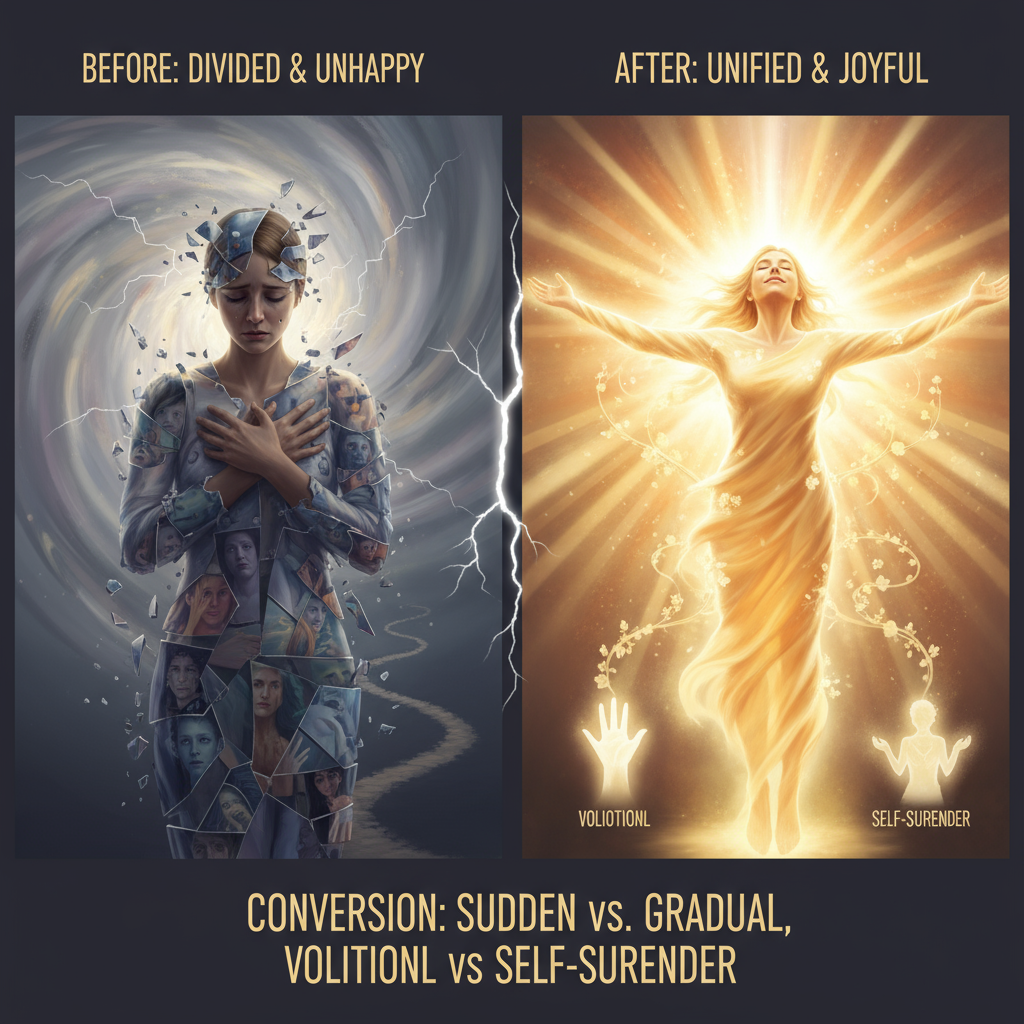
Introduction
A conversion experience, in William James' analysis, is a dramatic psychological transformation in which a person moves from a divided, unhappy or guilty self to a unified, joyful and morally transformed state, typically attributed to divine intervention. Famous examples include Paul on the road to Damascus and Augustine's tolle lege moment — both sudden, life-altering transformations that the recipients attributed entirely to God. The claim that these experiences present powerful evidence for God involves two distinct questions: whether conversion experiences are genuine psychological phenomena (which is largely uncontested), and whether the best explanation of them is divine causation rather than psychological or neurological processes. I will argue that conversion experiences do constitute evidence for God's existence — particularly through James' pragmatic argument from effects and Swinburne's principles of credulity and testimony — but that this evidence is not powerful enough to be conclusive, given the availability of naturalistic explanations from Freud and neuroscience.
Mark-scheme aim
PECREL 1 — James' pragmatic case and Swinburne's principles vs Freudian and naturalistic explanations
James and Swinburne construct the strongest positive case for conversion experiences as evidence for God, grounding it in observable effects and reasonable epistemic principles, but Freud and neuroscience offer naturalistic alternatives that significantly reduce the evidential force.
James, in The Varieties of Religious Experience (1902), argues pragmatically: if the effects of a conversion experience are real and lasting — greater peace, moral transformation, renewed purpose — then we have grounds for taking the cause seriously. He identifies two key tests for validity: the experience must produce lasting positive change, and it must result in what he calls "saintliness" — lives of genuine moral improvement observable to others. Since conversion experiences consistently and dramatically reshape personality and behaviour across cultures and centuries, James concludes that God — or at least "a higher power" — is the most plausible explanation. Swinburne reinforces this with the Principle of Credulity (we should accept what things appear to be unless there is specific reason to doubt them) and the Principle of Testimony (we should believe what people sincerely report about their own experiences unless there is specific reason not to). Taken together, the sheer cumulative weight of conversion testimony across history and culture constitutes, for Swinburne, a form of evidence that it would be irrational to dismiss without specific counter-evidence.
However, Freud offers a systematic naturalistic explanation that undercuts the evidential value of conversion experiences. In The Future of an Illusion (1927), Freud argues that religious experiences — including conversions — are wish-fulfilment: projections of unconscious desires for a protective father-figure onto the universe, driven by our inability to cope with the anxiety of mortality and helplessness. On this account, the dramatic transformation of conversion is real, but it is caused by the resolution of inner psychological conflict, not by any external divine agent. Modern neuroscience adds weight to this: temporal lobe activity, low serotonin levels, and abnormal brain states have been shown to correlate with intense religious experiences, suggesting a physiological rather than supernatural explanation.
James directly anticipates and rejects the "nothing but" fallacy: even if a conversion experience has a neurological or psychological correlate, this does not prove it is nothing but a brain event. A theist can argue, with Swinburne, that God works through natural psychological and neurological processes, just as physical processes are the medium through which other genuine events occur. Furthermore, as James notes, the positive effects of religious experiences — lasting moral improvement, reduced anxiety, greater compassion — are unlike the effects of mere hallucinations or delusions, which typically deteriorate over time. If the experiences were simply wish-fulfilments, we would expect them to fade when the wish goes unmet in the real world; in fact, many converted people maintain their transformation for life.
James' pragmatic argument is genuinely compelling in one respect: it shifts the debate from unprovable metaphysical claims to observable evidence about effects, which is more tractable. However, it ultimately cannot distinguish between God and psychology as the cause: all the effects James cites (peace, moral transformation, joy) are equally consistent with a purely psychological account in which conversion resolves internal conflict. Freud's explanation is therefore not defeated — it is a genuine rival. Swinburne's principles are reasonable as epistemic defaults, but they establish only that it is not irrational to take conversion experiences as evidence for God, not that they constitute powerful or decisive evidence. The evidence is real but underdetermined.
So, conversion experiences do constitute genuine evidence worth taking seriously, but the availability of naturalistic explanations means they cannot be described as powerful evidence — since "powerful" implies the evidence weighs significantly more heavily towards theism than towards any alternative.
Mark-scheme aim
PECREL 2 — Universality, the conversion-from-faith problem and cumulative argument
A second line of support for the evidential force of conversion experiences comes from their cross-cultural universality and their role in Swinburne's cumulative case, but the specific challenge of conversions away from theism and problems of conflicting religious content significantly weaken this.
James argues that the universality of conversion-type experiences across different religions and cultures is itself evidentially significant: if these experiences were merely products of individual psychology or specific religious conditioning, we would expect much greater variety in their structure and effects. Instead, the common pattern — a crisis of the divided self resolved by surrender to a higher power, followed by lasting moral transformation — appears in Christian, Muslim, Buddhist and other contexts. This suggests a common cause that transcends cultural particularity, and Ockham's razor points towards God (or at minimum a transcendent reality) as the simplest explanation. Swinburne incorporates this into his cumulative case: combined with cosmological and teleological arguments, conversion experiences add weight to an already developing case for theism.
However, this universality argument faces two serious difficulties. First, many conversion experiences are conversions away from theism — people who have powerful experiences of release and transformation when they leave religion, adopt atheism or embrace a non-theistic spirituality. If the transformative experience itself is the evidence for God, then these atheistic conversions provide equally strong evidence against God, which cancels out the evidential force. Second, conversion experiences have radically different and often mutually incompatible content across religions: a conversion to evangelical Christianity typically involves belief in a personal, trinitarian God, while a Buddhist awakening involves no God at all. As Divinityphilosophy.net notes, we cannot use the same body of evidence to simultaneously support contradictory theological conclusions.
A defender might respond that conversions away from theism are typically less dramatic and less lasting than conversions towards it, and that conflicting content does not disprove a common divine source — God might reveal himself differently according to the cultural frameworks available to the recipient. Pluralists like John Hick argue that all genuine religious experiences point to the same ultimate reality ("the Real") that different traditions conceptualise differently, so the diversity of content is expected rather than problematic. Swinburne can also argue that prior probability — established by other arguments for God — means theistic conversions are intrinsically more likely to be veridical than non-theistic ones.
These responses are partially effective. Hick's pluralism is philosophically sophisticated but considerably weakens the original claim: if conversion experiences point only to "some transcendent reality" rather than the God of classical theism, they cannot support the strong theistic conclusion required for "powerful evidence for the existence of God." The problem of conflicting content remains genuinely damaging: it shows that at most conversion experiences evidence some kind of transformative encounter, but not which specific theological description of that encounter is correct. This significantly limits their evidential power for the specific God of, say, Christianity.
Conversion experiences therefore present genuine and interesting evidence for some form of transcendent reality, but their conflicting content and the existence of non-theistic conversions mean they fall short of providing powerful evidence for the existence of God specifically.
Mark-scheme aim
Conclusion (RJ)
Conversion experiences present genuine but not powerful evidence for the existence of God. James' pragmatic argument from effects and Swinburne's principles of credulity and testimony establish that conversion experiences are a rational data point that should not simply be dismissed, and their cross-cultural universality adds some further weight. However, the availability of Freudian and neurological explanations shows that the effects James documents are consistent with purely naturalistic causes, and the existence of non-theistic conversions and conflicting religious content means that even the strongest accumulation of conversion testimony underdetermines the specifically theistic conclusion. The most defensible verdict is that conversion experiences contribute to a cumulative case for theism but cannot stand alone as powerful evidence: they are better described as suggestive pointers than decisive proof.