On This Page
Hume's Challenges to A Posteriori Arguments
"'Hume presents insurmountable challenges to a posteriori arguments for the existence of God.' Discuss."
Back to Paper 1 essays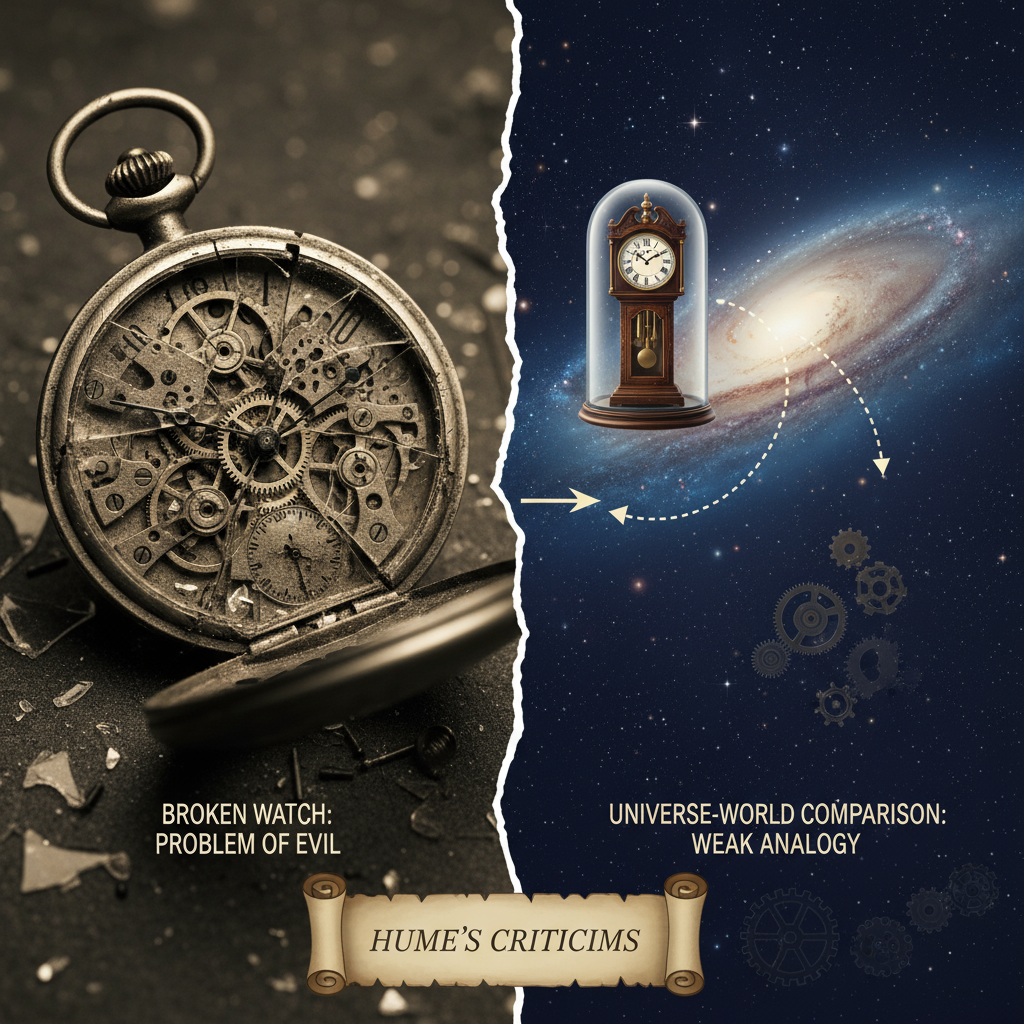
Introduction
David Hume, writing in his Dialogues Concerning Natural Religion (1779), launches a sustained assault on a posteriori arguments for God's existence — principally the teleological argument (arguing from design and order in the universe to an intelligent designer) and the cosmological argument (arguing from the existence of contingent things to a necessary first cause). Aquinas and Paley are the most prominent defenders of these arguments: Aquinas' Five Ways reason from observation of motion, causation and contingency to God, while Paley's watchmaker analogy infers a divine designer from the apparent purposive complexity of nature. The question is whether Hume's challenges are truly insurmountable — that is, whether they permanently defeat these arguments — or whether responses from Swinburne, modern cosmology and Aquinas' defenders blunt their force sufficiently to keep the arguments alive. I will argue that Hume's challenges are extremely powerful and largely succeed against the versions of the arguments he targets, but that some modern formulations, particularly Swinburne's cumulative case, survive the most damaging objections, making "insurmountable" too strong a verdict.
Mark-scheme aim
PECREL 1 — Hume's critique of the teleological argument: disanalogy, uniqueness and alternative explanations
Hume's most devastating objections to the teleological argument centre on the weakness of the analogy between human artefacts and the universe, and the availability of better alternative explanations — but these challenges have been partially answered by modern defenders.
Paley's argument claims that just as finding a watch implies a watchmaker (because its parts are fitted together for a purpose), so the complexity of nature implies a divine designer. Hume, through his character Philo in the Dialogues, attacks this on three fronts. First, disanalogy: the universe is not sufficiently similar to a human artefact to warrant the same inference; machines are precise and mechanical, but the universe appears "more like a vegetable" — organic, irregular and self-organising. Second, uniqueness: we infer design by comparing similar cases, but the universe is a one-off; we have only ever observed one universe, so we have no basis for saying what kind of cause universes in general tend to have. Third, alternative explanations: even if there is a designer, there is no reason to identify it with the Christian God — it could be multiple gods, a weak god who made errors and died, or a morally neutral designer who does not care about human beings.
However, Hume's challenges are not without replies. Richard Swinburne reformulates the teleological argument as an inference to the best explanation rather than a simple analogy: given the fine-tuning of physical constants (gravity, electromagnetism, nuclear forces) to permit life, the most parsimonious explanation is a single intelligent cause, since it is simpler to posit one God than multiple coincidences or competing designers. Furthermore, Darwin's theory of evolution removes the force of Paley's particular version of the argument (explaining biological complexity without design), but does not address the fine-tuning argument: why do the laws of physics themselves permit life? This lies beyond what natural selection can explain, giving the teleological argument new life in the form of the cosmological anthropic argument.
A Humean can respond that Swinburne's "simplicity" move begs the question: it is not obvious that "one God" is simpler than a brute natural fact, especially when the designer itself requires an explanation. Moreover, the multiverse hypothesis — that there are many universes with different physical constants, making at least one hospitable to life statistically inevitable — offers an equally parsimonious non-theistic explanation of fine-tuning. Hume's uniqueness point also applies to multiverses, but at least the multiverse hypothesis does not require positing a being of infinite intelligence and power.
On balance, Hume's objections to Paley's original watchmaker analogy are largely successful: that specific formulation does depend on a flawed comparison and cannot demonstrate the Christian God. However, modern fine-tuning versions of the teleological argument are more resilient, since they do not rely on the same disanalogy and address the laws of physics themselves. The multiverse response is a genuine counter but remains speculative. So Hume's challenges are highly damaging to classical teleological arguments but not fully insurmountable against all versions.
This means that Hume's objections, while not permanently closing down all teleological arguments, expose serious and largely uncorrected weaknesses in the version he directly targets, making his challenges here formidable if not entirely insurmountable.
Mark-scheme aim
PECREL 2 — Hume's critique of the cosmological argument: causation, composition and necessary being
Hume's challenges to the cosmological argument — centring on the limits of a posteriori causation, the fallacy of composition, and the incoherence of a "necessary being" — are even more difficult to overcome, though Copleston and Swinburne offer partial defences.
Aquinas' cosmological argument (particularly the Third Way) argues from the existence of contingent beings — things that could exist or not — to the necessity of a necessary being (God) that explains why anything exists at all. Hume attacks this from three directions. First, he challenges causation itself: in the Enquiry, he argues that we never perceive necessary connection between cause and effect, only constant conjunction; causation may be no more than a habit of mind. Applied to the universe, this means we cannot be confident that the universe requires a cause at all. Second, the fallacy of composition: even if every part of the universe has a cause, it does not follow that the whole universe does — as Bertrand Russell later illustrated, "every human has a mother but the human race doesn't have a single mother." Third, the concept of a necessary being is incoherent a posteriori: any being whose existence we could conceive of a posteriori could also conceivably not exist, so calling God "necessary" adds nothing meaningful.
However, Hume's challenges here are also contestable. Frederick Copleston, in his famous 1948 radio debate with Russell, argued that we need a sufficient reason for the existence of the universe as a whole — not just its parts — and that God as a self-explanatory necessary being provides this, whereas Russell's "brute fact" simply stops the inquiry without explanation. Leibniz's principle of sufficient reason supports this: there must be a reason why there is something rather than nothing. Moreover, Hume's attack on causation, while philosophically interesting, seems to undercut scientific reasoning generally, not just theistic inference; if we accept scientific explanations as meaningful, it is not obvious we can reject causal cosmological arguments on Humean grounds alone.
A Humean can respond that Copleston and Leibniz assume that the universe requires an explanation — this is precisely what is at issue. Russell's point is that "the universe just exists" is as intellectually honest a stopping point as "God just exists," and considerably more parsimonious. Furthermore, quantum mechanics demonstrates that at the sub-atomic level events can occur without identifiable causes, which undermines the universal causal principle on which Aquinas relies. Hume's point about necessary being also remains sharp: even if we accept that something must be necessary, there is no reason from the argument itself why this must be the God of classical theism rather than, say, the universe itself or the laws of physics.
Hume's challenges to the cosmological argument are the more persuasive of the two sets. The fallacy of composition point, combined with Russell's "brute fact" response and the quantum undermining of universal causation, constitute a formidable cluster of objections that Aquinas' defenders have not fully resolved. Copleston's response requires the principle of sufficient reason, which is itself a contested philosophical assumption. The most that can be said for the cosmological argument after Hume is that it remains a possible explanation — one that Swinburne argues is the simplest — but not a demonstratively compelling one. These challenges are, therefore, very close to insurmountable for the classical formulations.
So, while the cosmological argument retains some force as an inference to the best explanation, Hume's fundamental objections about causation, composition and necessary being leave it significantly weakened, and no response has fully overcome them.
Mark-scheme aim
Conclusion (RJ)
Hume presents challenges to a posteriori arguments for God's existence that are largely but not entirely insurmountable. His objections to Paley's watchmaker analogy — disanalogy, uniqueness, and alternative explanations — successfully defeat that classical formulation, though modern fine-tuning arguments are more resilient. His challenges to the cosmological argument — the limits of causal reasoning, the fallacy of composition, and the incoherence of a necessary being — are even more difficult to answer, and when reinforced by Russell and quantum physics, come very close to insurmountable for classical versions. The most defensible overall verdict is that Hume permanently exposes the limitations of a posteriori reasoning about God: it can never yield the certainty its proponents want, and the most it can offer — as Swinburne concedes — is probability rather than proof. In that sense, Hume's challenges are not merely historically significant but remain live and serious objections that no defender of these arguments has fully overcome.