On This Page
Irenaeus vs Augustine on Evil
"'Irenaeus' theodicy gives a more satisfactory response to the problem of evil than Augustine's theodicy.' Discuss."
Back to Paper 1 essays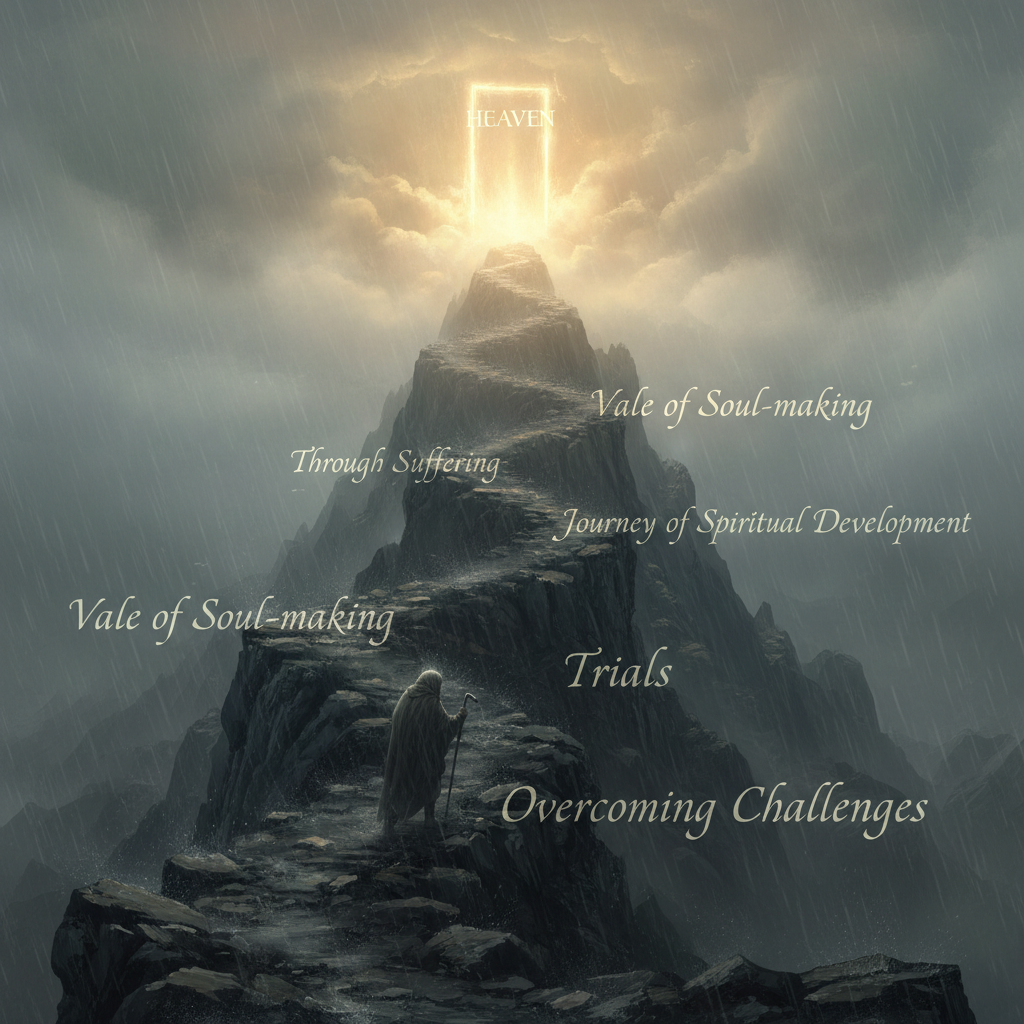
Introduction
Augustine and Irenaeus offer two contrasting theodicies — systematic attempts to reconcile the existence of a perfectly good, omnipotent God with the reality of evil and suffering in the world. Augustine's theodicy is retrospective and soul-deciding: evil entered a perfect world through the free choices of angels and humans at the Fall, it is a privation of good (privatio boni), and God's justice and mercy are demonstrated through punishment and redemption. Irenaeus' theodicy, developed by John Hick into a soul-making model, is prospective: humans are created immature, in God's image but not yet in his likeness, and evil is the necessary environment for moral and spiritual development towards God. The claim that Irenaeus' response is more satisfactory requires us to assess which better preserves God's attributes, coheres with modern knowledge, and adequately accounts for the full range of evil. I will argue that Irenaeus' theodicy is indeed more satisfactory in several important respects — particularly its compatibility with science and its forward-looking developmental model — but that neither theodicy fully resolves the problem, and Augustine retains important strengths.
Mark-scheme aim
PECREL 1 — Compatibility with science and moral responsibility: Irenaeus' advantages vs Augustine's problems
Irenaeus' theodicy is more satisfactory than Augustine's primarily because it does not depend on a literal Fall narrative and is thus compatible with modern science, while Augustine's account is undermined by evolutionary biology and raises serious questions about God's justice.
Augustine's theodicy requires a literally perfect original creation that was corrupted by the Fall of Adam and Eve, and explains natural evil as God's punishment for human sin. God is therefore entirely absolved of responsibility for evil, since humans chose to introduce it into a perfect world, and God's justice in punishing all of humanity through original sin is presented as righteous. Irenaeus, by contrast, argues that humans were created immature and imperfect — made in God's image but requiring development into his likeness — and that evil is part of the environment God deliberately provided for this growth. On this account, the world was never perfect; it was designed as a "vale of soul-making" (Hick's phrase), where challenge and suffering enable moral and spiritual growth.
Augustine's account faces a devastating challenge from Darwinian evolution: there was no original perfect state from which humans fell, and natural evil (predation, disease, natural disasters) predates humans by hundreds of millions of years and cannot therefore be explained as punishment for human sin. As Get Revising notes, "Hick's development of the Irenaean theodicy makes it more acceptable in the modern world, as it does not require literal interpretation of the Bible and is not discredited by modern science." Furthermore, Augustine's notion that all humanity is justly punished for the sin of two individuals seems morally problematic: collective punishment of billions for Adam's choice is difficult to reconcile with a God of perfect justice, and the idea that unbaptised infants are damned strikes most modern readers as grotesque.
An Augustinian can respond that the account does not require crude literalism: Augustine himself interpreted the Fall allegorically in some works, and the theological point — that evil arises from creaturely freedom, not from God — stands even without a literal Garden of Eden. The concept of original sin can be understood as a structural condition of human nature (a tendency towards selfishness and disorder) rather than a literal inherited guilt, which is more defensible philosophically and less dependent on the precise historical facts of human origins. Moreover, Augustine's privatio boni — that evil is a privation or absence of good rather than a substance — is a sophisticated metaphysical move that absolves God of creating evil, since a privation is not a thing that needs to be created.
The Augustinian response is partially successful: the privatio boni doctrine is genuinely insightful and avoids the problem of God creating evil as a positive entity. However, even a non-literal Augustine still cannot explain natural evil as punishment for sin if there was no historical Fall, and the logic of collective punishment remains morally troubling however interpreted. Irenaeus' prospective model avoids both problems: natural evil is justified as soul-making material rather than divine punishment, and there is no need to hold all humans guilty for a single ancestral choice. On the specific question of compatibility with modern knowledge and moral coherence regarding punishment, Irenaeus is clearly more satisfactory.
Thus, on the criteria of scientific coherence and moral intelligibility of punishment, Irenaeus' theodicy is significantly more satisfactory than Augustine's, giving it a substantial advantage in the overall comparison.
Mark-scheme aim
PECREL 2 — Dysteleological evil and God's responsibility: Irenaeus' limits and Augustine's theological strengths
However, Irenaeus' theodicy faces its own serious challenge from dysteleological evil and raises troubling questions about God's responsibility for evil, on which Augustine's account is arguably stronger.
Irenaeus and Hick argue that evil serves soul-making purposes: through suffering, hardship and moral challenge, humans develop into fully virtuous beings who freely choose God. This requires that all evil is ultimately purposive — that every instance of suffering contributes to someone's spiritual development. However, dysteleological evil — suffering that appears to serve no developmental purpose — severely tests this claim. The suffering of children who die in infancy before developing morally, the random victims of natural disasters, and the extreme suffering of Holocaust victims are not plausibly explained as soul-making material. As D.Z. Phillips argues, treating innocent suffering as an educational instrument for others instrumentalises victims in a morally unacceptable way. Furthermore, if God deliberately created a world with evil in order to facilitate soul-making, then God is directly responsible for the suffering it causes — a conclusion that sits uncomfortably with classical theism.
On the question of God's responsibility, Augustine has an advantage: in his account, God created a perfect world and evil entered through creaturely freedom, so God is not responsible for evil in the same direct way. God permits evil as a consequence of the good gift of freedom, but does not design the world to include evil as a necessary ingredient. This better preserves the classical attribute of omnibenevolence: a perfectly good God who designs suffering as a tool seems harder to defend than one who permits it as a consequence of freedom.
Hick responds to dysteleological evil with an eschatological argument: the suffering of this life will be redeemed in the afterlife, where all souls continue their development towards God, and the ultimate goodness of the whole process will be apparent from the perspective of eternity. He also argues that a world perfectly safe and challenge-free would not produce genuine virtue — beings would be what Hick calls "human pets" rather than moral agents. On God's responsibility, Hick argues that a God who designs a soul-making world is not morally defective: a good teacher who sets difficult problems for students is not thereby cruel, but genuinely caring for their development.
Hick's eschatological response is philosophically honest but evidentially weak: it defers justification to an afterlife we cannot observe, which means the theodicy cannot be evaluated on available evidence. The teacher analogy for God's responsibility is helpful but limited: a good teacher does not design the curriculum to include the Holocaust or childhood cancer. Augustine's theodicy better preserves God's omnibenevolence by keeping God at one remove from the design of evil, and its privatio boni doctrine remains a sophisticated resource. Nevertheless, as Get Revising notes, neither theodicy fully resolves the problem — both ultimately rely on appeals (to free will, to eschatology, to privation) that leave the full force of the evidential problem of evil unaddressed.
So while Irenaeus is more satisfactory in terms of scientific coherence and prospective development, Augustine retains an important advantage in preserving God's omnibenevolence more cleanly, and both fail to fully account for dysteleological evil.
Mark-scheme aim
Conclusion (RJ)
Irenaeus' theodicy is, on balance, more satisfactory than Augustine's but falls short of being fully convincing. It is superior in being compatible with evolutionary science, in offering a forward-looking developmental model that does not require collective punishment, and in giving natural evil a positive purpose rather than treating it as divine retribution. However, it struggles seriously with dysteleological evil, relies on an eschatological justification that cannot be verified, and raises troubling questions about God designing a world that includes innocent suffering. Augustine's theodicy, though undermined by science and morally problematic in its doctrine of collective punishment, preserves God's omnibenevolence more cleanly through the privatio boni and the freedom defence. The most defensible overall verdict is that Irenaeus and Hick's model is better suited to the modern intellectual context and more philosophically coherent, but neither theodicy fully resolves what remains the most powerful challenge to classical theism.