On This Page
Omnipotence and the Logically Impossible
"How fair is the claim that an omnipotent God should be able to do absolutely anything, even the logically impossible?"
Back to Paper 1 essays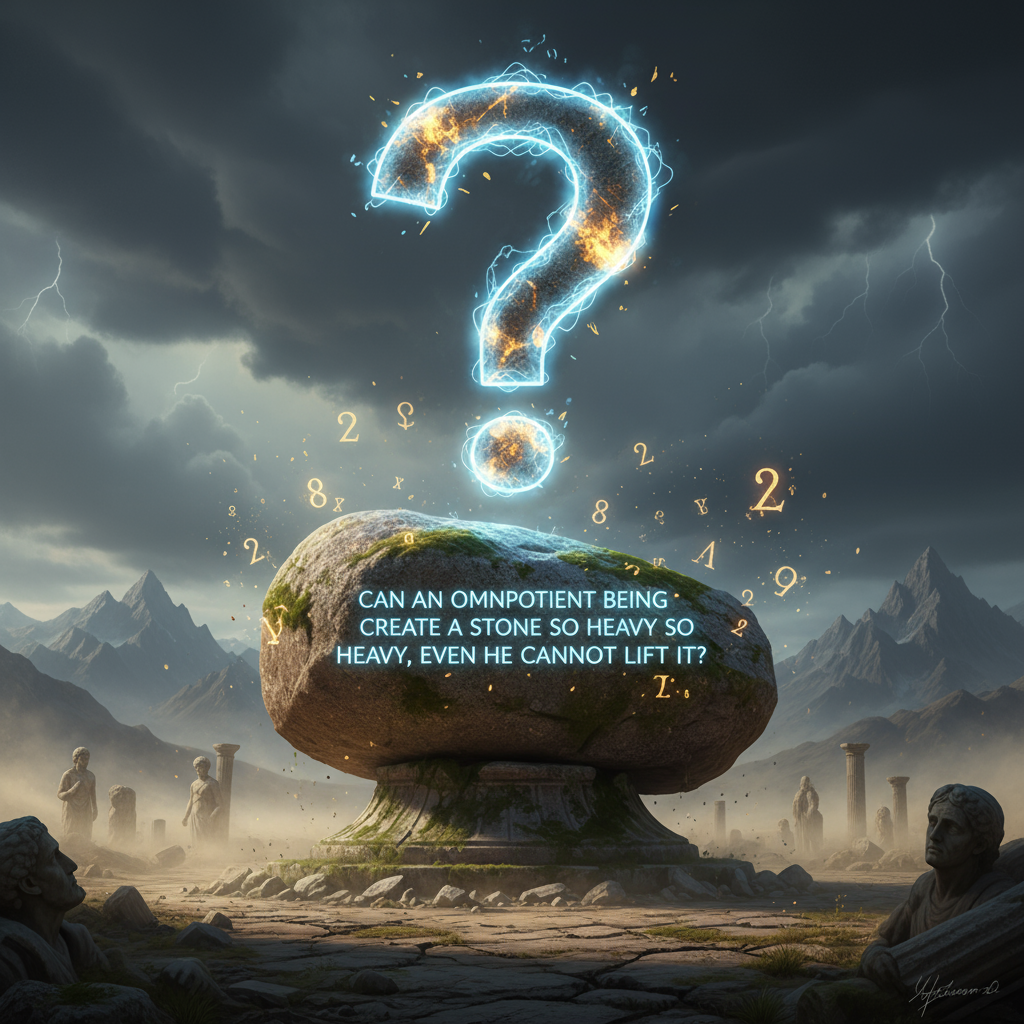
Introduction
Omnipotence — the attribute of being all-powerful — is one of the three classical attributes of the God of classical theism, alongside omniscience and omnibenevolence. The claim that omnipotence means God can do absolutely anything, even the logically impossible, is associated with Descartes, who argued that God, as a supremely perfect being who created all things including logic itself, is bound by no constraints whatsoever. This is challenged by Aquinas and Swinburne, who argue that the logically impossible is not a coherent description of any "thing" God might or might not do, and that limiting God to the logically possible imposes no real restriction on divine power. The question asks how fair this claim is — which requires assessing whether the Cartesian unlimited view is coherent, whether it better captures what omnipotence means, and what problems each position generates. I will argue that the claim is not fair: Aquinas' restriction of omnipotence to the logically possible is more coherent and does not genuinely diminish God's power, while Descartes' version creates serious philosophical problems for God's nature and relationship with creation.
Mark-scheme aim
PECREL 1 — Descartes' unlimited omnipotence vs Aquinas and the paradox of the stone
Descartes' claim that God can do absolutely anything, including the logically impossible, appears to maximise divine power, but on examination it generates incoherent paradoxes and undermines God's other attributes — while Aquinas' restriction is more defensible than it first appears.
Descartes argues that God created everything, including the laws of logic, and therefore cannot be bound by them — to say God cannot do the logically impossible would be to place a constraint above God, which is incompatible with genuine omnipotence. This view, sometimes called voluntarism, holds that even necessary truths (like "2 + 2 = 4") are contingent on God's will: God could have made them otherwise. By contrast, Aquinas argues that logically impossible "actions" — such as making a square circle or making something both exist and not exist — are not really actions at all: they are meaningless combinations of words that describe no coherent state of affairs. As Aquinas puts it, "whatever involves a contradiction is not held by omnipotence" — not because God lacks power, but because there is nothing there to be done. The paradox of the stone sharpens this: can God make a stone so heavy that even God cannot lift it? If yes, there is something God cannot do (lift it); if no, there is something God cannot do (make it).
Descartes could respond that the paradox of the stone merely shows the limits of human language, not of God's power: our finite minds cannot conceive of what an unlimited being could do. However, this response is unsatisfying: if "God can do the logically impossible" is itself meaningless — as Mackie argues, it is "only a form of words which fails to describe any state of affairs" — then Descartes has not expanded God's power but merely asserted something without content. Aquinas' position faces a different challenge: if God is limited to the logically possible, does this not imply that logic is a constraint external to and greater than God, contradicting divine sovereignty?
Aquinas' reply is that logic is not a constraint imposed on God from outside but reflects the internal coherence of God's own rational nature. God does not fail to make square circles because some external force prevents him, but because "square circle" describes nothing — it is not a task at all. C.S. Lewis reinforces this: "Nonsense remains nonsense even when we talk it about God." Furthermore, Swinburne adds that a God who could suspend logic would be arbitrary and unpredictable: if God could change the laws of logic, we could have no reliable knowledge of anything, including God himself. This would make rational theology — including the very claim that God is omnipotent — impossible to sustain.
Aquinas' position is clearly more philosophically coherent: the logically impossible is not a domain of tasks God mysteriously fails to perform but a set of pseudo-descriptions that have no referent. Descartes' unlimited view, while apparently more respectful of divine power, actually empties omnipotence of content by making it extend to meaningless formulae, and threatens to make God arbitrary and beyond rational understanding. However, the claim in the title is not entirely without point: there is a genuine theological concern that any limitation on God — even a logical one — seems to constrain a being who is supposed to be absolutely perfect. The fairness of the claim depends on whether we think this concern is philosophically weighty enough to override the incoherence problems.
So the claim is not fair in the sense that Aquinas' restriction imposes no genuine limitation on divine power — there is nothing to do in the logically impossible — while Descartes' unlimited version generates serious incoherence and undermines rational theology.
Mark-scheme aim
PECREL 2 — Implications for God's other attributes: free will, omnibenevolence and the problem of evil
A further reason the claim is not fair is that if God could do absolutely anything including the logically impossible, this generates insurmountable problems for God's other attributes — particularly omnibenevolence, the free will defence, and the problem of evil.
If God can do the logically impossible, then the free will defence against the problem of evil collapses entirely. The free will defence relies on the claim that even God cannot create beings with genuine freedom who are also guaranteed to choose good — this is a logical impossibility. But if God can do the logically impossible, he could have created free beings who always choose good, making the existence of moral evil entirely unjustifiable. Similarly, if God can act against logic, then God could simultaneously be omnibenevolent and permit gratuitous suffering — any apparent contradiction between God's goodness and the world's evil dissolves, but only by making the concept of omnibenevolence entirely empty. Furthermore, Descartes' voluntarism implies that God could change the moral law, making good and evil arbitrary: what is good is only good because God says so, not because it has any intrinsic value. This leads to the Euthyphro dilemma: either good is independent of God (limiting God) or good is whatever God wills (making morality arbitrary).
A defender of Descartes might argue that the problems above are only problems for our limited human reasoning, not for God. If God transcends logic, then our concepts of "contradiction," "omnibenevolence," and "free will" may not apply to God in the same way — God's nature might be radically beyond human categories. This is essentially a form of divine mysterianism: God is so far beyond our understanding that we cannot evaluate claims about what he can or cannot do.
The mysterian response, while pious, effectively ends rational theology: if we cannot reason about God's nature at all, we cannot meaningfully affirm that God is omnipotent, omniscient or omnibenevolent in the first place. Aquinas insists that God's nature is rational and self-consistent, and that this rationality is itself a divine perfection — not a limitation. Swinburne argues that omnipotence should be understood as the power to bring about any logically possible state of affairs, which is still an incomprehensibly vast power far exceeding anything in human experience. On this view, saying God cannot make a square circle is no more a limitation than saying God cannot cease to exist — it reflects God's necessary perfection, not a deficiency.
This exchange confirms that the claim in the title is not fair: the Cartesian version, when applied consistently, destroys the coherence of classical theism rather than enhancing it. A God who can do the logically impossible cannot be reliably described as good, free-will-respecting, or just — these concepts presuppose logical consistency. Aquinas' restriction, by contrast, preserves the coherence of all God's attributes together, making rational theology possible. The title's claim is therefore not only philosophically unfair — in the sense of being inaccurate — but also theologically counter-productive: it undermines the very God it is trying to honour.
Thus, the implications of the claim for God's other attributes confirm that it is not fair: an omnipotence extending to the logically impossible does not make God greater but makes God incoherent.
Mark-scheme aim
Conclusion (RJ)
The claim that an omnipotent God should be able to do absolutely anything, even the logically impossible, is not fair. Descartes' unlimited view appears to maximise divine power, but Mackie rightly identifies "God can do the logically impossible" as a form of words with no coherent content, and Aquinas correctly argues that the logically impossible describes no real task or action. When the implications are followed through, the Cartesian position undermines the free will defence, empties omnibenevolence of meaning, and makes rational theology impossible. Aquinas and Swinburne's restriction of omnipotence to the logically possible imposes no genuine limitation on God — it reflects the internal coherence of a perfectly rational divine nature — while preserving the consistency of all God's attributes together. The most defensible conclusion is that true omnipotence means maximal coherent power, not the power to make nonsense true, and the claim in the title conflates greatness with incoherence.