On This Page
Ontological Argument and Logical Fallacy
"'The ontological argument fails because it rests on a logical fallacy.' Discuss."
Back to Paper 1 essays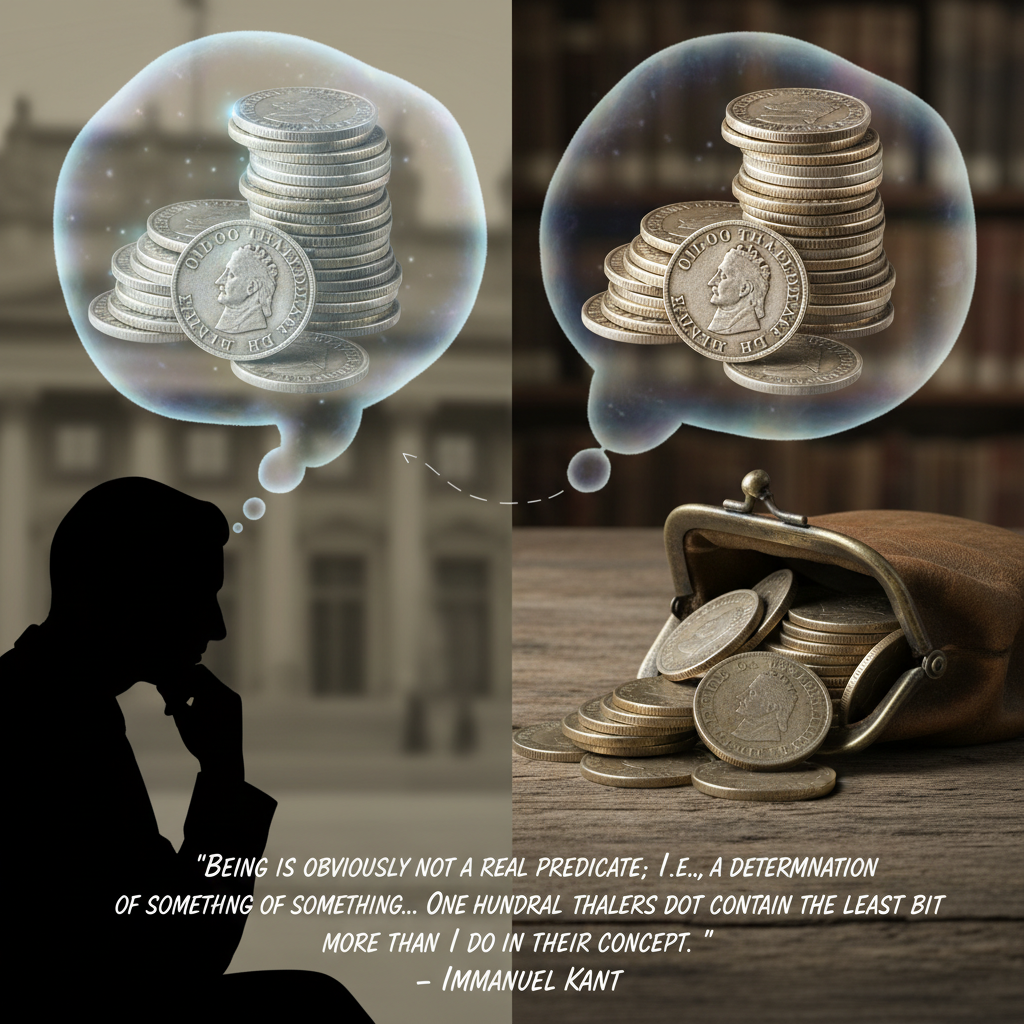
Introduction
The ontological argument, first formulated by Anselm of Canterbury in the Proslogion (1078), is a unique a priori attempt to prove God's existence from the definition of God alone, without appeal to empirical evidence. Anselm defines God as "that than which nothing greater can be conceived" and argues that such a being must exist in reality as well as in the understanding, since existing in reality is greater than existing in the mind alone. Descartes offered a second version: a supremely perfect being must possess all perfections, and existence is a perfection, so God must exist. The claim in the title is that this argument fails specifically because it contains a logical fallacy — most commonly identified as Kant's charge that "existence is not a predicate." However, the title narrows the reason for failure to logic alone, which invites us to ask whether the argument fails for this reason, whether it fails for other reasons, and whether modern formulations by Plantinga successfully avoid the alleged fallacy. I will argue that while the argument does rest on a questionable logical move regarding existence, "logical fallacy" is not the whole story: Gaunilo's challenge is weaker than it appears, Kant's is stronger but not wholly decisive, and Plantinga's modal version partially survives — yet the argument ultimately fails to be persuasive to those who do not already accept its premises.
Mark-scheme aim
PECREL 1 — Gaunilo and Kant: defining things into existence vs existence as predicate
The two most prominent logical objections to the ontological argument — Gaunilo's reductio and Kant's "existence is not a predicate" — both challenge the move from concept to reality, but with different degrees of success.
Gaunilo of Marmoutier responded to Anselm with a reductio ad absurdum: if Anselm's logic were valid, we could prove the existence of a perfect island by the same method — it would have to exist in reality because existing in reality is greater than existing only in the mind. This suggests Anselm's argument proves too much and must therefore be fallacious. Kant's objection is philosophically deeper: he argues that existence is not a real predicate — it does not add to our concept of a thing but merely asserts that the concept has an instance. When I describe "100 thalers", the concept is the same whether the coins exist or not; existence adds no new information to the description. Similarly, defining God as having existence as a property does not make it so; "God exists" must be verified in experience, not deduced from definition.
Both objections face counter-arguments. Gaunilo's island analogy is arguably disanalogous: islands are contingent, bounded objects with no intrinsic reason to be the greatest possible of their kind, whereas God, as an unlimited, maximally great being, is conceptually different in kind. Anselm himself replied that his argument only works for a being of unlimited greatness, not for any finite thing. Kant's objection, while powerful against Anselm and Descartes' formulations, was formulated before modern predicate logic — in which "existence" is treated as a second-order predicate (a predicate of predicates, asserting that a concept has instances), not a first-order predicate of objects. Within this framework, some philosophers argue Kant's point becomes less decisive.
However, even granting that Gaunilo's specific island analogy is imperfect, the underlying logical point stands: Anselm's argument moves from the concept of a being to its real existence, and that move is problematic regardless of whether the being is limited or unlimited. Kant's insight survives the predicate-logic reframing: saying that God exists in reality rather than only in the understanding is still an existential claim that cannot be settled by conceptual analysis alone. As Bertrand Russell put it, it is easier to feel convinced the argument is fallacious than to identify precisely where the fallacy lies — but Kant comes closest.
On balance, Gaunilo's challenge is the weaker objection — Anselm can plausibly distinguish God from islands — but Kant's "existence is not a predicate" remains the most serious logical challenge and has not been fully overcome by defenders of the classical versions. The argument does rest on a questionable logical move, and this is a genuine reason for its failure. However, calling it simply a "logical fallacy" understates the case: it is better described as a contested philosophical assumption about the grammar of existence, around which debate continues. The argument fails, but it fails as a result of a deep and genuinely difficult philosophical problem, not a simple textbook fallacy.
So, Kant's objection identifies the core logical weakness of classical versions of the ontological argument, but whether this constitutes an irremediable fallacy depends on contested views about existence — meaning the argument's failure is philosophically interesting rather than straightforwardly obvious.
Mark-scheme aim
PECREL 2 — Plantinga's modal ontological argument: does it escape the fallacy charge?
Alvin Plantinga's modal reformulation of the ontological argument attempts to avoid the Kantian fallacy charge by substituting necessary existence for existence as a predicate, but this move introduces new problems and fails to be persuasive.
Plantinga argues that if God — defined as a maximally great being — is possible (exists in at least one possible world), then God necessarily exists in all possible worlds, including ours, because maximal greatness entails necessary existence (existing in every possible world). This reformulation is designed to sidestep Kant: "necessary existence" is a genuine modal property, not simply the predicate "exists." The argument runs: (1) It is possible that a maximally great being exists; (2) If it is possible, it is necessarily possible; (3) Therefore it necessarily exists in all possible worlds; (4) Therefore it exists in the actual world.
However, Plantinga's version faces two serious objections. First, the key premise — that a maximally great being is possible — is simply asserted rather than demonstrated. An atheist can run the same modal logic in reverse: if it is possible that no maximally great being exists (i.e. if "God does not exist" is possibly true), then God necessarily does not exist. Both arguments are formally valid; the dispute reduces to which possibility claim is more plausible — which cannot be settled by logic alone. Second, Hume's concern applies: if the ontological argument succeeded, "God does not exist" would be a logical contradiction — but it clearly does not feel contradictory in the way "a round square exists" does, suggesting the argument overstates the logical necessity of God's existence.
A defender of Plantinga might argue that the concept of a maximally great being is coherent and non-contradictory — unlike a round square — and that coherence is a sufficient basis for asserting possibility. Furthermore, Plantinga does not claim the argument will persuade a committed atheist; he claims it shows that belief in God is rationally permissible — a weaker and more defensible claim. On this reading, the argument is not a proof but a demonstration that theism is logically consistent and that the believer does not hold a contradictory position.
This reframing is honest and important: if Plantinga's goal is rational permissibility rather than proof, then the objection that the argument is unpersuasive to atheists is beside the point. However, the title's claim — that the argument fails — concerns whether it proves God's existence, and on that question Plantinga does not succeed. The possibility premise remains question-begging against a non-theist, and the modal version, while more sophisticated than Anselm's, still cannot establish its key premise without independent evidence or argument. The argument is therefore valid but not sound for those who do not already accept theism.
Plantinga's modal version escapes the narrowest form of the Kantian fallacy charge, but ultimately fails for a related reason: its key premise — that maximal greatness is possible — cannot be established by reason alone, making the argument circular for non-believers and thus not a proof of God's existence.
Mark-scheme aim
Conclusion (RJ)
The ontological argument does fail, but the title's attribution of this failure solely to a logical fallacy is only partially accurate. Kant's objection that existence is not a predicate correctly identifies the core weakness in Anselm's and Descartes' versions, but this is better described as a contested philosophical assumption than a simple logical fallacy, and Plantinga's modal reformulation avoids the narrowest form of the charge. The deeper reason for the argument's failure is that, as Oppy and Russell suggest, it cannot establish its key premises — that God is possible, or that existence is a perfection — without begging the question against a non-theist. The most defensible conclusion is therefore that the ontological argument fails not merely because of a logical fallacy, but because it cannot generate genuine agreement across worldviews: it is valid but not demonstrably sound, and persuasive only to those who already accept the premises.