On This Page
Persuasiveness of Ontological Arguments
"How persuasive are ontological arguments for the existence of God?"
Back to Paper 1 essays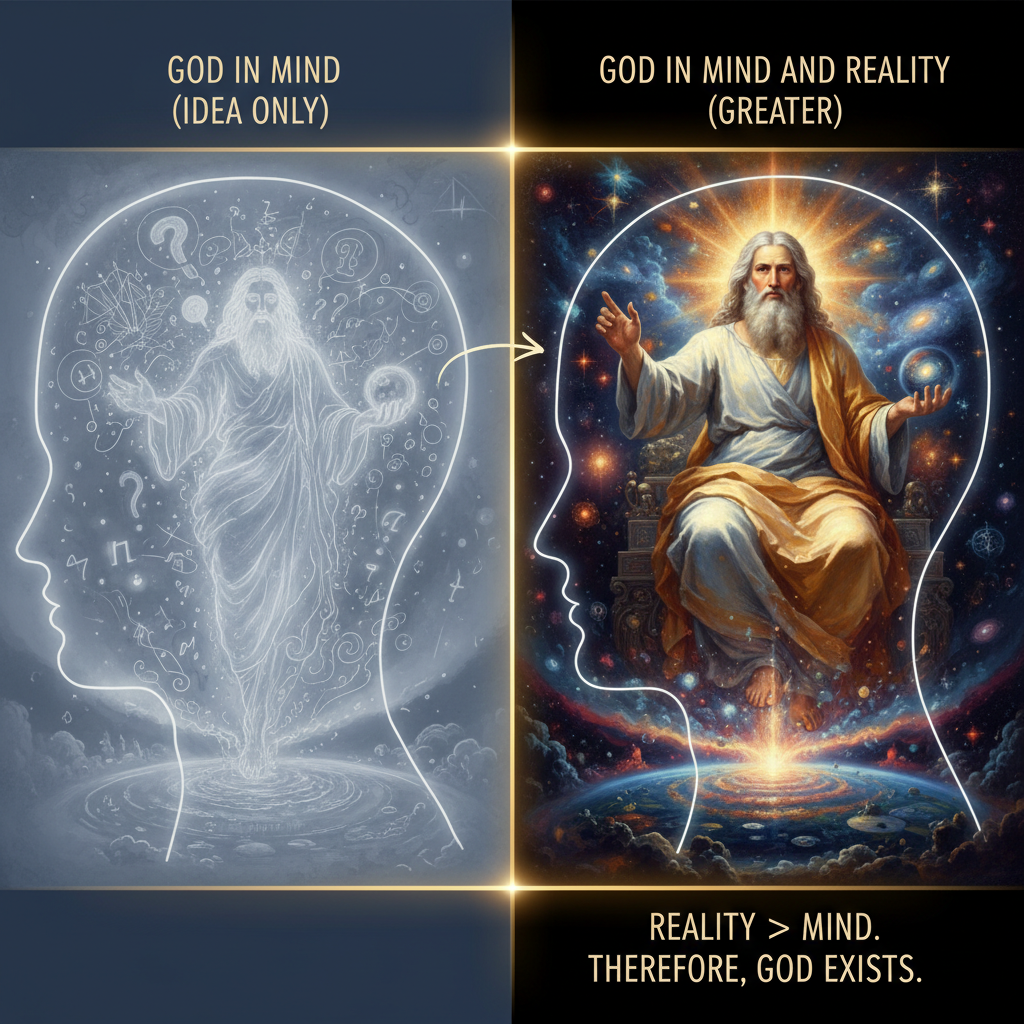
Introduction
Ontological arguments are a priori attempts to demonstrate God's existence through reason alone, without appeal to the observable world — making them unique among arguments for God's existence. Anselm's original version in the Proslogion defines God as "that than which nothing greater can be conceived" and argues that such a being must exist in reality since existence in reality is greater than existence in the mind alone. Descartes reformulated this: a supremely perfect being must possess all perfections, including existence. In the 20th century, Plantinga offered a modal version arguing from the possibility of a maximally great being to its necessary existence in all possible worlds. The question asks how persuasive these arguments are — a lower bar than asking whether they succeed as proofs, yet still a demanding standard. I will argue that ontological arguments have genuine philosophical elegance and succeed in clarifying the concept of God, but are ultimately unpersuasive to those who do not already share theistic commitments, because their key premises cannot be established independently of the conclusion.
Mark-scheme aim
PECREL 1 — Strengths of persuasiveness: logical elegance, the God-concept and Plantinga vs Gaunilo and Kant
Ontological arguments have genuine strengths that make them partially persuasive: they capture something important about the concept of God and, in Plantinga's version, avoid the most obvious logical objections.
The argument's greatest strength is its logical elegance: if it works, God's existence is a matter of pure reason, as certain as a mathematical proof, and cannot be undermined by any empirical findings. Anselm's definition — that God is the greatest conceivable being — is widely regarded as one most theists and atheists can accept as a starting definition: the debate is about what follows from it. The second form of Anselm's argument (that a necessary being is greater than a contingent one, so God cannot be conceived as not existing) has an intuitive appeal: if God exists at all, God exists necessarily, and it seems odd to speak of God "happening to exist" or "ceasing to exist" contingently. Plantinga's modal version adds rigour: by using possible worlds semantics and arguing that necessary existence is a genuine property — not simply "existence" as Kant criticised — it avoids the most direct form of the Kantian objection.
However, these strengths are significantly undermined by objections. Gaunilo's island, though imperfect as an analogy, exposes the general worry that Anselm's logic proves too much: any sufficiently defined concept might be "defined into existence" by similar reasoning. Kant's deeper point — that "existence is not a predicate" — remains troubling: adding "exists in reality" to the concept of God does not tell us whether anything in reality actually corresponds to that concept. The classical versions therefore fail to bridge the gap between concept and reality, which is precisely what an existence proof must do.
A defender can respond that the ontological argument is not trying to add "existence" as just another property, but to demonstrate that the concept of God is uniquely self-grounding: unlike islands or chairs, the concept of a maximally great necessary being is incoherent if it refers to something that merely happens to exist. On this view, once we truly understand what "God" means, we see that God either necessarily exists or necessarily does not — and since the concept is not self-contradictory (unlike a round square), necessary existence follows. Plantinga makes this explicit with his modal version, offering a logically valid argument that defenders of God can use to show their belief is internally coherent.
The argument is genuinely persuasive as a clarification of the internal logic of theism: if God exists, God necessarily exists, and the concept is not self-contradictory. This is a real and important philosophical contribution. However, as an attempt to persuade a non-theist, it is much weaker. The Kantian objection still bites against classical versions, and Plantinga's modal version depends on the contested possibility premise. The argument is therefore most persuasive to those already disposed towards theism, helping them see that their belief is logically structured and not arbitrary, rather than convincing atheists who have no independent reason to grant the possibility premise.
Ontological arguments are persuasive within a theistic framework — clarifying and systematising belief in God — but have very limited persuasive force for those approaching the question without prior theistic commitments.
Mark-scheme aim
PECREL 2 — Wider persuasiveness: Hume's modal challenge, question-begging and theological value
Even setting aside the specific Kantian objection, ontological arguments face a deeper challenge to their persuasiveness: they are question-begging in a way that limits their audience to those already sympathetic to theism, and Hume's modal challenge undermines even Plantinga.
Hume argues that if an ontological argument succeeds, "God does not exist" would be a logical contradiction — like "a round square." But "God does not exist" simply does not feel like a logical contradiction; an atheist can coherently assert it without apparent self-contradiction, suggesting that God's existence is not a logical necessity in the way the argument requires. At the level of modal logic, Oppy notes that Plantinga's argument is formally symmetric: just as one can argue from "it is possible that a maximally great being exists" to "it necessarily exists," one can equally argue from "it is possible that no maximally great being exists" to "it necessarily does not exist." Both are valid; neither is more obviously true than the other, so the argument settles nothing for a genuine agnostic.
A defender might argue that the symmetry objection proves too much: all philosophical arguments can be "symmetrised" in some sense. The relevant question is which starting possibility claim is more plausible — and arguably, the concept of a maximally great being is perfectly coherent (unlike a round square), giving the theist reasonable grounds to assert possibility. Furthermore, even if the argument does not convince atheists, the OCR question bank includes the question of whether the argument is persuasive — not whether it proves God beyond all doubt. A valid argument with plausible premises still has persuasive value for those open to its premises.
However, the deeper problem remains: the premise "it is possible that a maximally great being exists" is not epistemically neutral. To grant it is already to concede that there is no incoherence in the concept of an omnipotent, omniscient, omnibenevolent necessary being — which is precisely what atheists often dispute, especially in light of the problem of evil. If the concept of God is already problematic — not self-contradictory in a formal sense, but arguably impossible given the existence of evil — then the possibility premise fails, and the entire modal argument collapses.
This exchange reveals the fundamental limit of ontological arguments as tools of persuasion: their persuasive force is almost entirely proportional to prior theistic commitment. Those who find the concept of God coherent and attractive will find the argument illuminating and reinforcing; those who are sceptical of the concept will find the possibility premise unconvincing and the argument circular. Divinityphilosophy.net captures this well: the argument "is a valid argument…the question of its soundness depends on one's worldview." This is an honest and important conclusion, but it significantly limits the argument's independent persuasive power.
Ultimately, ontological arguments are most accurately understood as exercises in fides quaerens intellectum — faith seeking understanding — that illuminate the logic of theistic belief rather than generating new converts, which means their persuasiveness is real but limited to those already within the theistic framework.
Mark-scheme aim
Conclusion (RJ)
Ontological arguments are partially persuasive but fundamentally limited in their reach. Anselm's formulation captures something philosophically important — that God's existence, if real, would be necessary rather than contingent — and Plantinga's modal version is logically sophisticated enough to avoid the narrowest form of Kant's objection. However, the arguments are ultimately persuasive only within a theistic framework: they require premises — that existence in reality is greater than existence in the mind, that a maximally great being is possible — that a committed non-theist has no independent reason to accept. As Divinityphilosophy.net concludes, the argument succeeds in Anselm's original purpose of "faith seeking understanding" — clarifying and systematising theistic belief — but as a standalone proof persuasive to all rational enquirers, it falls short.