On This Page
People as Complex Physical Matter
"'People are no more than complex physical matter.' Discuss."
Back to Paper 1 essays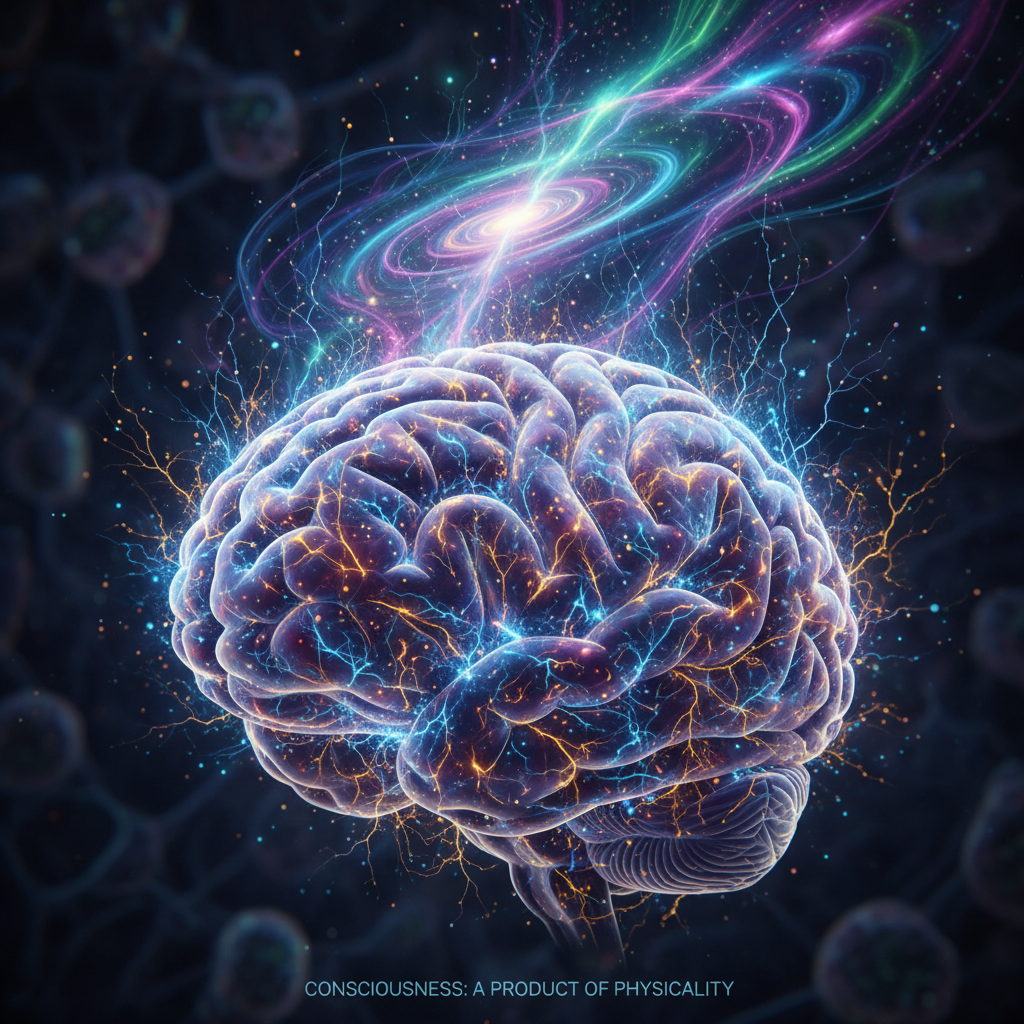
Introduction
The statement reflects the position of hard materialism: the view that everything about a person — thoughts, feelings, consciousness, identity — can be fully explained by physical and chemical processes in the brain and body, with no need for a soul or separate mental substance. This is challenged by dualists, who argue that there are features of human existence — consciousness, rational insight, moral agency — that cannot be reduced to matter alone. The debate draws on Plato's substance dualism, Aristotle's hylomorphism, Descartes' mind–body distinction, Ryle's category-error critique, and scientific materialists like Dawkins. I will argue that while materialism captures important truths about the dependence of mental life on the body, the statement is too strong: human consciousness and moral identity suggest that people are more than complex physical matter, even if they are not a wholly separate Platonic soul.
Mark-scheme aim
PECREL 1 — The materialist case: Dawkins, identity theory and Ryle vs dualist alternatives
The strongest argument for the statement comes from scientific materialism and the identity theory of mind, supported by Ryle's demolition of substance dualism as a philosophical confusion.
Hard materialism holds that human beings are entirely physical: emotions are neurochemical events, memories are patterns of synaptic connection, and personality is the product of genes and environment. Richard Dawkins, a reductive materialist, argues that humans are essentially "carriers for genes" and that when the body dies, the mind dies with it; there is no non-physical part of a person. This is supported by the mind-brain identity theory: mental states are identical to brain states, just as "the Morning Star" and "the Evening Star" are two names for the same object (Venus). fMRI scans correlating specific thoughts and emotions with brain activity are cited as evidence. Gilbert Ryle reinforces this from a philosophical angle, arguing that Descartes' dualism commits a category error — treating the mind as a ghostly "thing" in addition to the body, as if after listing all the buildings of a university someone asked "but where is the university?" For Ryle, "mind" describes how a person behaves and processes information, not an extra substance lurking inside the body.
However, materialism faces a serious and widely recognised problem: the hard problem of consciousness. Even if we map every brain state perfectly, we seem unable to explain why there is subjective experience at all — why there is "something it is like" to taste coffee or see red. As Seneca's OCR notes observe, "it is hard to see how even very complex arrangements of physical 'stuff' can give rise to the felt experience" of qualia. Dawkins' response — that consciousness is "a bunch of tricks in the brain" and that we are not reliable experts on our own thinking — is interesting but has been criticised for sidestepping rather than solving the problem. Additionally, Ryle's category-error argument, while effective against crude Cartesian dualism, does not by itself rule out the possibility of a richer, non-reductive account of mind that goes beyond pure materialism.
A materialist might respond that the hard problem is not evidence for a non-physical soul, but simply a gap in current understanding; as neuroscience advances, subjective experience may be explained naturalistically, just as vitalists once thought life could never be explained biochemically — until it was. They could also argue that the burden of proof lies with those who posit a non-material entity: extraordinary claims require extraordinary evidence, and the soul has never been observed or measured.
This response is honest but incomplete: it is a promissory note rather than an explanation. The fact that science has previously closed explanatory gaps does not guarantee it will close this one, especially since consciousness seems qualitatively different from other natural phenomena — it is the very medium through which we know anything at all. Ryle and Dawkins do succeed in showing that crude substance dualism is incoherent, but they do not establish that people are no more than physical matter; they establish only that the mind is not a separate Cartesian ghost. There remains logical space for a position in which mental and personal properties are real and irreducible features of complex physical systems without being a separate substance — as Aristotle's hylomorphism and John Polkinghorne's "soft materialism" suggest.
So, while the materialist case is powerful in refuting Platonic and Cartesian dualism, it falls short of establishing that people are nothing but complex physical matter, leaving open the possibility that mental and personal properties are genuinely real features of the human being that are not fully captured by physics and chemistry alone.
Mark-scheme aim
PECREL 2 — Dualist and hylomorphic alternatives: Plato, Aristotle and Descartes on what matter cannot explain
Dualist and hylomorphic thinkers argue that certain features of persons — rational insight, moral agency, and personal identity — point beyond mere physical complexity, suggesting the statement is an overstatement.
Plato argues that the soul is the true self: immaterial, rational and capable of knowing the Forms, while the body is a changeable prison. He uses the argument from recollection to suggest that our grasp of perfect abstract concepts (justice, equality) cannot come from physical experience alone and implies a soul that transcends matter. Descartes, independently, argues from the cogito that the thinking self — res cogitans — is a non-extended, indivisible substance entirely distinct from the body (res extensa). Even Aristotle, who rejects Plato's separate World of Forms, insists the soul is the formal cause of the body — its organising, animating principle — and is not reducible to the mere chemistry and physics of flesh and bone. Aquinas synthesised this, arguing that the soul is not "me" but requires a body to be complete, yet still constitutes the personal identity that persists through physical change. Richard Swinburne, a modern dualist, adds that there are "fundamental truths about persons" — their values, memories, first-person perspectives — that cannot be captured in any physical description.
These positions all face a common difficulty: interaction and evidence. If the soul or mind is genuinely non-physical, how does it causally interact with the body? Descartes' attempted answer — the pineal gland — is widely regarded as scientifically and philosophically inadequate. Moreover, the strong mind-brain correlations shown by neuroscience (brain damage reliably alters personality, anaesthesia abolishes consciousness) suggest that what we call "soul" or "mind" is deeply dependent on physical states, which fits materialism better than dualism. Plato's recollection argument, as noted earlier, can be explained without positing a pre-existent soul.
A dualist or Aristotelian can respond that correlation does not equal reduction: the fact that mental states track brain states does not prove they are nothing but brain states, any more than the fact that a symphony requires physical vibrations in air means the symphony is nothing but air pressure. Swinburne's point is that the first-person perspective — the irreducibly personal "what it is like to be me" — is not captured in any third-person physical description, however complete. Aristotle's hylomorphism specifically avoids the interaction problem by insisting the soul is not a separate substance but the form of the living body; yet it still denies that a person is reducible to "mere matter," since the same matter arranged differently (a corpse) is not a person.
This rebuttal is, on balance, more persuasive than it might initially appear. Aristotle's hylomorphic account is particularly compelling because it steers between the two extremes: it avoids Plato's and Descartes' problematic separate soul, while resisting Dawkins-style reduction of persons to gene carriers. The statement "people are no more than complex physical matter" fails because it ignores the formal, organisational, and experiential dimensions of persons that matter-talk alone does not capture. A human body with all its chemistry intact but dead is complex physical matter; a living, thinking, morally responsible person is something more — not a supernatural addition, but a different level of organisation and being that the language of physics and chemistry underdescribes.
Thus, dualist and hylomorphic accounts — particularly Aristotle's — show convincingly that persons are more than the physical matter of which they are composed, even if not in the strong Platonic sense of a separable, immortal soul-substance.
Mark-scheme aim
Conclusion (RJ)
The statement that 'people are no more than complex physical matter' is therefore not convincing as it stands. Materialists like Dawkins and Ryle rightly demolish crude substance dualism and correctly identify that mental life is deeply dependent on the brain, but they do not succeed in showing that consciousness, personal identity, and moral agency are fully explained by physics and chemistry. Plato and Descartes overstate the case in the other direction, positing separate, non-physical soul substances that cannot interact coherently with the body. The most persuasive position is Aristotle's hylomorphism — and its modern descendant, soft materialism — which holds that persons are complex physical beings whose formal organisation and capacities for thought, experience and moral agency make them genuinely more than the matter they are composed of, even though they are not composed of anything other than matter. People are therefore best described as embodied persons, not mere complex physical matter.