On This Page
Plato's Analogy of the Cave
"Discuss critically the philosophical views presented by Plato in his Analogy of the Cave."
Back to Paper 1 essays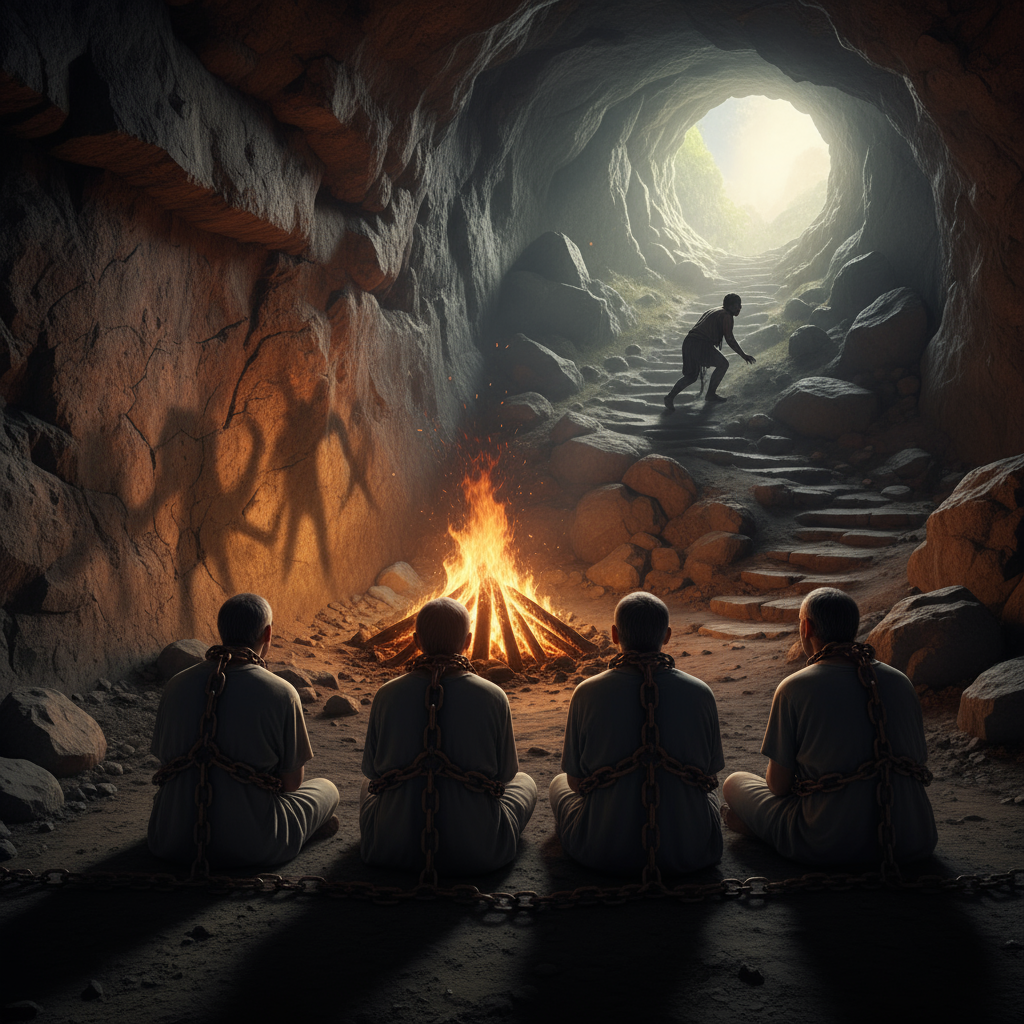
Introduction
In the Analogy of the Cave (Republic VII), Plato presents a powerful image of human beings as prisoners chained in a cave, mistaking shadows for reality, and of a painful ascent into the sunlight that represents enlightenment. Philosophically, this narrative encapsulates his metaphysical dualism (the visible world vs. the intelligible world of Forms), his epistemology (opinion vs. knowledge), and his political theory (philosopher-kings as the only suitable rulers). To discuss these views critically is to ask both how coherent and persuasive they are as an account of reality and knowledge, and how acceptable their political implications are. I will argue that the Analogy is a profound and enduringly insightful metaphor for intellectual and moral development, but that its underlying commitment to a separate realm of Forms and to a political elite is open to serious criticism.
Mark-scheme aim
PECREL 1 — Metaphysics and epistemology: appearance vs reality, Forms and knowledge
The Cave illustrates Plato's view that the physical world is a realm of appearances, while true reality lies in the World of Forms, grasped by reason; this has both strengths and weaknesses.
In the story, prisoners stare at shadows cast on a wall and take these for reality; only the freed prisoner, who painfully turns and ascends, comes to see real objects and finally the sun. The cave stands for the visible world, shadows for deceptive sense experience, the outside world for the intelligible realm, and the sun for the Form of the Good, which illuminates and gives being to all other Forms. The freed prisoner's journey symbolises the soul's ascent from doxa (opinion) based on the senses to epistēmē (knowledge) of unchanging Forms through dialectic. Plato's claim is that only by turning away from the senses and training the intellect can we know what is truly real and good.
One strength of this picture is that it captures how people can be trapped in unexamined assumptions, mistaking cultural "shadows" for truth, and how education can be disorientating and painful. It also anticipates sceptical worries about the reliability of the senses and the need for critical reflection. However, as an argument for a separate metaphysical realm of Forms, it is much less compelling. Critics like Aristotle argue that we do not need a second, invisible world to explain properties; forms can be understood as immanent in things, not existing in a distinct ontological domain. Moreover, the claim that the physical world is merely a shadow seems to undervalue the role of empirical investigation, which, as later science shows, can yield deep and reliable knowledge without postulating a transcendent realm.
A Platonist might respond that the Cave is not intended as a strict logical proof but as an intuition pump: it invites us to see that our everyday experience is limited and that there must be a higher, intelligible order that explains why things are the way they are (for example, why different just acts can all be called "just"). They could argue that the success of mathematics — which abstracts away from particular instances — supports Plato's idea that the mind can access timeless structures that are not reducible to sensory data.
This rebuttal shows why the Analogy remains philosophically suggestive: it highlights the gap between changing experiences and our search for stable truth. Nonetheless, without independent arguments for a separate realm of Forms, the move from "we can be ignorant" to "there exists a higher, non-physical reality" is not justified by the story alone. The Cave is therefore highly effective as a metaphor for epistemic awakening and the limitations of uncritical sense-based belief, but only weakly supports Plato's full-blown two-world metaphysics.
So, while the epistemological message of the Cave retains great force, its metaphysical underpinning in the World of Forms is more questionable, limiting how convincing that aspect of Plato's view is.
Mark-scheme aim
PECREL 2 — Education and politics: philosopher-kings and elitism
The Analogy also embodies Plato's view that only philosophers, who have seen the Good, are fit to rule, raising questions about elitism and the role of ordinary citizens.
The freed prisoner, after adjusting to the light, is compelled to return to the cave to free and enlighten the others, even though they mock and threaten him. This represents the philosopher-king, who, having contemplated the Form of the Good, knows what is truly just and beneficial for the city and therefore has a duty to govern. The other prisoners symbolise ordinary people, who are content with shadows and resist having their worldview challenged. Plato uses this to argue that democracy, which hands power to the ignorant majority, is fundamentally flawed; only those who know the Good should rule.
This vision has an attractive side: it emphasises that power should be connected to genuine understanding and moral insight, not mere popularity. Yet it is also profoundly elitist and anti-democratic. It assumes that most people are incapable of real knowledge and casts them as irrational and violent when confronted with truth. Critics argue that this underestimates citizens' capacity for deliberation and opens the door to paternalistic or authoritarian politics, where rulers claim privileged access to truth and override the views of the governed "for their own good." In modern liberal democracies, we tend to value participation and equal political rights rather than rule by a cognitive elite.
A defender of Plato could respond that his concern is not to suppress citizens but to protect the common good. They might point to contemporary issues where expert knowledge (e.g. climate science, public health) is crucial and argue that leaving decisions entirely to uninformed opinion can be dangerous. The Cave reminds us that some people do, in fact, know more, and that their insight should play a significant role in governance.
This defence has weight: the point that expertise matters is hard to deny, and the Analogy sharply dramatises the tension between truth and public opinion. Nonetheless, Plato's model appears too rigid and hierarchical. It offers no significant role for the critical scrutiny of the rulers themselves and provides little protection against abuse of power by those who merely claim to be enlightened. A more convincing lesson to draw from the Cave is that education should be widespread and critical thinking fostered among all citizens, rather than that political power should be reserved to a small philosophical caste.
Thus, the Cave's educational message — that enlightenment is demanding but necessary — is compelling, but its political conclusion — that only philosophers should rule — is far less convincing in light of modern democratic values and concerns about authority.
Mark-scheme aim
Conclusion (RJ)
Plato's Analogy of the Cave presents a vivid and philosophically rich picture of human ignorance, education and the search for truth. Its core insights — that we can live chained to illusions, that genuine understanding requires painful re-orientation, and that knowledge carries moral and political responsibilities — remain deeply compelling. However, when its underlying philosophical views are examined critically, significant problems emerge: the story does not by itself justify belief in a separate World of Forms, and its implication that only a small enlightened elite should rule is difficult to reconcile with modern commitments to equality and democratic participation. The Analogy is therefore most convincing as a powerful metaphor for intellectual and moral awakening, but less convincing as a literal blueprint for metaphysics or politics.