On This Page
Plato: Soul Distinct from Body
"How convincing is Plato's view that the soul is distinct from the body?"
Back to Paper 1 essays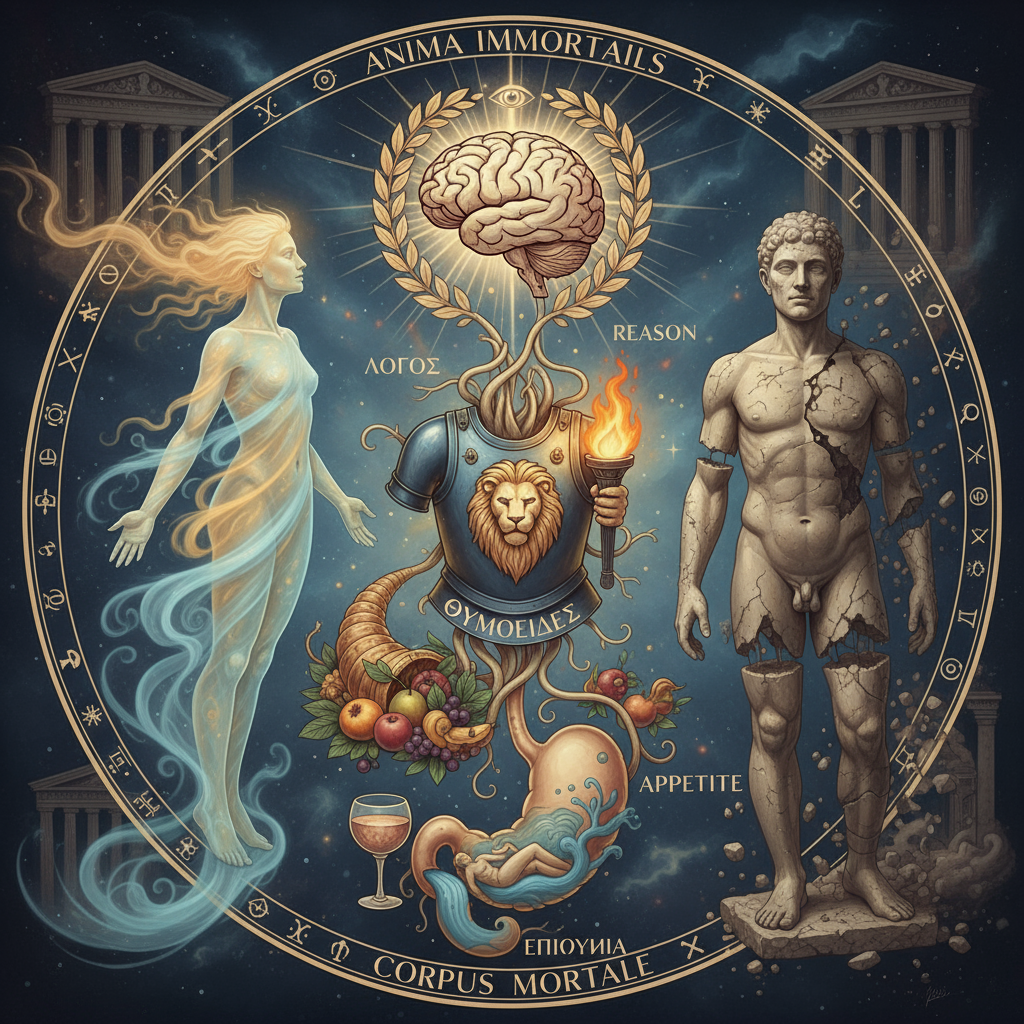
Introduction
Plato presents a strong substance dualist account of the human person: the soul and the body are two distinct kinds of substance, with the soul immaterial, immortal and capable of existing without the body. In the Phaedo, Socrates argues that the soul pre-exists embodiment, survives bodily death, and is the true self, while the body is a temporary, changeable prison. Assessing how convincing this is requires testing both the arguments Plato offers — such as the Argument from Recollection and the claim that the soul is akin to the unchanging Forms — and whether later critiques (Aristotle, Ryle, and modern mind-science) undermine or refine his position. I will argue that Plato's view is only partly convincing: his dualism captures real features of our moral and rational experience, but his claim that the soul is a distinct, separable substance is philosophically and empirically weak.
Mark-scheme aim
PECREL 1 — Recollection, simplicity and Forms vs alternative explanations
Plato's argument from recollection and his claim that the soul is simple and akin to the Forms are central to his case that the soul is distinct from the body, but both can be challenged without abandoning all talk of "soul".
In the Phaedo, Socrates argues that when we recognise imperfect equal things (sticks, stones), we implicitly compare them to the standard of perfect Equality, which we have never seen with the senses. He infers that the soul must have encountered the Form of Equality before birth, so the soul existed independently of the body. He also claims that the soul is simple, invisible and indivisible, like the Forms; bodies are composite and therefore can be broken up and destroyed, but the soul, being simple, cannot be destroyed, so it is immortal. This supports the idea that the soul is a distinct, indestructible substance which merely inhabits the body.
However, both moves are open to powerful objections. First, the recollection story is not the only way to explain our grasp of abstract concepts: we might form the idea of "perfect Equality" by idealising from experience, noticing that some things are more or less equal and extrapolating a limit case, rather than literally recalling a previous encounter with a transcendent Form. Nothing in the phenomenology of learning geometry or perfect circles requires positing a pre-existent soul. Second, the inference from "simple and invisible" to "indestructible" is shaky. Even if the soul were non-material, it does not follow that it cannot cease to exist; simplicity alone doesn't logically guarantee immortality. The key step — from the soul being like the Forms to sharing all their properties — is assumed rather than demonstrated.
A Platonist might reply that these alternative explanations underestimate the normative force of our concepts. When we judge that an example is unequal, we seem to measure it against a standard that is not just a mental construction but an objective, mind-independent reality (the Form). They might also say that thinking of the soul as simple and non-composite is precisely what makes it a suitable vehicle for grasping such timeless truths, and that the strong connection between rational insight and a non-material subject is more than a loose analogy.
This response does salvage part of the intuition: Plato is onto something in connecting our grasp of universals and necessary truths with a "higher" aspect of ourselves that is not reducible to bodily flux. Yet the burden of proof lies with the claim that this higher aspect is literally a pre-existent, separable substance. If equally coherent accounts can explain our concept-formation within an embodied, developing mind (as Aristotle and modern cognitive science suggest), then Plato's leap to a distinct, immortal soul looks speculative. The argument from recollection is therefore suggestive rather than compelling, and the simplicity claim does not deliver the metaphysical punch Plato wants.
So, while these arguments give Plato's dualism some initial plausibility, they are not strong enough to make his claim that the soul is a distinct, separable substance fully convincing.
Mark-scheme aim
PECREL 2 — Dualism vs hylomorphism and modern mind–body dependence
A second, deeper challenge to Plato's view comes from Aristotle's hylomorphic account and from modern evidence about mind–brain dependence, which together make a sharply distinct soul less convincing.
Aristotle rejects Plato's two-substance dualism and understands the soul as the form of a living body — the organising principle or set of capacities (nutrition, perception, thought) that make a living being what it is. On this view, there is no "soul thing" in addition to the body; rather, "soul" is the way the matter is alive and structured. Talking about a soul entirely separate from a body is like talking about the "form" of a statue when there is no statue: it is conceptually incomplete. In the 20th century, Gilbert Ryle sharpened this into the charge of a category error: treating the mind or soul as an extra ghostly entity ("the ghost in the machine") rather than as a way of describing the behaviour and capacities of the person. Contemporary neuroscience further supports this: changes to the brain — through injury, disease, or drugs — systematically alter memory, personality and reasoning, suggesting that what we call "mental" life is deeply dependent on the physical organ.
From this perspective, Plato's picture of a soul that can detach and exist on its own looks detached from what we actually know about persons. If every known mental function correlates with brain activity, the idea of a fully functioning, thinking, remembering self without a body seems speculative at best. Hylomorphism offers a more parsimonious ontology: one substance (the embodied human) with different aspects, rather than two radically different substances awkwardly interacting. Ryle's category-error point reinforces this by arguing that Plato's language misclassifies "soul" as a thing where it might be better understood as a set of abilities or ways-of-being of an organism.
A defender of Plato might respond that correlation does not equal identity: the fact that mental states correlate with brain states does not prove that the mind is nothing but the brain. They might argue that certain features of consciousness — subjective experience (qualia), first-person perspective, free will, or irreducible normativity of moral experience — are not well captured by purely physical descriptions. These phenomena could be taken as evidence that there is indeed a "soul-like" dimension that cannot be fully explained in Aristotelian or physicalist terms, even if it interacts with and depends on the body during earthly life.
This rebuttal has force in highlighting that reductive physicalism is not obviously adequate, and it preserves some of Plato's insight that there is "more" to us than matter. Yet it still does not establish the strong Platonic conclusion that the soul is a distinct, separable substance capable of existing entirely independently of the body. The data support at least a deep dependence of mental life on embodiment, and hylomorphism seems to integrate this better while still allowing for a rich conception of the human. In this sense, Aristotle and modern mind-science push us towards seeing Plato's dualism as an overstatement: he correctly identifies an aspect of human depth and rationality, but mislocates it in a separate metaphysical entity.
Taken together, these considerations suggest that Plato's claim that the soul is distinct from the body is philosophically and empirically under-supported, even if his broader intuition — that our rational, moral life cannot be reduced to mere bodily processes — retains some appeal.
Mark-scheme aim
Conclusion (RJ)
Plato's view that the soul is distinct from the body is therefore only partially convincing. His arguments from recollection and from the soul's simplicity capture something important about our grasp of universals and our sense of being more than our bodies, but they do not demonstrate the existence of a pre-existent, indestructible soul-substance, and they face strong alternative explanations grounded in embodied cognition. Aristotle's hylomorphism and modern science offer a more economical and evidence-sensitive model of the person, in which "soul" is inseparable from bodily form, while still acknowledging the richness of mental life. Thus, Plato remains insightful as a diagnostician of the human condition and as a source of religious hope, but his strict substance dualism — that the soul is a distinct thing which simply uses the body — is not, on balance, philosophically convincing.