On This Page
Symbol in Religious Language
"'Symbol is too often misleading for it to be useful in religious language.' Discuss."
Back to Paper 1 essays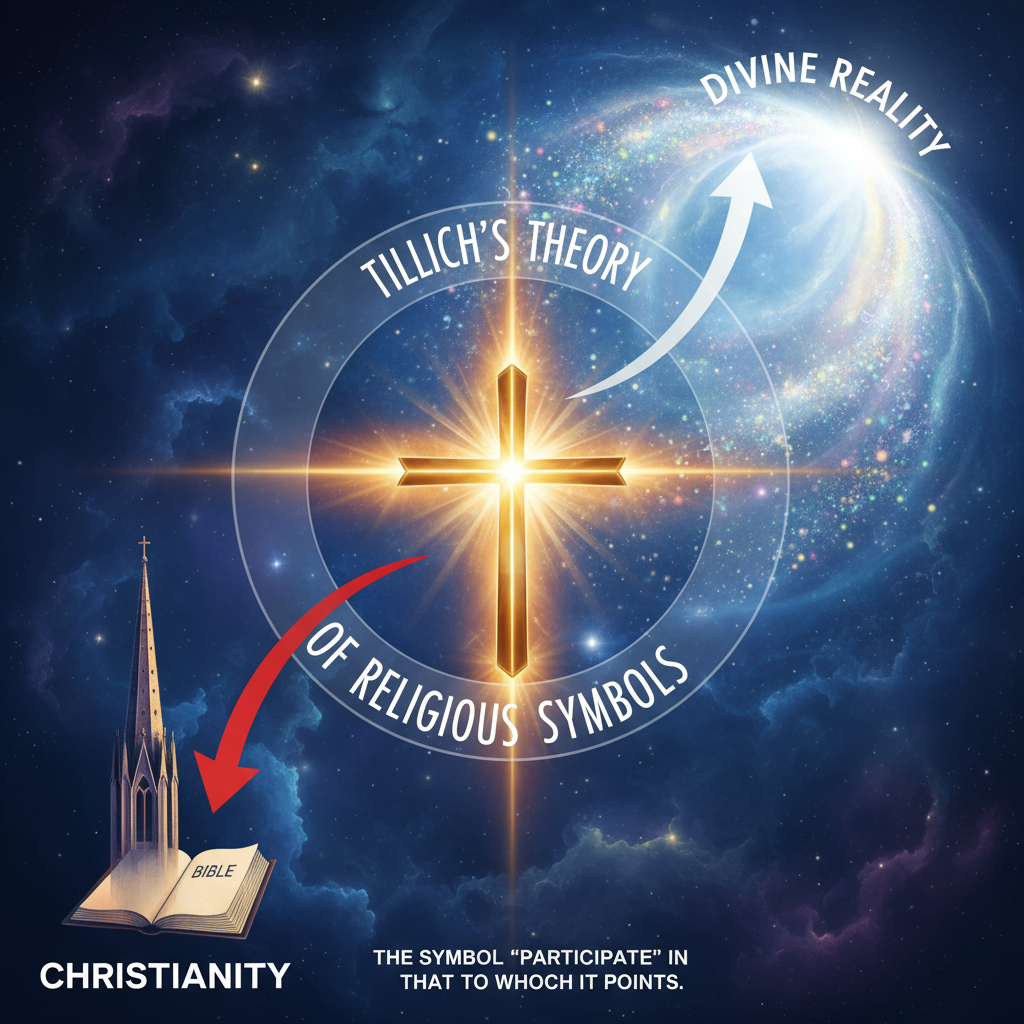
Introduction
Paul Tillich argues that virtually all religious language is symbolic rather than literal: since God is "the ground of all being" — the ultimate, inexhaustible reality — no finite, literal language can adequately capture the divine, and symbols are the only mode of expression that "participates in" what they point to rather than merely pointing at it from outside. Tillich distinguishes symbols from signs: signs (like a speed limit) merely indicate, while symbols (like a national flag) participate in the reality they represent, evoking genuine response and opening new levels of meaning. The claim that symbols are too often misleading to be useful targets two related concerns: that symbols are culturally variable and historically contingent (changing meaning, generating confusion) and that they are too subjective and non-cognitive to carry reliable religious truth. I will argue that the claim has genuine force — symbols do mislead, and Tillich's account of how to distinguish valid from invalid symbols is insufficiently clear — but that this does not make symbols useless: their participatory power and affective depth make them indispensable even if imprecise.
Mark-scheme aim
PECREL 1 — Cultural variability, the swastika problem, and Tillich's account of symbol death
The most powerful evidence for the claim that symbols mislead is their historical variability: symbols change meaning radically over time and across cultures, sometimes becoming the opposite of their original significance, and Tillich's own acknowledgement of this problem undermines confidence in their reliability.
Tillich himself acknowledges that symbols are not permanent: they can "grow" as they gain cultural significance and "die" when they lose it, ceasing to evoke the participation and response they once did. The paradigmatic example of misleading symbol change is the swastika: originally a Hindu symbol representing good fortune, wellbeing and the cycle of life, it was adopted by the Nazi Party in the 1920s and now carries, in Western contexts, an overwhelming connotation of fascism, genocide and racial hatred. A contemporary religious text using the swastika symbolically for its original meaning would almost certainly be catastrophically misleading to most readers, regardless of the author's intention. The cross itself provides a subtler example: in the Roman Empire it was a symbol of shameful, criminal execution; in Christian theology it became a symbol of redemption and love — the same physical form carrying radically different meanings to different audiences.
Tillich's response to the variability problem is that genuine religious symbols are those that successfully "open up levels of reality" and evoke authentic participation — but this creates a troubling circularity: we identify good symbols by whether they genuinely open up reality, but we assess whether they open up reality partly by whether we accept the symbol as valid. Tillich gives no clear, culturally independent criterion for distinguishing symbols that genuinely communicate religious truth from those that merely mislead or manipulate. J. Randall similarly treats religious language as symbolic and non-cognitive — capable of inspiring action and community but not making truth-claims — which raises the question: if symbols cannot be assessed for truth or falsity, how do we know when they mislead rather than genuinely communicate?
Tillich's defender can argue that the swastika case actually illustrates his theory working correctly: the swastika "died" as a religious symbol in Western contexts because it ceased to participate authentically in the divine reality it once pointed to — it was killed by its association with evil. On this account, symbol change and symbol death are self-correcting mechanisms, not failures: symbols that mislead lose their power and are abandoned, while symbols that genuinely participate in ultimate reality persist across generations. The cross enduring as a Christian symbol despite its original criminal associations suggests that authentic symbols have a resilience that misleading ones lack.
This response is partially persuasive: it is true that some symbols — the cross, the lotus, the dove — have shown remarkable resilience and continued to communicate meaningfully across centuries and cultures. However, the self-correcting mechanism is too slow and uneven to reassure us about individual cases: a symbol can mislead for decades or centuries before "dying." The circularity problem also persists: Tillich's framework tells us that good symbols work, but provides no independent test for whether a given symbol is good before the fact — which is precisely when the guidance is needed. The claim that symbols mislead is therefore substantially correct as an empirical observation, even if "too often to be useful" overstates the case.
Symbols do mislead in ways Tillich's own theory cannot reliably prevent, but this shows they require careful contextualisation rather than abandonment — the misleading tendency is a genuine limitation, not a refutation of all symbolic religious language.
Mark-scheme aim
PECREL 2 — Non-cognitive symbols and the question of usefulness: Tillich vs the analogy comparison and verificationism
Even granting that symbols mislead, the claim that they are not useful overreaches: Tillich, Randall and the via negativa comparison all suggest that symbols perform functions in religious language that analogy and literal language cannot replicate, and their non-cognitive character is a feature, not merely a bug.
Tillich argues that the only non-symbolic statement one can make about God is "God is Being Itself" — everything else, including "God is love" or "God is our Father," is symbolic. Symbols are useful, on his account, precisely because they participate in what they represent: they do not merely describe God from the outside but draw the speaker and community into a genuine encounter with ultimate reality. Randall lists four functions of symbolic religious language: it arouses emotion and motivates action, stimulates and inspires community solidarity, allows expression of experiences that resist literal articulation, and clarifies the individual's experience of God. None of these functions requires that symbols be cognitively precise — in fact, their affective and participatory power depends on their going beyond propositional content. A creed can state propositional truths, but a symbol like the Eucharist or the burning candle in a Catholic church does something different and arguably deeper: it enacts participation in the divine presence.
However, if symbols are non-cognitive — as both Tillich and Randall acknowledge — then they cannot be true or false, and their religious usefulness is limited to emotional and communal functions rather than informational ones. Logical positivists like A.J. Ayer would argue that non-cognitive symbolic language is therefore meaningless as a description of reality: it might inspire and unify communities, but it tells us nothing about whether God actually exists or has the attributes believers ascribe to him. Furthermore, John Hick questions whether Tillich's symbolic language is meaningfully different from Aquinas' analogy — both acknowledge that language about God "points beyond itself" without fully capturing divine reality, and if there is no clear distinction, symbol theory adds little to what analogy already provides.
Tillich can respond to the positivist critique by questioning whether cognitive, propositional communication is the only valuable or meaningful kind: the question "is it true or false?" does not exhaust the question "is it meaningful or useful?" Music, poetry and art are not cognitive in the positivist sense, yet they communicate something that propositions cannot — and religious symbols function similarly, opening dimensions of human experience to which propositional language is simply not fitted. On Hick's challenge about the distinction from analogy, Tillich can insist that participation is what distinguishes symbol from analogy: an analogy compares, but a symbol enacts — the Eucharist does not merely compare the bread to Christ's body, it participates in the event it represents.
Tillich's music and poetry analogy is genuinely persuasive: dismissing all non-cognitive language as "meaningless" impoverishes our account of how language works, and the participatory character of symbols gives them a depth that analogy lacks. However, the positivist challenge identifies a real limitation for those who want religious language to carry informational content about God's existence and nature: symbols cannot perform this function. The claim in the title therefore partially succeeds as applied to one demand we might make of religious language (cognitive precision) but fails as applied to others (participatory depth, affective resonance, communal solidarity). Symbols are misleading if used as if they were cognitive descriptions; they are not misleading, and are genuinely useful, if understood as Tillich intends — as participatory pointers to ultimate reality.
Symbols are therefore not too often misleading to be useful, but they are too often misused — applied as if they were literal descriptions rather than participatory enactments — and it is this misuse, not the symbolic character itself, that generates the misleading effects the title targets.
Mark-scheme aim
Conclusion (RJ)
The claim that symbols are too often misleading to be useful is partially correct but ultimately overstated. Tillich's own acknowledgement of symbol death and change, the swastika case, and the circularity of his criteria for valid symbols confirm that symbolic religious language does carry significant risks of misleading — and that these risks are not fully addressed by his theoretical account. However, the functions Tillich and Randall identify — participatory depth, affective resonance, communal solidarity, and the articulation of experiences that resist propositional expression — are genuinely valuable and cannot be replicated by analogy or literal language alone. The most defensible verdict is that symbols are invaluable but require careful contextualisation and theological literacy to be used without misleading: the problem is not that symbols are inherently useless, but that they are easily misapplied by those who treat them as literal descriptions rather than participatory pointers to ultimate reality.