On This Page
Aquinas on Conscience
"'Aquinas' understanding of the conscience is convincing.' Discuss."
Back to Paper 2 essays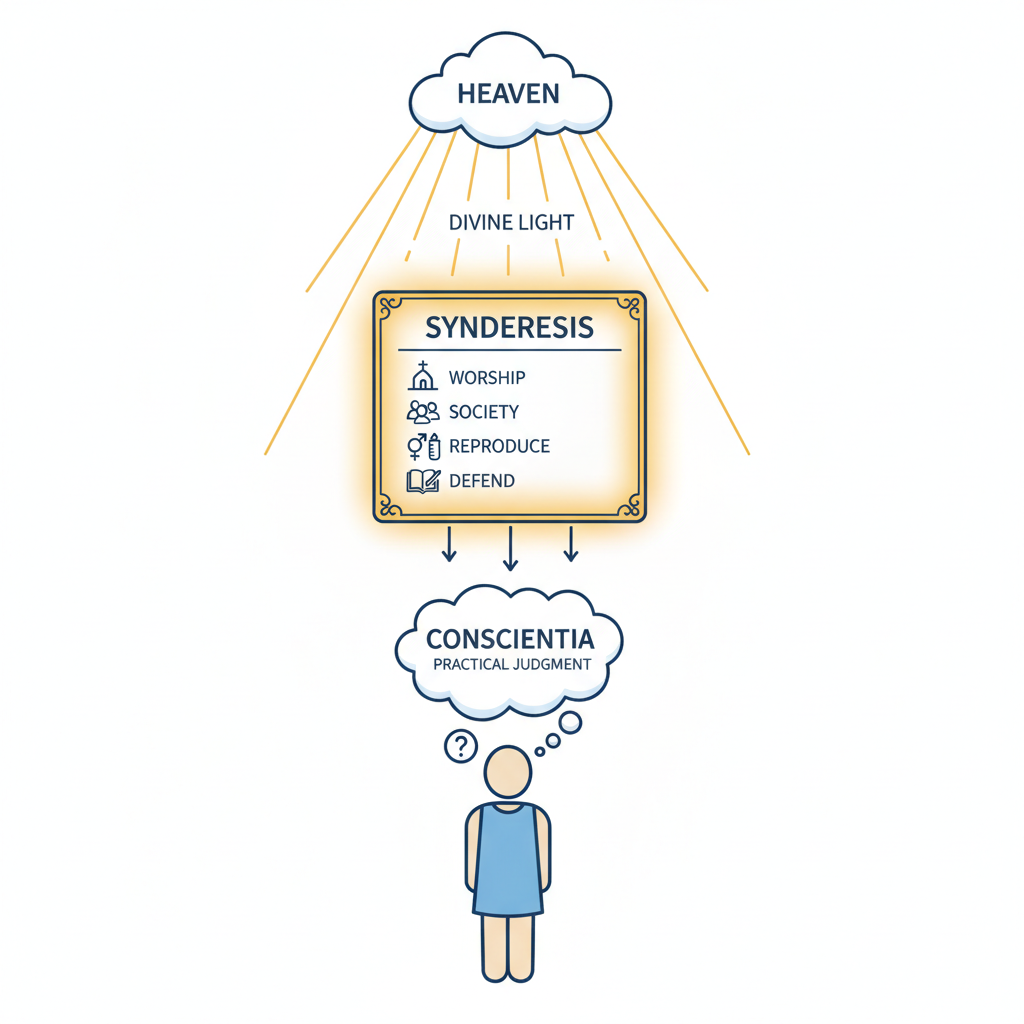
Introduction
Aquinas' understanding of the conscience is one of the most systematic and sophisticated accounts in the Western moral tradition. He defines conscience not as a mystical inner voice or a direct communication from God, but as ratio — reason — operating through two distinct mechanisms: synderesis (the innate, infallible first principle directing every person towards good and away from evil) and conscientia (the fallible act of applying that principle to particular moral judgements). This is, as Lauren's revision notes observe, "the application of knowledge to activity" — a rational, process-based account that is theological in foundation but potentially secular in application. The claim that it is convincing must be assessed on multiple grounds: whether the synderesis/conscientia distinction is philosophically coherent; whether the vincible/invincible ignorance distinction adequately handles cases of erroneous conscience; whether the theological grounding in the imago Dei is necessary or dispensable; and how Aquinas compares with the secular psychological account of Freud. I will argue that Aquinas' account is substantially convincing — its rational, process-based character, its account of erroneous conscience, and its compatibility with secular thought are genuine strengths — but that its theological foundation creates a dependency on theism that limits its universal persuasiveness, and that Freud's psychological account raises unresolved challenges about the origins and reliability of the synderesis principle itself.
Mark-scheme aim
PECREL 1 — The synderesis/conscientia distinction and the erroneous conscience: Aquinas' genuine strengths
The synderesis/conscientia distinction is philosophically coherent and genuinely illuminating — it explains both how conscience can be universally oriented towards good while remaining fallible in practice — and the vincible/invincible ignorance distinction handles erroneous conscience with sophisticated moral nuance.
Synderesis is Aquinas' term for the infallible, God-given first principle: "do good and avoid evil" is so fundamental to human rational nature that it can never itself be wrong. It is not a conclusion reached by reasoning but the starting premise of all moral reasoning — the bedrock intuition that good should be pursued, built into every rational person by virtue of being made in the image of a rational God. Conscientia, by contrast, is the fallible act of applying synderesis and ratio to particular situations: reasoning from the universal principle ("preserve life") to the specific judgement ("I should not perform this action") involves genuine cognitive work that can go wrong through error, bias, or insufficient information. This two-level structure is convincing because it explains a genuine feature of moral experience: people seem deeply and universally committed to doing good at the most basic level, while simultaneously making serious moral errors in particular judgements — the synderesis/conscientia distinction accounts for both of these facts simultaneously. The vincible/invincible ignorance distinction further strengthens the account: a person who acts wrongly through invincible ignorance — where the error was not their fault and could not reasonably have been corrected — is not morally culpable, because they genuinely followed their conscience as best they could. Vincible ignorance, however — where the person could and should have known better — does not excuse, since the duty to inform one's conscience adequately is itself a moral obligation.
However, the synderesis/conscientia distinction, while illuminating, generates a serious practical problem: how does one know whether a given moral judgement represents genuine conscientia faithfully applying synderesis, or a rationalisation of self-interest? Aquinas insists that conscience must be followed even when erroneous — but if a person's conscientia has been systematically corrupted by education, culture or vice, they may sincerely believe they are following synderesis while in fact acting on deeply conditioned prejudice. Historical atrocities committed by individuals who sincerely believed they were doing good — crusaders, inquisitors, participants in genocide — illustrate that conscientious subjective certainty is not itself a reliable guide to moral truth. The vincible/invincible ignorance distinction is helpful but cannot fully resolve this: determining which category a person's ignorance falls into requires the very moral knowledge whose absence is the problem.
Aquinas can respond that the problem of systematic conscientious error is precisely what the duty to educate conscience is designed to address: the vincible/invincible ignorance distinction is not a static division but a dynamic obligation. A person has an ongoing duty to seek moral truth, expose their conscience to correction through reason and community, and not rest in easy certainty — which, in principle, guards against the systematic conditioning problem. Furthermore, as Lauren's notes emphasise, Aquinas insists on prudence as a cardinal virtue: careful deliberation before acting is itself a moral requirement, and a prudent agent who reasons carefully is less likely to mistake conditioned prejudice for genuine synderesis.
Aquinas' response is partially persuasive: the duty to educate conscience and the virtue of prudence do provide structural resources against systematic moral error. However, they presuppose the very rational capacity and moral community access that may be absent precisely in the worst cases — a person raised entirely in a culture of systematic moral error has no internal resource beyond synderesis to detect the problem, and synderesis is too abstract a principle ("do good") to resolve specific moral disputes. The distinction is therefore most convincing as an account of individual conscience in a well-functioning moral community, less convincing as a universal account of how conscience operates under conditions of systematic moral corruption.
The synderesis/conscientia distinction is genuinely illuminating and the vincible/invincible ignorance account is morally sophisticated, but the problem of systematic conscientious error reveals that Aquinas' account is most convincing as an aspirational model of how conscience should function rather than a descriptive account of how it reliably does.
Mark-scheme aim
PECREL 2 — Theological dependency, secular compatibility, and the Freudian challenge
Aquinas' theological grounding in the imago Dei — while giving his account coherence and authority within a theistic framework — is the main source of doubt about its universal convincingness, and Freud's psychological account raises a specific challenge to the reliability of synderesis that Aquinas cannot fully answer without theological premises.
Aquinas grounds both ratio and synderesis in the imago Dei: every human being possesses reason and the orientation towards good because God, as a rational being, has created humans in his image. This gives the account a compelling internal coherence — if God is the source of both moral order and human reason, then conscience reliably oriented towards good is exactly what we should expect. However, this coherence depends entirely on the existence of God: if God does not exist, the claim that synderesis is infallibly oriented towards good has no foundation — it becomes merely an empirical claim about human psychology, subject to all the disconfirming evidence of conscienceless cruelty. Freud offers the direct secular challenge: the conscience is not ratio oriented towards divine goodness but the super-ego — the internalised voice of authority, shaped by parental discipline, cultural norms and social pressure. On Freud's account, what presents itself as "synderesis" — the deep inner orientation towards good — is actually the accumulated psychological residue of authority figures encountered in childhood, which has nothing to do with objective moral truth. The guilt experienced when conscience is violated is not moral insight but the anxiety of a threatened ego.
However, Freud's account faces its own serious limitations as a challenge to Aquinas. As the OCR mark scheme notes, Freud's conscience as super-ego is descriptive not normative: it explains the psychological mechanism of guilt but cannot account for why some conscientious acts are morally right and others wrong. If conscience is merely the super-ego, then the person whose super-ego has been formed by morally corrupt authority figures has no defective conscience — their psychological mechanism is functioning perfectly. This collapses into moral relativism: Freud provides no standard by which consciences can be evaluated as better or worse calibrated, which is precisely what Aquinas' ratio-based account supplies. Furthermore, as Lauren's notes observe, Aquinas' account "fits a secular view too" — the claim that ratio applied to synderesis generates moral knowledge does not require theological acceptance; the rational structure of conscientia is accessible to secular moral agents.
Nevertheless, Freud's super-ego account raises an irreducible challenge to Aquinas' claim that synderesis is infallible: if the deep orientation towards good is actually the internalised voice of authority, then what presents itself as infallible synderesis may be deeply culturally conditioned. Fromm's development of Freud is relevant here: he distinguishes between authoritarian conscience (the internalised voice of external authority, as Freud describes) and humanistic conscience — the authentic voice of one's own deepest self, oriented towards genuine human flourishing. Fromm's humanistic conscience is closer to Aquinas' synderesis than Freud's super-ego, but it lacks Aquinas' theological grounding and generates the question of whether any individual's "deepest self" is reliably oriented towards good or towards self-interest.
The most defensible verdict is that Aquinas' account is convincing within a theistic framework but requires the existence of God to ground its most important claim: that synderesis is infallibly oriented towards genuine moral good rather than merely towards what cultural conditioning presents as good. Without that grounding, the account is reduced to Fromm's humanistic conscience — plausible and valuable, but without the infallibility that Aquinas claims for synderesis. Freud's super-ego account is descriptively richer but normatively empty — it explains psychological conscience but cannot evaluate it — which shows that Aquinas' normative account is not simply replaceable by psychological description. The 2018 OCR mark scheme confirms this balance: Aquinas is convincing because "conscience is a reasoned process rather than just a feeling," but less convincing because of its "dependence on theological premises."
Aquinas' understanding is therefore convincing in its rational structure, its two-level account, and its compatibility with secular thought — but its claim to universal persuasiveness depends on the existence of God, which Freud's psychological challenge and secular moral philosophy cannot be asked to simply assume.
Mark-scheme aim
Conclusion (RJ)
Aquinas' understanding of the conscience is substantially convincing but not universally so. The synderesis/conscientia distinction is philosophically illuminating, the vincible/invincible ignorance account handles erroneous conscience with genuine moral sophistication, and the identification of conscience as ratio — rather than a mysterious inner voice — gives the account a rational structure that is at least formally accessible to secular agents. However, the claim that synderesis is infallibly oriented towards good depends on the imago Dei premise — the existence of a rational God who has built this orientation into human nature — and without this theological grounding it cannot be distinguished from Fromm's humanistic conscience, which lacks the infallibility Aquinas claims. Freud's super-ego account, while normatively empty, raises a genuine empirical challenge to the universality of synderesis that Aquinas cannot fully answer without theological premises. The most defensible verdict is that Aquinas offers the most sophisticated and morally serious account of conscience available in the Western tradition — convincing for those who accept its theological grounding, and still structurally valuable for those who do not.