On This Page
Emotivism and Moral Statements
"'Statements such as "stealing is wrong" are no more than expressions of emotion.' Discuss."
Back to Paper 2 essays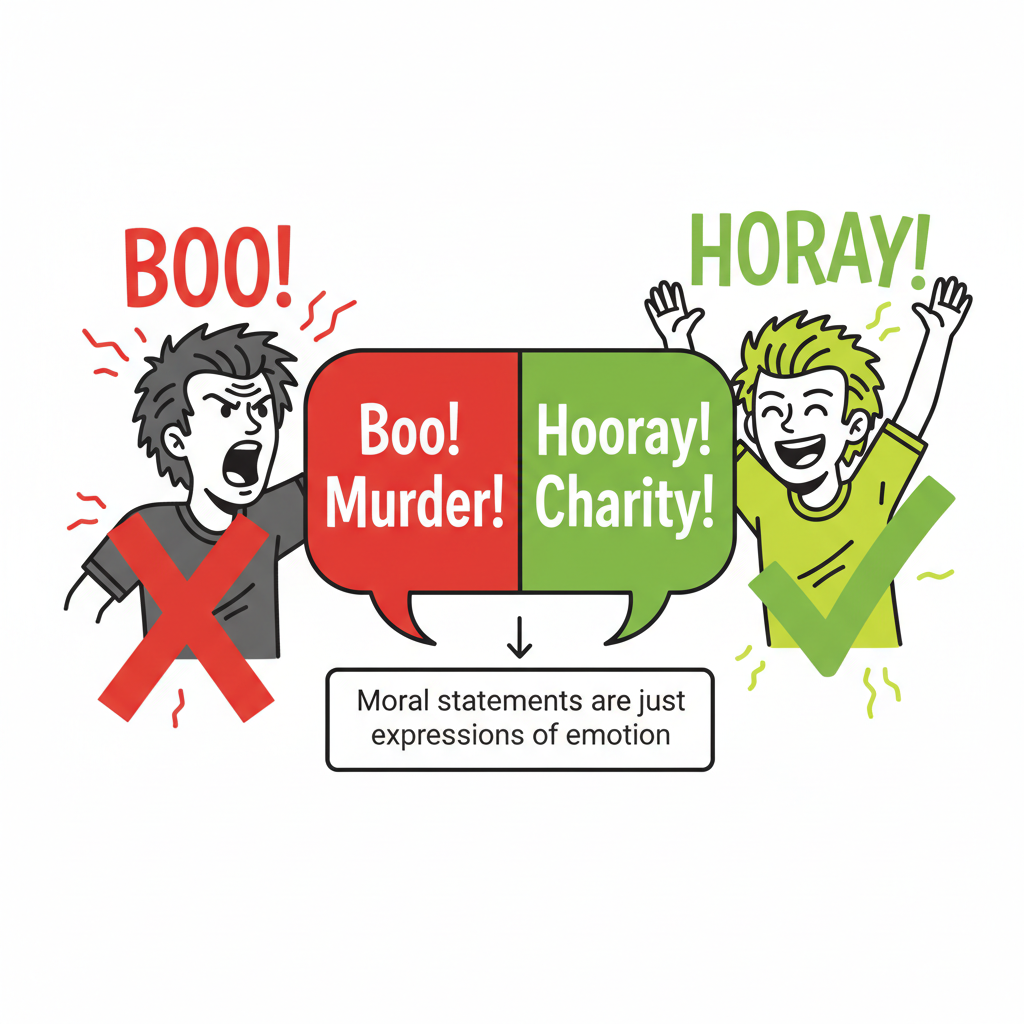
Introduction
The claim that moral statements are no more than expressions of emotion is the position of emotivism — the non-cognitivist meta-ethical theory most fully developed by A.J. Ayer in Language, Truth and Logic (1936) and refined by C.L. Stevenson. Ayer argues that moral statements are neither analytic (true by definition) nor synthetic (verifiable by experience), and therefore — on the verification principle — they carry no cognitive content at all. "Stealing is wrong" does not describe a fact about stealing; it expresses the speaker's emotional disapproval: it is equivalent to "Stealing — Boo!" The claim must be tested against the cognitivist alternatives — moral naturalism (moral statements describe natural facts) and moral intuitionism (Moore, Prichard) — as well as against Hare's prescriptivism, which accepts that moral statements are non-cognitive but argues they do more than express emotion: they also prescribe conduct. I will argue that the claim correctly identifies the non-cognitive, non-truth-apt character of moral statements but significantly understates their complexity — Stevenson's attitude theory and Hare's prescriptivism both show that moral language does more than express emotion, even if it does not describe objective facts.
Mark-scheme aim
PECREL 1 — Ayer's case for emotivism and the Boo/Hurrah theory vs the "more than emotion" challenge
Ayer's emotivist case — grounded in the verification principle and Hume's fork — provides a compelling argument that moral statements like "stealing is wrong" are not truth-apt, but the Boo/Hurrah formulation is too reductive and faces the decisive Frege-Geach and moral disagreement challenges.
Ayer applies his verification principle to ethics: a statement is meaningful only if it is either analytic (logically true) or synthetically verifiable by sense experience. Moral statements fail both tests — "stealing is wrong" is neither a definitional truth nor empirically testable — and are therefore cognitively meaningless. They are not statements at all but expressions of emotion: "in saying that a certain type of action is right or wrong, I am not making any factual statement… I am merely expressing certain moral sentiments." This produces the "Boo/Hurrah" theory: "stealing is wrong" means "Stealing — Boo!" while "generosity is good" means "Generosity — Hurrah!" Stevenson refines this by distinguishing emotive meaning (the emotional charge of moral language) from descriptive meaning, and arguing that moral utterances express and invite attitudes rather than simply vent feelings — giving moral language a social, persuasive function beyond pure expression.
However, the simple "expressions of emotion" account faces the Frege-Geach problem (Peter Geach, 1960s): in logical reasoning, moral statements appear in positions where they cannot be mere emotion-expressions. The argument "if stealing is wrong, then getting your little brother to steal is wrong; stealing is wrong; therefore getting your little brother to steal is wrong" uses moral claims as logical premises — but an emotional exclamation cannot function as a logical premise. If "stealing is wrong" were just "Stealing — Boo!" the argument would read "if Stealing — Boo!, then getting your little brother to steal — Boo! — Boo!" which is grammatically and logically incoherent. Furthermore, emotivism cannot adequately account for moral disagreement: if "stealing is wrong" expresses my emotion and "stealing is not wrong" expresses yours, we are not contradicting each other — we are simply reporting different feelings, like "I love coffee" and "I hate coffee." Yet moral disagreements are experienced as genuine disputes about truth, not merely the exchange of emotional reports.
Stevenson's revision addresses both problems partially: moral statements express and invite attitudes rather than simply venting emotion, which gives them a social and persuasive dimension that explains why moral disagreement feels like genuine dispute — we are trying to change each other's attitudes, not merely reporting our own. On the Frege-Geach problem, Stevenson can argue that moral language has both emotive and descriptive elements, and the logical embedding of moral claims exploits the descriptive element — though this concedes that moral statements are not merely emotional expressions.
Stevenson's revision is a genuine improvement but creates a serious internal tension: by acknowledging that moral statements have both emotive and descriptive elements, it implicitly concedes that they are not no more than expressions of emotion — which directly undermines the claim in the title. The Frege-Geach problem is a serious and widely acknowledged challenge to pure emotivism: it shows that moral statements function grammatically and logically as propositions, not merely as exclamations, which suggests they have more semantic content than pure emotional expression can supply. The claim in the title is therefore too strong — moral statements are at least also something else.
Ayer's basic insight — that moral statements are not straightforwardly truth-apt descriptions of objective facts — is sound, but the reductive conclusion that they are no more than emotional expressions fails the Frege-Geach test and cannot account for the genuine disputational character of moral disagreement.
Mark-scheme aim
PECREL 2 — Hare's prescriptivism, naturalism, and intuitionism: what moral statements actually do
Hare's prescriptivism provides a more adequate non-cognitivist account of what moral statements do, while the cognitivist alternatives of naturalism and intuitionism — though each facing serious problems — show that the emotivist reduction is too impoverished to capture the full function of moral language.
R.M. Hare argues in The Language of Morals (1952) that moral statements are not expressions of emotion but prescriptions: they are universalisable imperatives that guide and demand action. "Stealing is wrong" does not mean "Stealing — Boo!" but "Do not steal — and this applies universally to all relevantly similar cases." This accounts for both the action-guiding function of moral language (prescriptions motivate behaviour in a way that mere emotional expressions do not) and the universalisability that distinguishes genuine moral claims from arbitrary preferences (if I say stealing is wrong, I must be committed to its wrongness in all relevantly similar cases). Prescriptivism is still non-cognitive — moral statements are not truth-apt — but it shows that moral language does considerably more than express emotion. Naturalism offers a fully cognitivist alternative: moral statements describe natural facts about the world — for utilitarians, "stealing is wrong" means "stealing reduces aggregate welfare" — which is empirically assessable. Intuitionism (Moore, Prichard) argues that moral facts are non-natural but still real and knowable through rational intuition rather than observation.
However, both naturalism and intuitionism face serious challenges that partially rehabilitate the emotivist position. Moore's naturalistic fallacy undermines naturalism: any attempt to define "good" in terms of natural properties (pleasure, welfare, survival) commits the open question fallacy — "is this thing that maximises welfare really good?" is always a meaningful question, showing that "good" cannot simply mean "maximises welfare." Intuitionism, while avoiding the naturalistic fallacy, generates the problem of moral disagreement: if moral facts are self-evident to rational intuition, why do intelligent, thoughtful people disagree about them so systematically? Ayer's response to intuitionism is sharp: different people's "intuitions" are simply their emotions presenting themselves with a false air of objectivity.
Naturalists — particularly Philippa Foot's naturalism of flourishing — can respond to Moore's open question argument: it is not any natural property that defines "good" but specifically those properties that constitute human flourishing, which practical reason can recognise as genuinely good without circularity. Mackie's error theory offers a different response to the whole debate: moral statements are attempts to describe objective moral facts, but there are no such facts — so all moral statements are systematically false. This preserves the cognitive character of moral language while denying that moral statements successfully refer — a position between emotivism and naturalism.
Hare's prescriptivism shows definitively that the claim in the title is too reductive: even on a non-cognitivist account, moral statements universalise and prescribe in ways that pure emotional expression cannot. Foot's flourishing naturalism and Mackie's error theory show that the question of what moral statements do is more complex than either simple cognitivism or simple emotivism allows. The most defensible meta-ethical position on the OCR specification is that moral statements are neither purely cognitive descriptions of natural facts nor purely emotional expressions: they occupy a complex middle ground in which they guide action, universalise prescriptions, and express attitudes — all simultaneously.
The claim in the title is therefore not entirely wrong — it correctly captures the non-truth-apt, non-descriptive character of moral language — but "no more than expressions of emotion" understates what moral statements do, since Hare, Stevenson and even Mackie all show they do considerably more.
Mark-scheme aim
Conclusion (RJ)
The claim that statements such as "stealing is wrong" are no more than expressions of emotion is partially correct but significantly reductive. Ayer's emotivist case correctly identifies that moral statements are not straightforwardly truth-apt descriptions of natural or non-natural facts, and his application of the verification principle shows that cognitivist attempts to make moral statements empirically or analytically verifiable face serious difficulties. However, the "no more than emotion" formula is too impoverished: Stevenson's attitude theory, Hare's prescriptivism, and the Frege-Geach problem all show that moral statements also universalise, prescribe, invite attitude change, and function as logical premises in ways that pure emotional expression cannot. Moore's naturalistic fallacy undermines naturalism, but Foot's flourishing account and Mackie's error theory show that the meta-ethical question is not resolved by emotivism's simple formula. The most defensible conclusion is that moral statements are at least also prescriptions and universalisable guides to action — and that any meta-ethical theory that reduces them to nothing more than emotional exclamations has failed to account for the full complexity of how moral language actually functions.