On This Page
Globalisation and Business Ethics
"'Globalisation makes it impossible for businesses to act ethically.' Discuss."
Back to Paper 2 essays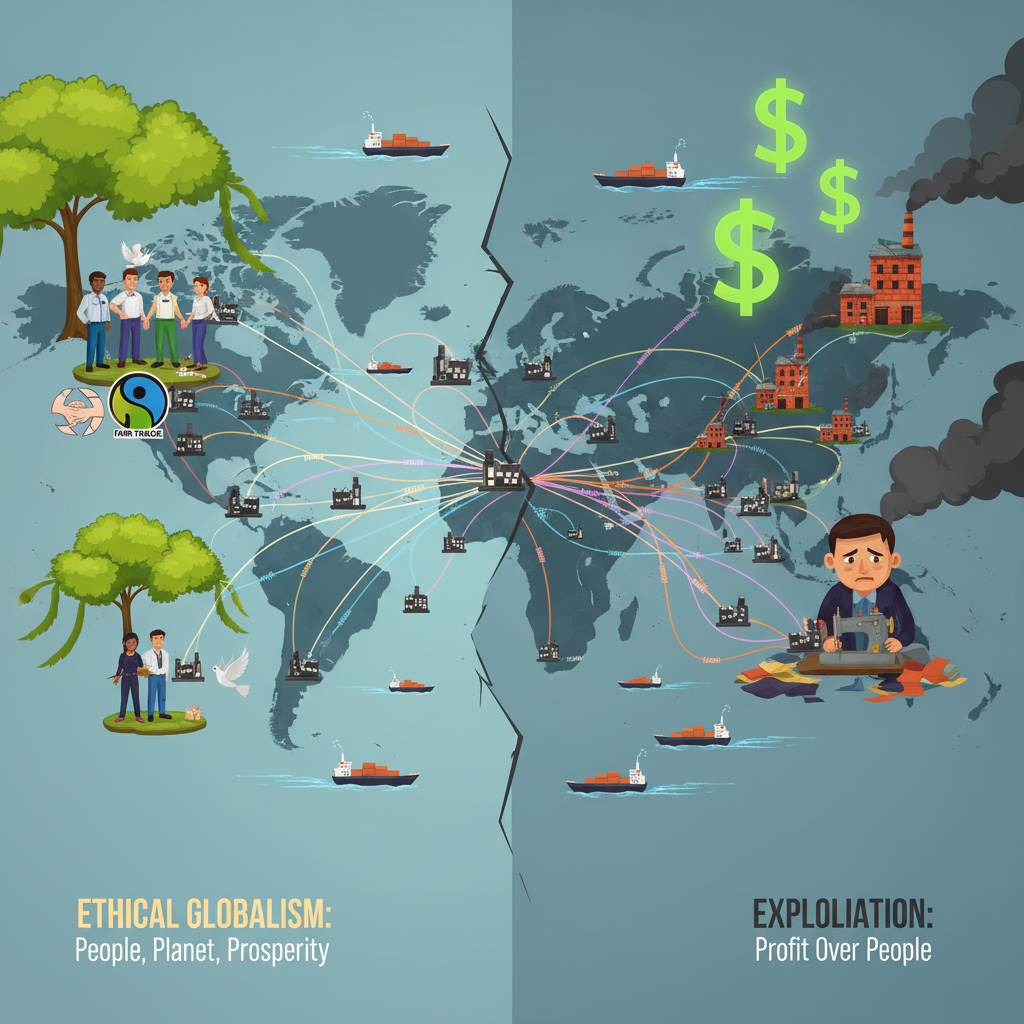
Introduction
Globalisation — the increasing economic, cultural and technological integration of nations, enabling corporations to operate across borders, source labour internationally, and supply goods to global markets — creates both intensified ethical pressures and new opportunities for ethical corporate behaviour. The claim that it makes ethical business impossible is a strong one: not merely that globalisation makes ethics more difficult, but that the structural pressures of global competition, regulatory arbitrage, and supply chain complexity fundamentally preclude ethical conduct. The key ethical issues globalisation raises include: sweatshop labour and exploitation of workers in developing countries; regulatory arbitrage (relocating to jurisdictions with weaker environmental and labour protections); neo-colonialism (the extraction of resources and labour from developing nations without adequate return); and the structural pressure of shareholder primacy in competitive global markets. I will argue that the claim is substantially overstated: globalisation does generate powerful structural pressures towards unethical conduct, but it simultaneously creates reputational incentives for ethical behaviour, enables the spread of ethical standards globally, and there are well-documented cases of corporations acting ethically in global contexts — suggesting impossibility is too strong a conclusion.
Mark-scheme aim
PECREL 1 — Structural pressures of globalisation and the Kantian/natural law case for impossibility
Globalisation creates genuine and severe structural pressures that push businesses towards unethical conduct — particularly the exploitation of workers in developing countries and regulatory arbitrage — and the Kantian analysis of these practices reveals systematic violations of human dignity that are difficult to avoid in a competitive global economy.
The structural logic of globalisation creates a race to the bottom: companies that source labour in low-wage, weakly regulated countries gain significant cost advantages over competitors who maintain higher ethical standards, which creates powerful market pressure to follow suit. The Bhopal disaster (1984), in which Union Carbide's chemical plant in India killed thousands due to safety standards that would have been legally impermissible in the US, illustrates how regulatory arbitrage — deliberately operating in jurisdictions with weaker protections — enables companies to profit from standards they could not legally maintain at home. Nike's sweatshop scandal in the 1990s demonstrated that global supply chains make ethical oversight almost impossible in practice: even when a corporation wants to act ethically, sub-contractors and sub-sub-contractors in complex global supply chains operate beyond meaningful corporate oversight. As Pope John XXIII identified, globalisation's economic structure risks replicating neo-colonialism: wealthy corporations extract resources and cheap labour from developing nations while returning insufficient benefit to those communities — a structural injustice that is embedded in the logic of cost-minimising global capitalism. From a Kantian perspective, these practices violate the humanity formula categorically: using workers in developing countries as means to profit — without regard for their welfare, safety or dignity — cannot be universalised without contradiction and treats persons merely as instruments.
However, while Kantian ethics reveals the moral inadequacy of exploitative globalisation, it does not establish that ethical business conduct is impossible — only that it is currently widespread that businesses fail to act ethically. The existence of a structural pressure is not the same as an insurmountable barrier: companies operating in global markets have demonstrated that ethical supply chain management, fair trade certification, and living wage commitments are viable, even if commercially demanding. The "good ethics is good business" thesis — supported by evidence that ethical companies attract more loyal customers, higher-calibre employees, and experience fewer costly scandals — suggests that the structural pressure is not universally in the direction of unethical conduct.
The strongest case for impossibility is Milton Friedman's shareholder primacy argument: a corporation's only responsibility is to maximise returns for shareholders, and any deviation from this — including voluntary ethical practices that cost money — is a misappropriation of shareholders' funds. On Friedman's account, companies that act ethically in global markets are either not surviving competitively (because ethical costs disadvantage them) or are using ethics as a public relations strategy rather than genuine moral commitment. Friedman famously cited McDonald's salads as an example: presented as a health commitment but actually worse nutritionally than burgers, illustrating that apparent ethical gestures are often window-dressing. If Friedman is right, genuine ethical conduct is not impossible but structurally irrational in competitive global markets — which may amount to practical impossibility for most firms.
Friedman's analysis is penetrating but overstated: it assumes that shareholder primacy is the only legitimate goal of corporations, which is a normative claim — not an empirical necessity — that is increasingly contested by stakeholder theory (Freeman) and by the long-term evidence that ethical companies tend to outperform less ethical ones over time. The Kantian framework shows why Friedman's maximising logic treats human beings as mere means — which is categorically wrong regardless of competitive pressure. The impossibility claim also ignores the growing body of evidence that globalisation, through reputational exposure and consumer activism, is actually generating stronger incentives for ethical conduct than existed before: Nike's supply chain reforms after its sweatshop scandal represent a real if imperfect ethical improvement driven by global transparency.
Globalisation creates serious and sometimes overwhelming structural pressures towards unethical conduct, but these pressures do not make ethical business impossible — they make it more demanding, more commercially costly in the short term, and harder to monitor, but not structurally impossible.
Mark-scheme aim
PECREL 2 — CSR, whistleblowing, and globalisation as an opportunity for ethical conduct
Globalisation simultaneously creates the conditions for greater corporate social responsibility, enables whistleblowing to expose unethical conduct globally, and incentivises ethical behaviour through reputational mechanisms that did not exist before — demonstrating that ethical business conduct is not impossible but increasingly expected and commercially rewarded.
Corporate Social Responsibility (CSR) — the idea that businesses have responsibilities to all stakeholders (employees, communities, environment), not merely shareholders — has expanded significantly as a corporate practice in the era of globalisation. While Friedman dismisses CSR as window-dressing, substantive CSR — living wages, environmental commitments, community investment — represents real ethical conduct that global companies do undertake. The good-ethics-is-good-business thesis provides the commercial rationale: in a globally transparent information environment, reputational damage from unethical conduct — sweatshops, environmental destruction, tax evasion — travels faster and further than ever before, making ethical conduct commercially rational in the long run. Whistleblowing has been amplified by globalisation and digital communication: the ability of employees, journalists and NGOs to expose corporate misconduct globally — as in the exposure of Foxconn's labour conditions in Apple's supply chain — creates a form of accountability that structurally incentivises ethical conduct. As the Seneca notes observe, "the pursuit of good ethics as the foundation of good business is something that the excesses of globalisation might be encouraging" — precisely because those excesses are now globally visible.
However, CSR is vulnerable to Friedman's window-dressing critique: many companies engage in greenwashing and ethical window-dressing — publishing sustainability reports and fair trade commitments while maintaining exploitative supply chains beyond public view. The complexity of global supply chains means that genuine ethical oversight — ensuring that every tier of suppliers meets ethical standards — is practically extremely difficult, and most large corporations cannot in good conscience vouch for the ethical conduct of all their suppliers. Furthermore, whistleblowing in global corporations carries enormous personal risks for the whistleblower — legal exposure, career destruction, and in some jurisdictions physical danger — which means relying on it as an ethical accountability mechanism is structurally inadequate.
These are genuine practical difficulties, but they are arguments for better regulation, more effective supply chain auditing, and stronger whistleblower protections — not for the impossibility of ethical conduct. The utilitarian observation is apt: global consumer pressure, investor ESG (Environmental, Social and Governance) criteria, and international regulatory frameworks such as the UN Global Compact and the Modern Slavery Act create structural incentives for ethical conduct that are gradually improving. The claim that globalisation makes ethical business impossible confuses a difficult problem with an insoluble one.
The optimistic response is broadly persuasive: the trajectory of corporate ethics in the global economy is towards greater transparency, accountability and ethical expectation — not towards the impossibility of ethical conduct. Globalisation makes ethical conduct more complex and demanding, particularly in supply chain management, but also provides the reputational incentives and information infrastructure that make ethical exposure and reform possible. The title's claim is therefore not just wrong but arguably the reverse of the truth: globalisation is, in the long run, making it harder for businesses to act unethically without consequence, even if it is also making genuinely ethical conduct more structurally demanding.
Globalisation therefore makes ethical business more complex and demanding rather than impossible — and the same global transparency that enables exploitation also enables the accountability mechanisms that drive ethical reform.
Mark-scheme aim
Conclusion (RJ)
The claim that globalisation makes it impossible for businesses to act ethically is substantially overstated. Globalisation does create severe structural pressures towards exploitation — regulatory arbitrage, supply chain opacity, shareholder primacy, and the competitive race to the bottom — and the Kantian analysis confirms that many standard practices of global business involve systematic violations of human dignity. However, the same forces that create these pressures also generate the reputational accountability, consumer activism, whistleblowing exposure, and CSR incentives that make ethical conduct commercially rational and increasingly expected in the long run. Nike's post-scandal supply chain reforms, the growth of ESG investing, and the international CSR framework all demonstrate that ethical conduct in global business is difficult and imperfect but not impossible. The most defensible verdict is that globalisation makes ethical business conduct significantly harder, more costly and more complex — but also, through global transparency, more necessary and more commercially rewarded than it has ever been.