On This Page
Moral Facts and Observation
"How convincing is the view that moral statements refer to facts that can be observed?"
Back to Paper 2 essays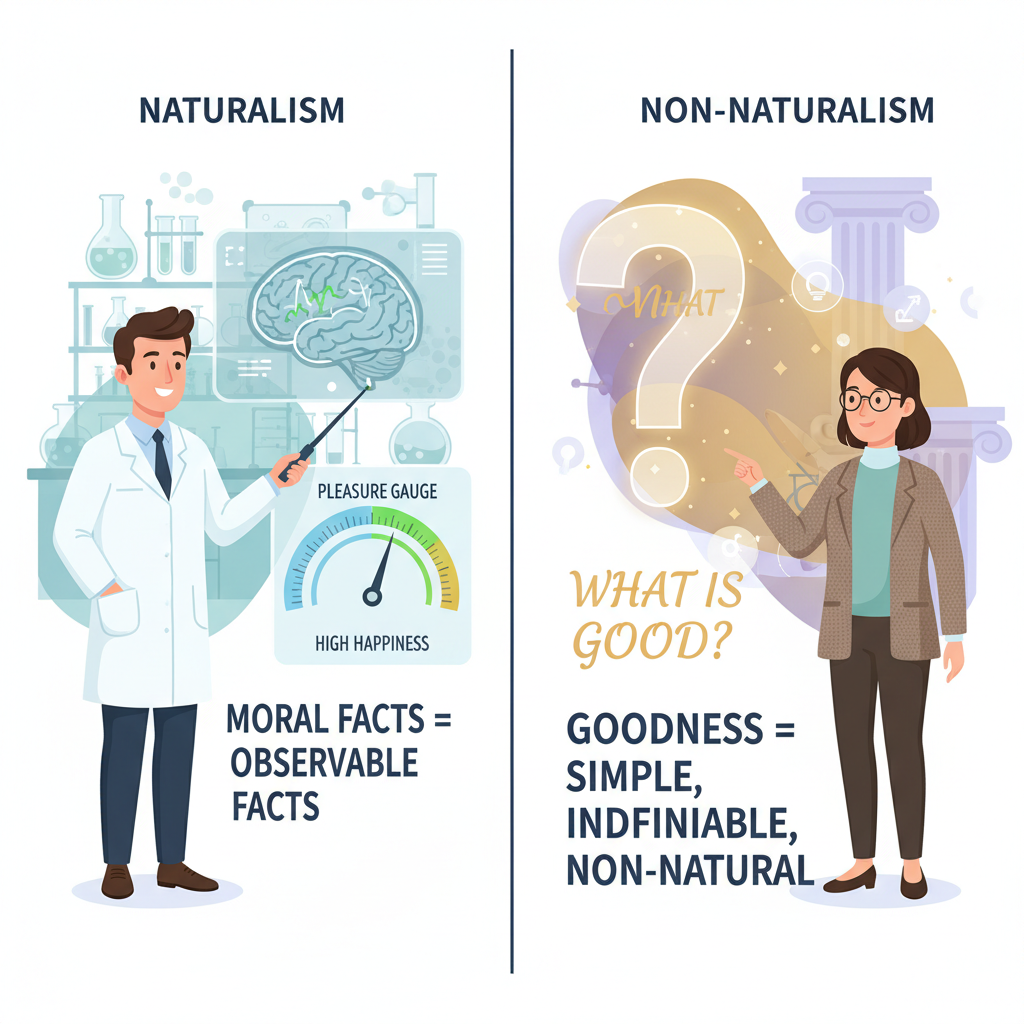
Introduction
The view that moral statements refer to observable facts is the position of moral naturalism — the cognitivist, realist meta-ethical theory that moral properties are natural properties discoverable through empirical observation of the world. For a naturalist, "stealing is wrong" is comparable to "the sky is blue" — a fact about the world that can be observed, assessed and verified. The main naturalist positions include utilitarian naturalism (Mill: "good" means "that which produces the greatest happiness," which is empirically measurable) and Foot's naturalism of human flourishing (moral goodness consists in those properties that constitute human flourishing, observable through reflection on human nature). The claim must be tested against: Moore's naturalistic fallacy and open question argument, which purports to show that no natural property can define "good"; Hume's is-ought gap, which challenges the inference from natural facts to moral obligations; and the non-cognitivist alternatives of emotivism and prescriptivism, which deny that moral statements are truth-apt at all. I will argue that the view is partially convincing — particularly in Foot's flourishing version — but that Moore's open question argument and Hume's is-ought gap together present challenges that moral naturalism has not fully resolved, and that moral intuitionism provides a stronger cognitivist alternative.
Mark-scheme aim
PECREL 1 — Naturalism's appeal and Moore's open question argument
Moral naturalism has genuine appeal as an account of moral facts — particularly because it grounds ethics in the observable reality of human welfare and flourishing — but Moore's open question argument presents a powerful challenge that the most common forms of naturalism have not fully escaped.
The appeal of moral naturalism is that it makes ethics continuous with science: moral truths are grounded in facts about the natural world that can be observed, measured and verified empirically, rather than being mysterious non-natural properties accessible only to intuition or faith. Utilitarian naturalism is the most familiar form: Mill identifies "good" with pleasure and the absence of pain, which are experiential states that can in principle be measured and compared. Foot's naturalism of flourishing is more sophisticated: she argues that moral goodness consists in those properties that constitute human flourishing — courage, honesty, practical wisdom — which are observable through reflection on what enables human beings to live and function well as the kind of creatures they are. As Thinka notes, "for a Naturalist, saying 'stealing is wrong' is just like saying 'the sky is blue' — you can look at the evidence and prove it."
G.E. Moore, in Principia Ethica (1903), argues that all forms of naturalism commit the naturalistic fallacy: any attempt to define "good" in terms of natural properties (pleasure, welfare, flourishing) generates the open question argument. For any natural property N, it is always a meaningful, open question to ask "is this thing that has N really good?" — if "good" simply meant N, this question would be trivially closed. "Does maximising pleasure produce what is really good?" is a meaningful question — not a tautology — which shows that "good" cannot simply mean "maximises pleasure." Moore argues that "good" is a simple, unanalysable, non-natural property known by intuition, not by observation — which directly contradicts the naturalist claim that moral facts are observable.
Naturalists have several responses to Moore. First, the open question argument itself may commit the intensional fallacy: just because "good" and "maximises welfare" are not synonymous in meaning does not show they are not co-referential properties in the world — water and H₂O are not synonymous in meaning but refer to the same natural substance. Second, Foot's flourishing naturalism avoids the cruder versions of naturalistic definition: she does not define "good" as "pleasure" but argues that moral virtues are the human analogues of natural goods observable in any species — a wolf with good legs and teeth is flourishing; a human with courage and honesty is flourishing — and this is observable without definitional circularity.
The water/H₂O response is a genuine philosophical advance: it shows that the open question argument does not straightforwardly prove that moral properties cannot be natural properties, only that moral terms are not analytically reducible to natural terms. Foot's flourishing account is the most defensible form of naturalism and largely escapes the crude naturalistic fallacy charge. However, as Moore's intuitionists would respond, the question "does human flourishing in Foot's sense produce what is really morally good?" remains open — a warrior culture might achieve great biological flourishing through practices most of us judge morally repugnant, showing that flourishing and moral goodness can come apart. Moore's challenge therefore retains significant force even against Foot's more sophisticated naturalism.
The naturalist case is most convincing in Foot's flourishing version, but Moore's open question argument shows that even the most sophisticated naturalism cannot straightforwardly establish that moral facts are observable natural facts — since the moral significance of any natural property remains evaluatively open.
Mark-scheme aim
PECREL 2 — Hume's is-ought gap, intuitionism as the stronger cognitivist alternative, and the emotivist challenge
Hume's is-ought gap presents a second fundamental challenge to the view that moral facts are observable, and Moore's intuitionism — while rejecting naturalism — preserves moral cognitivism by arguing that moral facts are real but not empirically observable, providing a stronger alternative to naturalism than emotivism.
Hume argues in the Treatise of Human Nature that no moral conclusion can be logically derived from purely factual premises: from the observable fact that "stealing causes harm" we cannot validly infer that "stealing ought not to be done" without an additional, non-factual evaluative premise. This is not a challenge to naturalism alone but to any theory that grounds moral obligations in observable facts: even if we can observe that stealing causes harm, the normative claim that it is therefore wrong requires a value judgement that is not itself derivable from observation. Moore's intuitionism responds by accepting that moral facts are not natural facts observable through the senses, but insisting they are nonetheless real, non-natural properties known through rational intuition. "Good" is a simple, non-natural property analogous to the property "yellow" — indefinable, directly apprehended, and not reducible to any natural description. On this account, moral cognitivism is preserved — moral statements can be true or false — but moral facts are not empirically observable.
Intuitionism faces its own serious challenge: the problem of moral disagreement. If moral facts are self-evident to rational intuition, why do rational, thoughtful people disagree about them so persistently and irresolvably? Ayer's emotivist response is pointed: "intuitions" are simply emotions presenting themselves with a false air of objectivity — when people disagree about moral intuitions, they are disagreeing about feelings, not tracking mind-independent facts. Mackie's error theory reinforces this from a different direction: moral statements are intended as objective fact-stating claims (cognitivism), but there are no moral facts — so moral statements are all systematically false. This preserves the cognitive character of moral language while denying that moral facts are observable — or indeed, exist at all.
The intuitionist can respond that moral disagreement does not disprove the existence of moral facts any more than disagreement about empirical facts disproves the existence of the physical world: people disagree about historical facts, mathematical proofs, and scientific findings without this showing that no objective facts exist in these domains. Moral disagreement may reflect limitations of access — bias, incomplete information, self-interest — rather than the absence of moral facts. On Mackie, the intuitionist argues that the inference from "moral facts are strange if they exist" to "moral facts do not exist" is not valid — the apparent queerness of moral facts reflects philosophical unfamiliarity, not non-existence.
The intuitionist response to moral disagreement is reasonable but not fully convincing: empirical disagreements are typically resolvable in principle through better evidence and investigation, while moral disagreements show no comparable convergence — which suggests the analogy with empirical fact is imperfect. Mackie's error theory is an intellectually honest position that takes seriously both the cognitivist grammar of moral language and the difficulty of moral ontology — but it ultimately concedes Ayer's point that there are no moral facts to observe, even while rejecting the emotivist account of moral language's function. The view that moral statements refer to observable facts is therefore convincing only within naturalism — and even there, Moore's open question and Hume's is-ought gap impose significant limitations.
The most defensible cognitivist position is therefore not naturalism but intuitionism: moral facts exist and are knowable, but not through empirical observation — which means the claim that moral statements refer to observable facts is ultimately not convincing as a complete account of moral cognitivism.
Mark-scheme aim
Conclusion (RJ)
The view that moral statements refer to facts that can be observed is partially convincing in its best form but ultimately inadequate as a complete account of moral cognitivism. Foot's naturalism of flourishing — grounding moral goodness in observable properties of human nature — is the most defensible version and largely escapes the crude naturalistic fallacy charge. However, Moore's open question argument shows that the moral significance of any natural property remains evaluatively open, Hume's is-ought gap shows that normative conclusions cannot be straightforwardly derived from observable facts, and Mackie's error theory demonstrates that even the cognitivist grammar of moral statements does not require the existence of observable moral facts. The strongest cognitivist position is Moore's intuitionism — moral facts are real and knowable, but not through empirical observation — which shows that moral cognitivism does not stand or fall with the observability claim. The most defensible verdict is that moral statements may refer to real moral facts, but those facts — if they exist — are not straightforwardly observable in the way naturalism requires, and the claim's confidence in empirical observability significantly underestimates the philosophical difficulty of grounding moral truths in the natural world.