On This Page
Telos in Natural Law Ethics
"Discuss critically the use of the concept of 'telos' in natural law ethics."
Back to Paper 2 essays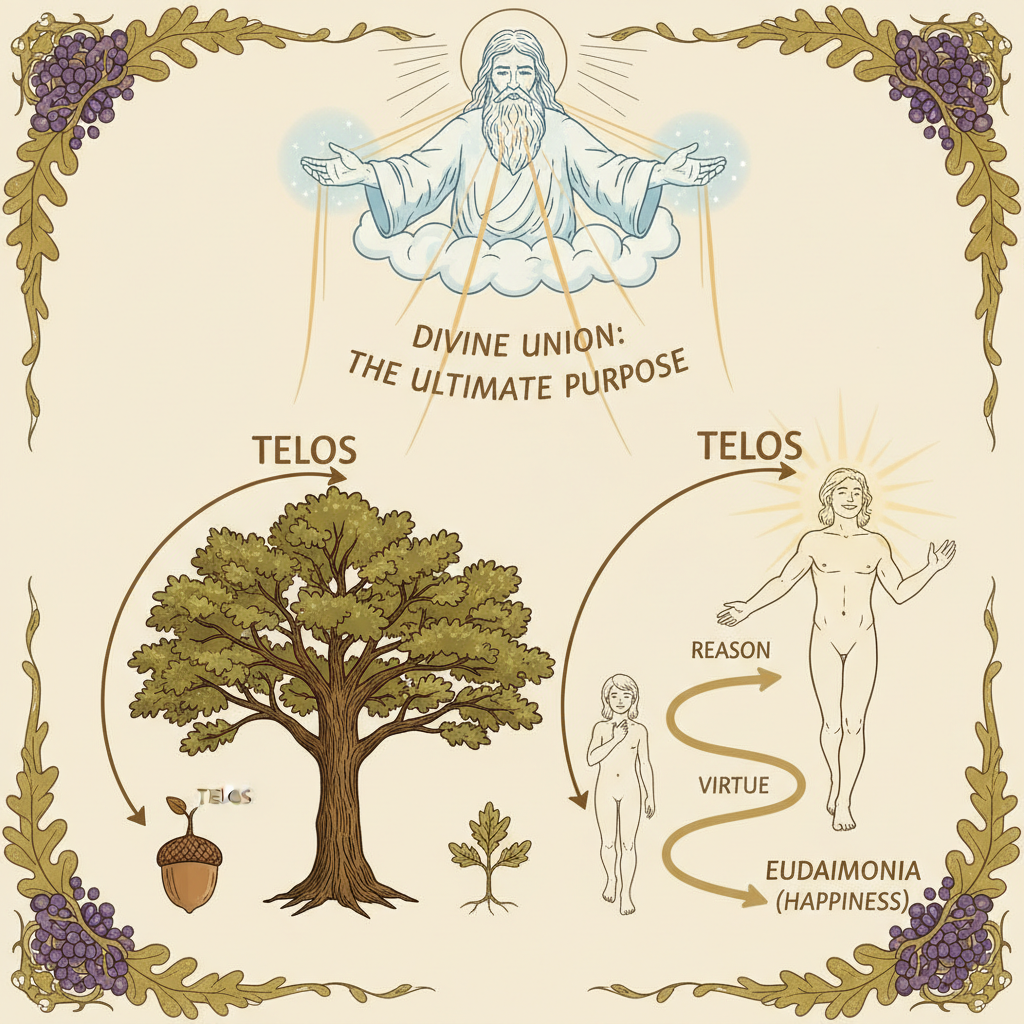
Introduction
Telos — from the Greek for "end" or "purpose" — is the foundational concept of natural law ethics. Aristotle first argued that everything in the natural world has an inherent purpose or goal towards which it naturally tends, and Aquinas integrated this into his Christian ethics: God designs all things with a telos, and for human beings that telos is to glorify God by living in accordance with the rational, moral nature God has given us. The entire structure of natural law — synderesis, the primary precepts, secondary precepts and the four tiers of law — depends on telos being a real, discoverable feature of human nature. To discuss it critically requires assessing whether telos is philosophically coherent, whether it can be established without assuming the existence of God, and whether the specific telos Aquinas identifies for human beings is plausible in light of modern science and moral philosophy. I will argue that telos is a powerful and internally coherent foundation for natural law ethics — and that Finnis' secular restatement shows it can survive without a theological premise — but that it faces decisive challenges from Darwinian evolution, the is-ought problem, and the difficulty of applying a single telos to the diversity of human nature.
Mark-scheme aim
PECREL 1 — The internal coherence of telos and Finnis' secular rescue vs Hume's is-ought problem
Telos is internally coherent as the foundation for natural law ethics — it provides a rational basis for moving from facts about human nature to moral norms — but Hume's is-ought objection raises a fundamental challenge that Aquinas and Finnis must answer.
Aquinas argues that God designs human beings with a rational nature oriented towards specific goods: preservation of life, reproduction, education of children, living in an ordered society, and worship of God. These five primary precepts are not arbitrary divine commands but reflect the natural orientations built into human nature by a rational God — they are discoverable by reason through observation of what human beings naturally tend towards. The concept of synderesis — the innate rational capacity to recognise the first principle of natural law ("do good and avoid evil") — depends entirely on telos: we know what is good because we know what human nature is directed towards. Finnis, in Natural Law and Natural Rights (1980), offers a secular restatement: by observing that all humans across all cultures pursue certain basic goods (life, knowledge, friendship, practical reasonableness), we can identify a telos for human flourishing without presupposing God's existence. This makes telos philosophically adaptable beyond its theological origins.
However, David Hume's is-ought problem poses a fundamental challenge: from purely descriptive facts about what humans naturally do or naturally tend towards, we cannot validly derive normative conclusions about what they ought to do. Even if we observe that humans naturally tend towards reproduction, it does not follow that reproduction is morally good or obligatory — this would commit the naturalistic fallacy. G.E. Moore sharpens this: any attempt to define "good" in terms of natural properties (including telos) commits the naturalistic fallacy, since "good" is a sui generis, non-natural property that cannot be equated with any natural feature of the world. If this is correct, the entire edifice of natural law — which moves from the telos of human nature to binding moral precepts — is built on a logical error.
Aquinas responds that the is-ought gap is bridged by the fact that God creates both natural and moral order simultaneously: the telos built into human nature is not merely a descriptive fact but a normative one, since it reflects God's rational design for what humans should be. For Finnis, the bridge is practical reason itself: the basic goods identified through telos are not simply observed natural tendencies but are recognised by practical reason as intrinsically valuable, which is itself a normative act. Neither account simply reads moral norms off natural facts — both invoke a further rational or theological premise to justify the move from is to ought.
Aquinas' response works within a theistic framework: if God exists and designed human nature with a telos, then the is-ought gap is bridged by the identity of natural and divine order. But this makes telos entirely dependent on the existence of God — if God does not exist, or if God's design is inaccessible to reason, the foundation collapses. Finnis' secular account is more philosophically independent but faces the objection that his identification of "basic goods" is itself culturally loaded — different cultures recognise different goods, and there is no neutral basis for privileging his list. Hume's challenge is not fully defeated by either account, but both show that telos is not simply a naive naturalistic fallacy — it involves a more sophisticated move that deserves serious engagement.
So the is-ought problem reveals that telos cannot stand alone as a foundation for natural law without either a theological premise (Aquinas) or a substantive account of practical reason (Finnis) — but with either of these, it remains a coherent if contested foundation.
Mark-scheme aim
PECREL 2 — Darwin, the problem of diversity, and the doctrine of double effect as a partial mitigation
Telos faces its most serious empirical challenge from Darwinian evolution, which offers a complete account of the apparent purposiveness of biological nature without invoking design — and the further problem that human nature is too diverse for a single, fixed telos to be plausibly assigned to it.
Aquinas' telos assumes that human nature has a fixed, God-given purpose discoverable by reason: the primary precept of reproduction, for instance, reflects the natural orientation of human sexuality towards procreation. Darwin's theory of natural selection undermines this by explaining apparent biological purpose entirely in terms of random mutation and differential survival: the complex, goal-directed appearance of natural organisms is a product of undirected processes, not divine design. As alevelphilosophyandreligion.com notes, "there's no scientific evidence for purpose/telos — science can explain everything in the universe… without needing the concept of 'purpose/telos'." If Darwin is right, there is no reason to believe that the natural orientation of human sexuality towards reproduction reflects any deeper telos — it is simply an evolutionary adaptation, carrying no moral weight. Furthermore, human nature is remarkably diverse: different cultures, individuals and historical periods display radically different "natural" tendencies, making it difficult to identify a single universal telos without arbitrarily privileging some tendencies over others.
A defender of natural law can respond that Darwinian evolution and telos are not mutually exclusive: God could use evolutionary processes as the mechanism by which he creates beings with a telos, just as a watchmaker might use automated machinery to produce watches that are still purposefully designed. This is essentially the theistic evolution position, which is compatible with both Darwinian biology and Aquinas' teleological ethics. On diversity, Aquinas distinguishes between the primary precepts (which are universal and fixed, applying to all humans at all times) and the secondary precepts (which apply primary precepts to specific situations and can vary with circumstances), giving natural law some built-in flexibility. The doctrine of double effect extends this flexibility further, allowing that an action with a harmful effect may be permissible if the harm is not intended and is proportionate to the good achieved.
The theistic evolution response is reasonable but circular for apologetic purposes: it preserves telos by presupposing the very theism it is supposed to help establish. On diversity, the primary/secondary precept distinction does provide some flexibility, but it is frequently insufficient: Aquinas' secondary precept that contraception is wrong (because it violates the primary precept of reproduction) remains absolute and applies universally, yet it is widely regarded as failing to respect the diversity of human circumstances and relationships. As the OCR mark scheme notes, critics argue that natural law's application of telos generates "too rigid" conclusions that do not adequately reflect the complexity of actual human lives.
The Darwinian challenge is the most powerful objection to telos: it does not prove telos is false, but it removes the scientific support that Aquinas assumed — the apparent purposiveness of nature — and replaces it with a naturalistic explanation that requires no designer. For those who do not already accept theism, there is therefore no independent reason to believe in a divinely-ordained telos, and Finnis' secular alternative, while valuable, depends on a contestable account of basic goods. The concept of telos is therefore most convincing within a framework of prior theistic commitment, and less persuasive as a public, universally accessible standard for ethics — which is precisely the role natural law claims to play.
Telos is thus critically vulnerable to the Darwinian challenge and the problem of diversity, and while the doctrine of double effect and theistic evolution provide partial responses, they do not restore the concept's claim to be a scientifically and philosophically neutral foundation for universal ethics.
Mark-scheme aim
Conclusion (RJ)
The concept of telos is powerful as the internal foundation of natural law ethics but faces serious external challenges that limit its persuasive range. Within a theistic framework, telos provides a coherent rational basis for moving from human nature to moral norms, and Finnis' secular restatement shows it can survive without explicit theological premises. However, Darwin's theory of natural selection removes the scientific support for designed purposiveness that Aquinas assumed; Hume's is-ought problem shows that telos cannot alone bridge facts about nature and moral obligations; and the diversity of human nature resists the single, fixed telos Aquinas assigns. The doctrine of double effect and the primary/secondary precept distinction provide some flexibility, but not enough to overcome the rigidity that a single divine telos generates when applied universally. The most defensible conclusion is that telos is a theologically compelling but philosophically exposed foundation — valuable within religious ethics, contested as a public standard for moral reasoning.