On This Page
Utilitarianism and Homosexuality
"How far might utilitarianism provide useful guidelines in discussions about the ethics of homosexuality?"
Back to Paper 2 essays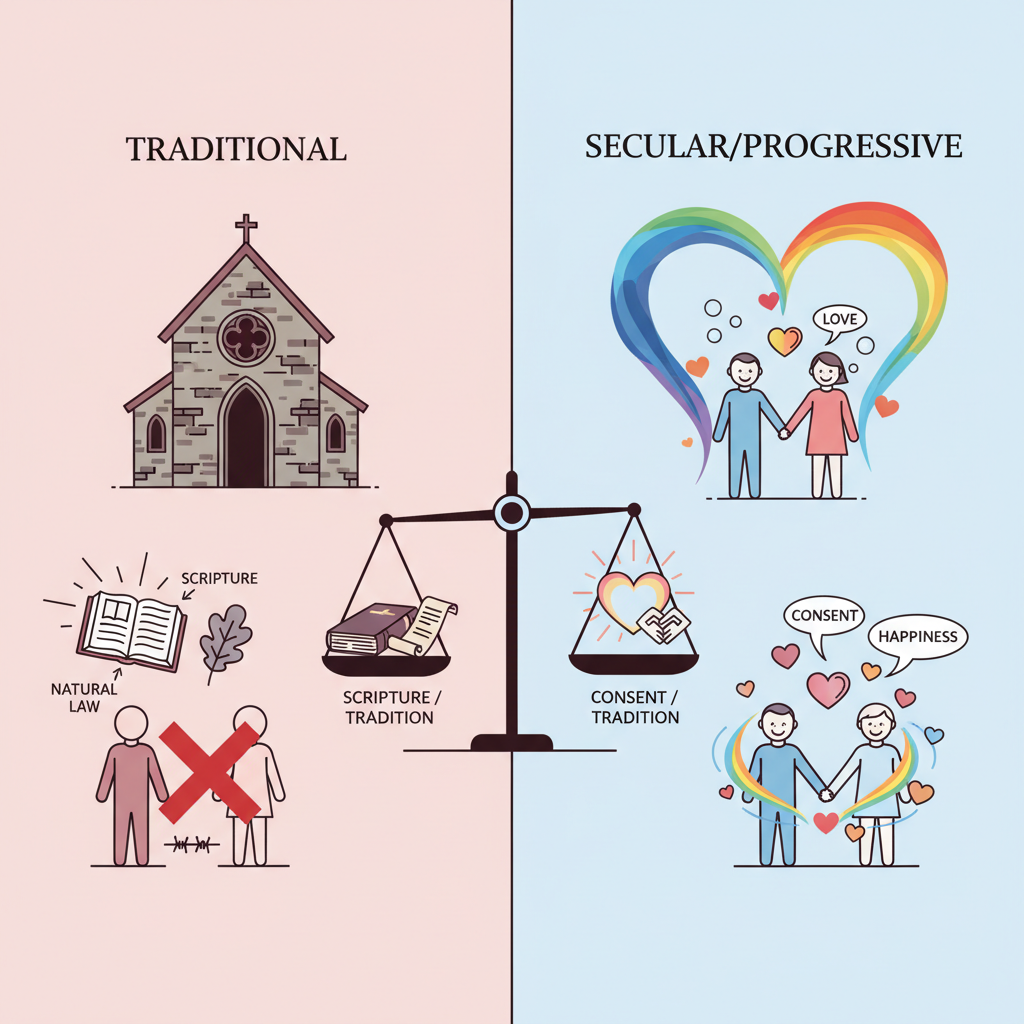
Introduction
The ethics of homosexuality is one of the most contested areas of contemporary sexual ethics, involving disputes between secular liberal frameworks (which typically affirm the moral permissibility of same-sex relationships) and traditional religious frameworks (which typically oppose them on natural law or scriptural grounds). Utilitarianism approaches the question consequentially: homosexual acts and relationships are morally evaluated by whether they produce the greatest happiness and minimise harm, without reference to the intrinsic nature of the acts or their conformity to any telos. Bentham — notably progressive for his era — applied the felicific calculus to homosexuality and concluded that same-sex activity between consenting adults produces pleasure without harming others, and therefore cannot be condemned on utilitarian grounds. Mill's harm principle — "the only justification for curbing individual freedom is to prevent harm to others" — provides a further utilitarian basis for the same conclusion. The question asks how far this provides useful guidelines — which requires assessing both the genuine strengths of utilitarian guidance on homosexuality and its limitations as a complete ethical framework for this question. I will argue that utilitarianism provides genuinely and significantly useful guidelines — particularly through the harm principle and the impartial welfare calculus — but that its consequentialist structure cannot alone address questions of human dignity, identity and rights that are central to the ethics of homosexuality.
Mark-scheme aim
PECREL 1 — The harm principle, impartial welfare, and Bentham's historical contribution
Utilitarianism provides its most significant and genuinely useful guidelines on homosexuality through Bentham's pioneering impartial welfare calculus and Mill's harm principle — together establishing a clear, accessible, and historically progressive basis for the moral permissibility of same-sex relationships.
Bentham applied the felicific calculus to homosexuality at a time when it was criminalised and subject to the death penalty in England — and concluded that same-sex activity between consenting adults produces pleasure for the participants without causing pain or harm to others. The calculus's criterion of extent (how many people are affected) and purity (whether the pleasure is followed by pain) both support permissibility: a committed homosexual relationship produces ongoing pleasure for two people without producing harm to any third party. Mill's harm principle provides the clearest utilitarian guideline: the state has no legitimate grounds for restricting any sexual behaviour between consenting adults that does not harm others, and homosexuality — as a private, consensual practice — falls entirely outside the legitimate scope of legal prohibition or moral condemnation. As PEPED observes, "if the new PREP drug increases responsible choice… there is nothing morally wrong with that as long as no one is harmed" — the pragmatic, utilitarian view grounds sexual freedom in the absence of harm. This is historically significant: utilitarian reasoning was the primary ethical framework used to argue for the decriminalisation of homosexuality in the UK (the Wolfenden Report 1957, enacted in 1967) — demonstrating that utilitarianism provides practically effective as well as theoretically defensible guidelines.
However, the rule utilitarian dimension of the question is more complicated: while act utilitarianism clearly permits homosexual acts between consenting adults with no third-party harm, rule utilitarianism requires assessing whether a general rule permitting or prohibiting homosexuality produces better aggregate outcomes over time. Rule utilitarians in earlier eras — operating in societies where homosexuality was widely stigmatised — might have concluded that a rule permitting homosexuality would produce net disutility through social disapproval, family breakdown, and loss of productivity, even if individual homosexual acts were harmless. This illustrates a serious limitation of purely utilitarian reasoning on homosexuality: it is sensitive to prevailing social attitudes in a way that makes its guidelines contingent on cultural context rather than morally principled.
Mill's own response to this problem is through the harm principle as a constraint on utility maximisation: even if permitting homosexuality produced net disutility in a disapproving society, the disutility is caused by others' unjustified prejudice, not by the homosexual activity itself — and a society's prejudicial disapproval cannot create a legitimate utilitarian case for restriction. The harm must be real and directly caused by the act, not merely the product of others' irrational responses to it. Singer's preference utilitarianism reinforces this: rational agents have strong preferences for autonomy, self-determination and the freedom to form loving relationships — these preferences must be included in the utility calculus, and their frustration through discrimination causes real and significant suffering that outweighs the preferences of those who disapprove.
Mill's prejudice-exclusion move is philosophically important and significantly strengthens utilitarian guidance: it prevents the harm principle from being contaminated by culturally contingent prejudice, making the guidelines more principled and less culturally relative. Singer's preference account similarly strengthens the case by giving weight to the deep preferences of gay and lesbian people for authentic self-expression and loving relationship. Together, these developments show that utilitarian guidelines on homosexuality are not merely an expression of liberal cultural consensus but rest on principled moral reasoning that transcends any particular cultural moment. However, the guidelines remain fundamentally consequentialist — they permit homosexuality because and insofar as it produces good outcomes — which generates a residual concern that is addressed in the second PECREL.
Utilitarianism provides genuinely useful and historically important guidelines on homosexuality through the harm principle and impartial welfare calculus — guidelines that are made more principled by Mill's prejudice-exclusion move and Singer's preference account — but the consequentialist foundation raises questions about whether permissibility grounded in outcomes alone is adequate to the full moral claim that gay and lesbian people make.
Mark-scheme aim
PECREL 2 — The limits of consequentialism: dignity, identity, and the comparison with Kantian ethics
Utilitarianism's consequentialist structure means its guidelines on homosexuality are inherently conditional — dependent on outcomes rather than intrinsically principled — which generates a significant limitation compared to Kantian ethics' unconditional protection of human dignity and identity.
The central limitation of utilitarian guidelines on homosexuality is that they permit same-sex relationships because and insofar as they produce good consequences — not because gay and lesbian people have an intrinsic right to form loving relationships as an expression of who they are. This is a morally significant difference: if a scenario could be constructed in which permitting homosexuality produced net disutility — in a society so deeply and pervasively homophobic that the resulting social harm outweighed the benefit to gay people — utilitarian guidelines would, in principle, support restriction. This is not a merely theoretical concern: utilitarian arguments were used in defence of anti-sodomy laws in 20th-century America by those who argued that social disapproval constituted a genuine harm outweighing the benefit to gay individuals. The guidelines are therefore only as robust as the contingent social context in which they are applied.
Kantian ethics provides a stronger and more principled foundation for the moral permissibility of homosexuality: the humanity formula — treat persons always as ends, never merely as means — generates an unconditional prohibition on the use of people as instruments of others' preferences, and the universalisability test applied to "allow all consenting adults to form loving relationships" generates no contradiction. The Kantian framework does not say "homosexuality is permissible because it produces good outcomes" but "homosexuality is permissible because gay and lesbian people are rational agents with intrinsic dignity whose capacity for autonomous loving relationship must be respected unconditionally." This grounds the permissibility of homosexuality in a way that is not vulnerable to adverse social utility calculations — it is a matter of unconditional right, not contingent benefit.
A utilitarian can respond that Kantian ethics has its own limitations on sexual ethics: the categorical imperative's universalisability test is not obviously supportive of homosexuality in all applications — Kant himself, in the Lectures on Ethics, regarded homosexual acts as a violation of human dignity because they reduce persons to instruments of pleasure. This shows that Kantian ethics is not uniquely reliable on homosexuality, and that the utilitarian harm principle — which is both simpler and more culturally accessible — provides more practically useful guidelines for the majority of moral agents. Furthermore, the utilitarian framework's strength in the Wolfenden process demonstrates that consequentialist guidelines are not merely theoretically available but practically effective in driving real social change.
The utilitarian response to the Kantian comparison is fair: Kant's own application was not consistently supportive of homosexuality, and the harm principle has proven more practically useful than abstract universalisability arguments in real political and legal contexts. However, the limitation identified — that utilitarian permissibility is contingent on outcomes rather than principled in rights — is not overcome by pointing to practical effectiveness: a framework whose guidelines are contingent on social context provides less reliable protection for gay and lesbian people in hostile social environments than one grounded in unconditional human dignity. The most defensible verdict is that utilitarianism provides very useful but not fully adequate guidelines — it establishes a clear and historically effective case for permissibility, but the strongest moral case for the equality and dignity of gay and lesbian people requires supplementation by rights-based reasoning that utilitarianism alone cannot supply.
Utilitarianism provides significantly useful guidelines on the ethics of homosexuality — through the harm principle, the impartial welfare calculus, and historically demonstrated practical effectiveness — but falls short of the full moral case precisely because its guidelines are consequentially conditioned rather than grounded in unconditional human dignity.
Mark-scheme aim
Conclusion (RJ)
Utilitarianism provides significantly but not completely useful guidelines in discussions about the ethics of homosexuality. Through Bentham's impartial welfare calculus, Mill's harm principle, Singer's preference utilitarianism, and the historically demonstrated effectiveness of utilitarian reasoning in the Wolfenden process, it establishes a clear, accessible and principled basis for the moral permissibility of same-sex relationships. Mill's prejudice-exclusion move prevents social disapproval from contaminating the harm calculation, making the guidelines more principled than a simple cultural-consensus reading of utilitarianism would suggest. However, the consequentialist foundation means that utilitarian guidelines are inherently contingent on outcomes — permitting homosexuality because and insofar as it produces good results — which provides weaker protection than an unconditional rights-based framework in hostile social environments. The most defensible verdict is that utilitarianism is the most practically useful available guideline for the ethics of homosexuality in secular democratic contexts — its accessibility, flexibility and historical track record are genuine strengths — but requires supplementation by Kantian or rights-based reasoning to ground the full moral claim of gay and lesbian people to equality and dignity as an unconditional entitlement, not a contingent benefit.