On This Page
Measuring Happiness and Harm
"'Utilitarianism fails because it is impossible to measure happiness and harm.' Discuss."
Back to Paper 2 essays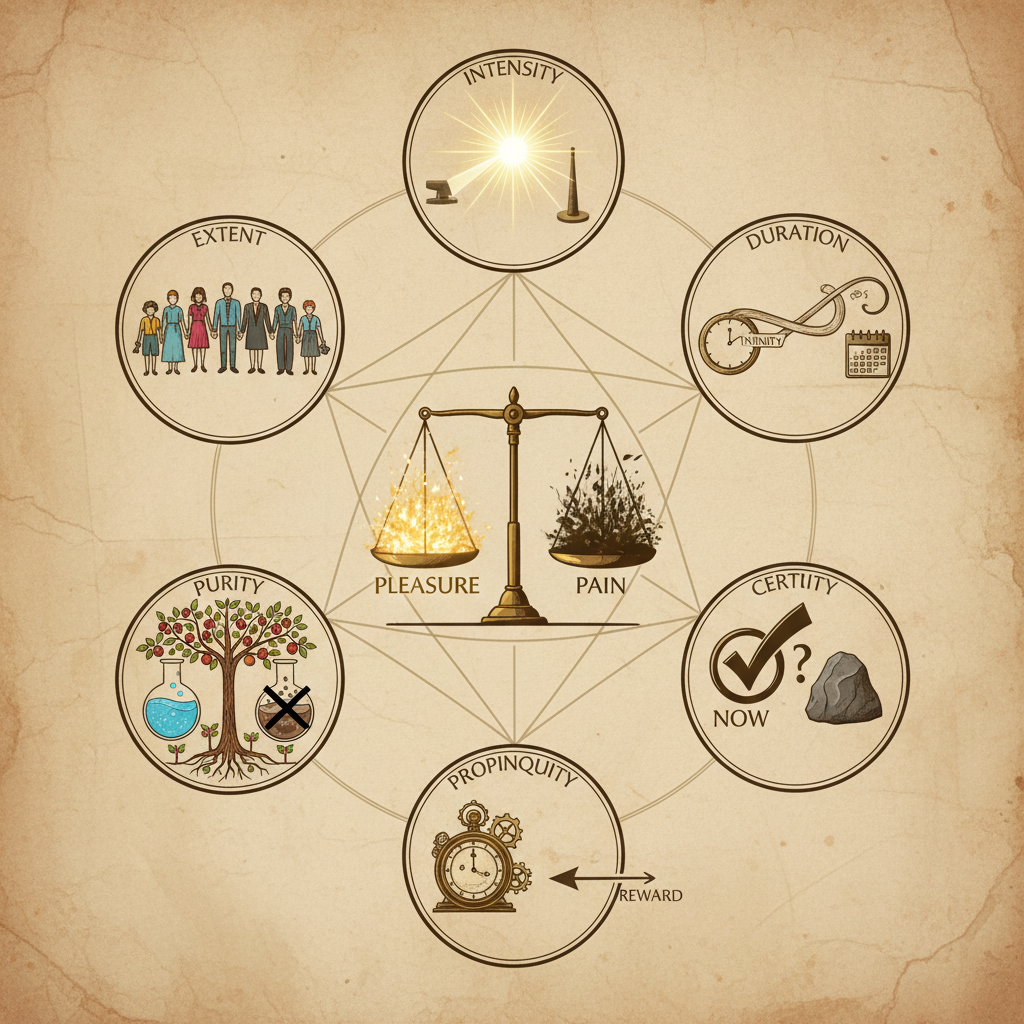
Introduction
The claim that utilitarianism fails because happiness and harm cannot be measured targets the very mechanism at the heart of Bentham's act utilitarianism: the felicific calculus, which claims to provide an objective, quasi-mathematical procedure for comparing the utility of different actions. Bentham himself was explicit: "nature has placed mankind under the governance of two sovereign masters, pain and pleasure" — and he believed that pleasure and pain could be measured along seven dimensions to yield an objective calculation of moral rightness. The claim questions whether this is possible, and whether the failure of the calculus entails the failure of utilitarianism as a whole. This requires distinguishing between Bentham's act utilitarianism (most vulnerable to the measurement objection), Mill's rule utilitarianism (which avoids case-by-case calculation), and Singer's preference utilitarianism (which replaces pleasure with preference-satisfaction). I will argue that the measurement objection succeeds against Bentham's act utilitarianism but does not entail the failure of utilitarianism as such — Mill and Singer substantially mitigate the problem, and the real failure of utilitarianism lies not in measurement difficulties but in its inadequate protection of minority rights and justice.
Mark-scheme aim
PECREL 1 — The felicific calculus: the measurement objection succeeds against Bentham
The measurement objection is decisive against Bentham's act utilitarianism: the felicific calculus fails both as an objective measuring procedure and as a practical guide to real moral decisions, and Mill's "swine ethic" objection reinforces this from within the utilitarian tradition itself.
Bentham's seven criteria — intensity, duration, certainty, propinquity, fecundity, purity and extent — attempt to reduce moral decision-making to quantitative calculation. The measurement objection attacks this on multiple fronts. First, pleasure and pain are subjective experiences: as UKEssays notes, "the felicific calculus cannot really account for different degrees of happiness nor of the fact that different people are made happy by different things, and to different degrees." What is intensely pleasurable to one person may be neutral or painful to another — there is no common currency for comparing subjective states across persons. Second, the calculus requires predicting future consequences with confidence — but as alevelphilosophyandreligion.com observes, "it requires us to predict the future consequences of actions (what if you save a baby's life but it grows up to be a serial killer?)" — which is not reliably possible. Third, even if consequences were predictable, the criteria of fecundity (will the pleasure lead to more pleasure?) and purity (will it be followed by pain?) require an infinite regression of future calculations that is practically impossible to complete.
Mill himself identifies what he calls the "swine ethic" objection to Bentham's calculus: if only quantity of pleasure matters, then a fully satisfied pig is morally better off than a partially satisfied Socrates — which is intuitively absurd. Mill's response — distinguishing higher and lower pleasures qualitatively — actually reinforces the measurement objection: by acknowledging that some pleasures are intrinsically better than others regardless of their quantity, Mill concedes that pleasure cannot be measured along a single numerical scale. The introduction of qualitative distinctions destroys the calculability that was the point of the felicific calculus in the first place.
A defender of Bentham can respond that the measurement objection sets an unrealistically high standard: no ethical theory produces perfectly precise, objective judgements, and the felicific calculus is meant as a heuristic framework — a systematic way of thinking about consequences — rather than a literal algorithm demanding mathematical precision. Furthermore, modern economics and welfare science have developed revealed preference methods, willingness-to-pay studies, and quality-adjusted life year (QALY) calculations that give empirical content to utility comparisons — showing that approximate measurement is achievable even if perfect measurement is not.
The heuristic response is partially persuasive: as a rough guide to consequences, the calculus is better than no framework at all. However, this concession significantly weakens the theory's claim to provide objective, impartial moral guidance — if the calculus is merely heuristic, two people applying it in good faith in the same situation may reach different conclusions, neither of which is objectively wrong on the theory's own terms. The QALY example shows approximate measurement is possible in constrained institutional contexts, but does not resolve the deep subjectivity problem for the full range of individual moral decisions. The measurement objection therefore substantially succeeds against Bentham's claim that act utilitarianism provides a uniquely objective moral calculus.
The measurement objection decisively undermines Bentham's act utilitarianism as a precise decision procedure, but its force depends on holding Bentham to his own high standard of objective calculation — a standard that Mill and Singer deliberately abandon.
Mark-scheme aim
PECREL 2 — Mill, Singer and rule utilitarianism: measurement mitigated but utilitarianism's real failure
Mill's rule utilitarianism and Singer's preference utilitarianism substantially mitigate the measurement problem — showing utilitarianism does not fail on measurement grounds alone — but the theory's deeper failure concerns minority rights and justice, which cannot be resolved by improving the measurement mechanism.
Mill's rule utilitarianism bypasses the case-by-case calculation problem entirely: by identifying rules that reliably maximise utility, the agent follows established rules rather than recalculating each time. The rules themselves are established by historical experience of what kinds of action generally produce good outcomes — "keep promises," "do not murder," "tell the truth" — and following them does not require real-time utility measurement. Singer's preference utilitarianism replaces Bentham's subjective hedonic pleasure with the satisfaction of rational preferences: preferences are observable through behaviour and revealed choice, making them more objectively assessable than hedonic states, and the theory can incorporate preferences for justice, autonomy and fair treatment that pure hedonism ignores. Together, these developments show that measurement problems are largely specific to Bentham's hedonistic calculus and do not afflict utilitarianism as a family of theories.
However, even with measurement resolved, utilitarianism faces a deeper problem: its structural inability to protect individual rights against majoritarian calculation. As the OCR mark scheme highlights, even well-measured utility calculations can be used to justify exploitation — "calculating the benefit or harm of an act through its consequences and measuring individual pleasure could lead to exploitation." The scapegoat problem (executing one innocent person to prevent widespread harm) remains fully within rule utilitarianism's scope if the rule "sacrifice one to save many" could be established as generally utility-maximising. Nozick's experience machine thought experiment exposes this: people refuse to plug into a machine that would give them maximal measured pleasure, because they value genuine autonomy, achievement and justice — goods that utilitarianism's pleasure-based framework systematically undervalues regardless of how well pleasure is measured.
Mill responds directly: justice is itself the highest utility — since everyone's security depends on the inviolability of rights, a properly long-sighted utility calculation always supports protecting individual rights. Rule utilitarianism's rules — which include "do not sacrifice the innocent" — emerge from experience of what maximises long-term aggregate welfare, providing stable protections for individuals without requiring case-by-case calculation. Singer's preference utilitarianism similarly protects minorities: since rational agents prefer autonomy and fair treatment, their preferences for rights protection enter the utility calculus with significant weight.
Mill's justice-as-utility argument is the strongest response to the rights problem, but as noted earlier it is ultimately circular: it preserves rights only if utility calculations always happen to support them, providing no guarantee in cases where a credible argument could be made that violating rights maximises long-term welfare. The claim in the title — that utilitarianism fails because of measurement impossibility — is therefore partially correct (it succeeds against Bentham) but misdirected (it does not succeed against Mill and Singer, whose real failure concerns justice and rights rather than measurement). The strongest objection to utilitarianism is not that it cannot measure but that it measures the wrong things.
Utilitarianism's failure is therefore not primarily a measurement failure — Mill and Singer show that measurement can be substantially improved — but a structural failure to give adequate weight to rights, justice and human dignity that no improvement in measurement technique can resolve.
Mark-scheme aim
Conclusion (RJ)
The claim that utilitarianism fails because it is impossible to measure happiness and harm is partially correct but ultimately misdirected. The measurement objection decisively undermines Bentham's act utilitarianism and its felicific calculus — which cannot objectively compare subjective states, predict future consequences reliably, or resolve the swine ethic problem without importing qualitative distinctions that destroy its calculability. However, Mill's rule utilitarianism avoids case-by-case calculation entirely, and Singer's preference utilitarianism replaces subjective pleasure with observable preference-satisfaction — together showing that measurement difficulties are specific to Bentham's version, not to utilitarianism as a whole. The deeper and more damaging failure of utilitarianism is its structural inability to protect minority rights and justice against majoritarian calculation — a problem that remains even after Mill and Singer's improvements, and which no refinement of the measurement mechanism can resolve. Utilitarianism does not fail because happiness cannot be measured; it fails, in its most serious respect, because even perfectly measured aggregate happiness is an insufficient foundation for a complete moral theory that includes justice, rights, and the inviolable dignity of persons.