On This Page
Bonhoeffer on Suffering
"Discuss critically the claim that Bonhoeffer's theology puts too much emphasis on suffering."
Back to Paper 3 essays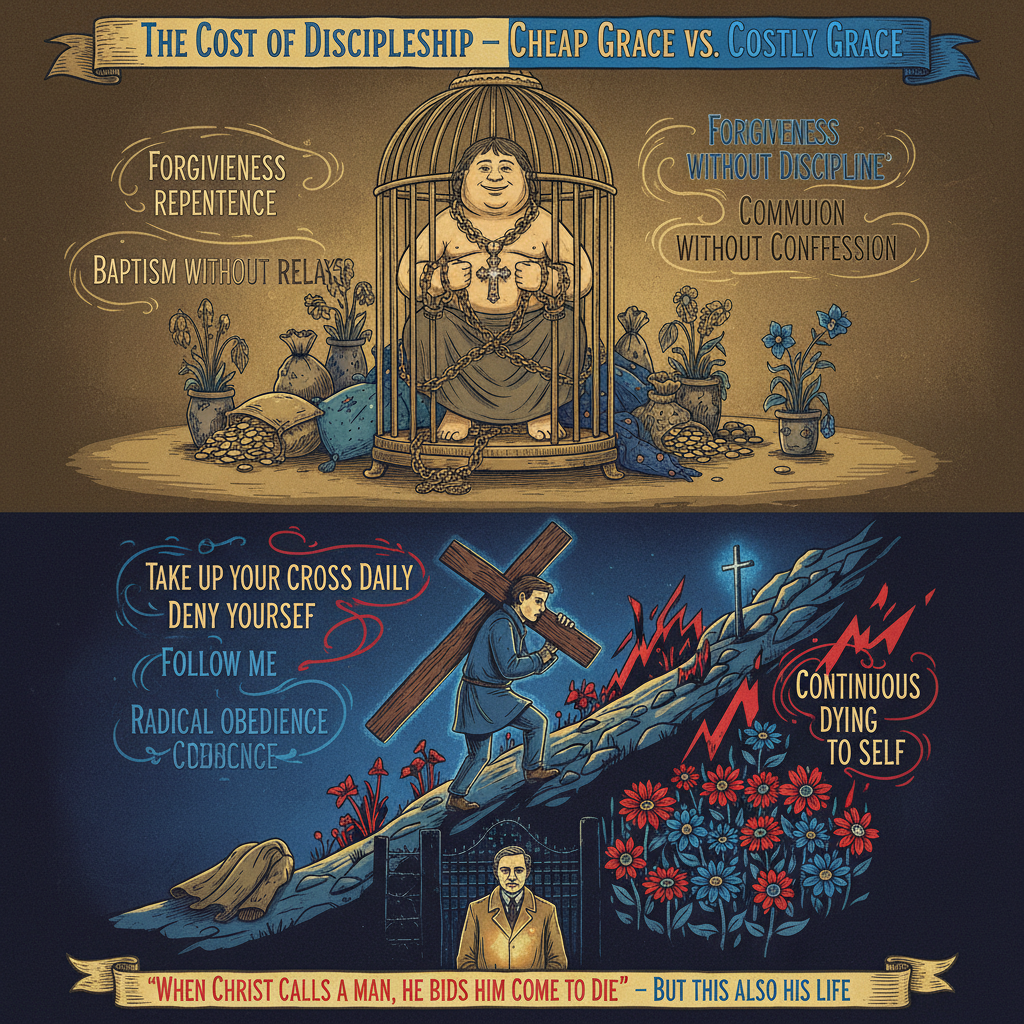
Introduction
Dietrich Bonhoeffer (1906–1945) — Lutheran pastor, theologian, and martyr — developed one of the most demanding accounts of Christian discipleship in the twentieth century, grounded in the twin concepts of costly grace and the suffering God. In The Cost of Discipleship (1937), he argues that cheap grace — "grace without discipleship, grace without the cross, grace without Jesus Christ" — is the greatest threat to the church, and that genuine following of Christ necessarily involves suffering, sacrifice and the willingness to take up one's cross. In his later Letters and Papers from Prison, he develops the concept of the suffering God: a God who does not rescue his followers from suffering but suffers alongside them in the weakness of the cross — "a man for others" — asking Christians to share in this solidarity with the vulnerable and oppressed. The claim that this theology over-emphasises suffering requires assessing: whether the emphasis is justified by the New Testament and the tradition; whether it neglects the resurrection and Christian joy; whether Bonhoeffer's Nazi context produced a situationally specific theology that cannot be universalised; and whether the suffering emphasis is the whole of his theology or one component of a richer vision. I will argue that the claim is partially fair — Bonhoeffer's theology does place exceptional weight on suffering, and the Seneca notes' concern that it is "stuck on the cross rather than the empty tomb" is a genuine limitation — but that the emphasis is theologically grounded, contextually appropriate, and part of a richer vision of discipleship that includes solidarity, action and the church for others.
Mark-scheme aim
PECREL 1 — The theological case for costly grace and the suffering God
Bonhoeffer's emphasis on suffering is theologically well-grounded in the New Testament and the cross — and his critique of cheap grace correctly identifies a genuine and persistent distortion of Christianity that the costly grace concept corrects.
Bonhoeffer's starting point is the New Testament's unambiguous connection between discipleship and suffering: Jesus' call to "take up your cross and follow me" (Matthew 16:24) and Paul's exhortation to "join with me in suffering, like a good soldier of Christ Jesus" (2 Timothy 2:3) both present suffering as an intrinsic — not merely incidental — dimension of authentic Christian life. Cheap grace describes the distortion that occurs when this is forgotten: it is "forgiveness of sins proclaimed as a general truth, the love of God taught as the Christian 'conception' of God… grace without price, grace without cost." Bonhoeffer's point is not that Christians should seek suffering for its own sake but that the grace of the Gospel genuinely costs something — it calls for genuine transformation, not mere intellectual assent or nominal church membership. His theology of the suffering God is similarly grounded in the incarnation and the cross: a God who became human in Jesus Christ, suffered crucifixion, and identified with the vulnerable and marginalised is a God whose followers are called to share that solidarity rather than seeking a religion that provides comfort and rescue from difficulty. As Lauren's notes confirm: "the experience of suffering is Christianity's way of engaging with Christ's suffering on the cross… the suffering God acts in solidarity." Bonhoeffer's own martyrdom — executed by the Nazis on 9 April 1945 for his role in the assassination plot against Hitler — gives this theology its most powerful vindication: it is not abstract but lived.
However, the Seneca notes identify a significant and widely acknowledged limitation: Bonhoeffer's theology risks being "too closely stuck on the cross, rather than the empty tomb and the hope of resurrection and the defeat of sin and death." The New Testament's message is not primarily a message of suffering but of resurrection and hope: the Easter proclamation — "he is risen" — is the founding moment of Christian faith, and Paul's entire soteriology is grounded in the resurrection ("if Christ has not been raised, your faith is futile" — 1 Corinthians 15:17). A theology that places so much emphasis on suffering that the resurrection becomes secondary is not fully representative of the New Testament's balanced vision. Furthermore, the Seneca notes observe that "not all Christians experience such extreme forms of suffering now" — Bonhoeffer's context of Nazi tyranny was historically extreme, and a theology forged in that crucible may over-weight suffering as the defining category for Christian life in much less extreme circumstances.
Bonhoeffer can respond that cheap grace is not a Nazi-specific problem but a persistent temptation of the institutional church in any era: the history of Christianity includes long periods in which nominal church membership, cultural Christianity, and religious comfort replaced genuine discipleship — a problem that is if anything more acute in prosperous, peaceful societies where the comfortable middle class fills churches without any experience of the cross. Furthermore, his concept of the church for others — the church that identifies with the poor, vulnerable and oppressed rather than serving the interests of the powerful — is not a theology of masochistic suffering but a theology of solidarity: suffering is embraced not for its own sake but because solidarity with those who suffer is what love requires. As the Christian History Magazine notes confirm: "his life demonstrates that discipleship is not only about suffering but also about participating in God's redemptive work in the world, even at great personal cost."
The cheap grace critique is genuinely universal and not merely contextually specific — the temptation to reduce Christianity to comfortable cultural religion without genuine personal cost is perennial and Bonhoeffer's corrective is permanently valuable. The church for others concept shows that his theology is richer than the over-emphasis charge suggests: solidarity, action and community are as central as suffering. However, the resurrection neglect is a genuine limitation: Bonhoeffer's corpus gives comparatively little sustained attention to the resurrection's implications for Christian hope and joy, which means his account of Christian life is more cross-centred than the New Testament's own balance warrants. The claim is therefore partially fair as a specific critique but not as a summary of his whole theology.
The costly grace concept and the suffering God are theologically grounded and permanently important, but the relative neglect of resurrection hope is a genuine imbalance — which makes the over-emphasis charge partially but not fully fair.
Mark-scheme aim
PECREL 2 — Religionless Christianity, the Nazi context, and the universalisability question
Bonhoeffer's religionless Christianity and the Nazi context in which it was developed raise the central question of whether his theology is a universally applicable theological vision or a historically specific response — and the answer significantly affects the fairness of the over-emphasis charge.
In Letters and Papers from Prison (written 1943–45), Bonhoeffer develops the concept of religionless Christianity: in a "world come of age" that has outgrown its need for the religious hypothesis of God as a problem-solver, Christians are called to live "etsi deus non daretur" (as if God did not exist) — not abandoning faith, but living without the crutch of religion as a means of escape from the world's suffering. This is a direct development of his suffering theology: the God who is relevant to modern secular humanity is not a divine rescuer but the "weak and powerless" God of the cross who suffers alongside the world. Bonhoeffer explicitly connects this to his Nazi experience: the German church's use of religion as comfort and social respectability — its failure to act in solidarity with Jewish victims and oppose the regime — is the concrete historical example of cheap grace that his whole theology is developed to address. The Seneca notes capture the contextual question directly: "we must look at the context in which Bonhoeffer was writing… not all Christians experience such extreme forms of suffering now — it could be argued that Bonhoeffer's experience of suffering in Nazi Germany influenced his writings so much that it led to an overemphasis on suffering."
The contextual objection has genuine force: religionless Christianity, the suffering God, and the call to civil disobedience were all developed in direct response to the specific conditions of Nazi tyranny — a situation of extraordinary moral clarity (the state was manifestly, catastrophically evil) that does not represent the ordinary conditions of Christian life in democratic, pluralistic societies. Applying a theology forged in extremis to the everyday moral decisions of contemporary Christians risks category error: the call to take up the cross against a genocidal regime does not translate directly into guidance for ordinary Christian moral life, and the attempt to do so may produce an inappropriate atmosphere of crisis and heroic self-sacrifice where patient, joyful, ordinary faithfulness would be more adequate.
However, the contextual argument can be turned in Bonhoeffer's favour: if his theology was shaped by the extremity of Nazi Germany, it reveals what was always present in mainstream German Christianity but hidden — cheap grace, institutional self-interest, the church's complicity with power — which are not Nazi-specific but structural features of any comfortable established church. The OCR mark scheme confirms this: "to stick rigidly to a traditional set of values and duties is to develop what he called 'rusty swords' — a religion which has no relevance to the present." Bonhoeffer's own testimony is that the costliness of discipleship is not a function of the Nazi extreme but of the nature of the Gospel itself — which speaks to any era in which the church is tempted to prefer comfort to solidarity.
The OCR mark scheme's endorsement of Bonhoeffer's "rusty swords" critique suggests that the over-emphasis charge is not sustained as a verdict on his whole theology: his emphasis on suffering corrects a real and perennial distortion of Christianity, is grounded in the New Testament's own cross-theology, and is part of a wider vision of solidarity, action and the church for others. The partially fair verdict is that his theology's comparative neglect of resurrection hope and joy creates a genuine imbalance — but that this is a relative weighting issue, not a fundamental theological error — and that the cheap grace critique and the solidarity vision are of permanent theological value that far exceeds the specific Nazi context in which they were developed.
Bonhoeffer's theology is not merely contextually specific but contains permanently valid theological insights — the over-emphasis charge is partially fair as a comment on relative weighting within his vision, not as a dismissal of the centrality of the cross in genuinely costly discipleship.
Mark-scheme aim
Conclusion (RJ)
The claim that Bonhoeffer's theology puts too much emphasis on suffering is partially fair but ultimately overstated. The costly grace concept and the suffering God are grounded in the New Testament's own cross-theology, correct a perennial and serious distortion of Christianity, and are given their most powerful concrete vindication by Bonhoeffer's own martyrdom. The Seneca notes' observation that his theology is "too stuck on the cross rather than the empty tomb" identifies a genuine relative imbalance: the resurrection's implications for Christian hope, joy and ultimate victory over suffering receive less sustained attention than the cross, and this creates an incomplete account of the full New Testament vision. However, the church for others, the solidarity vision, and the religionless Christianity concept all show that Bonhoeffer's theology is not reducible to a theology of suffering alone — it is a theology of participation in God's redemptive work, of which suffering is a necessary but not the only dimension. The most defensible verdict is that Bonhoeffer's theology appropriately emphasises the cost of discipleship in a way that corrects cheap grace, while acknowledging that a fuller theology would give resurrection hope and Christian joy a more prominent place in the vision of what costly discipleship is ultimately for.