On This Page
Christianity as Cause of Problems
"How fair is the claim that Christianity is a major cause of personal and social problems?"
Back to Paper 3 essays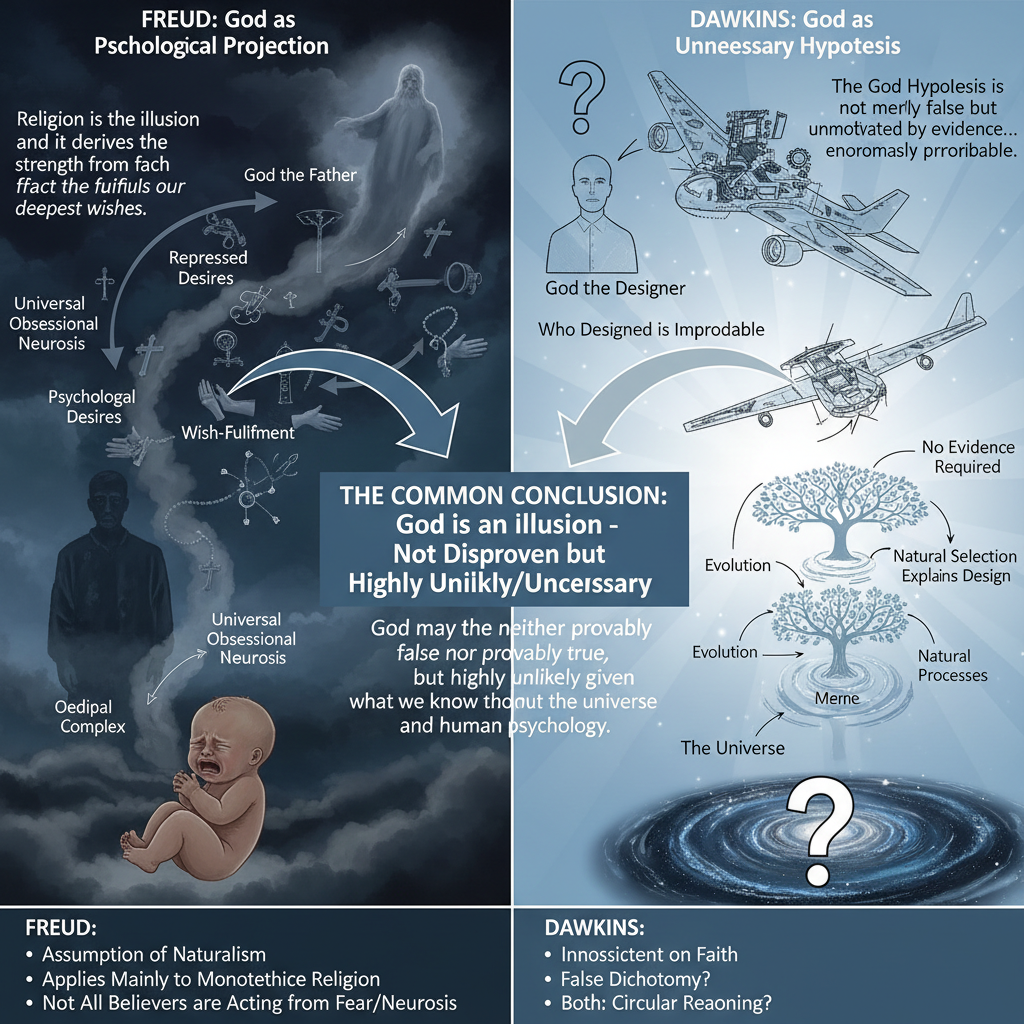
Introduction
The claim that Christianity is a major cause of personal and social problems is most comprehensively advanced by Dawkins and Freud — whose critiques together cover both the individual psychological harms of religious belief and the collective social costs of institutional Christianity. Freud, in The Future of an Illusion (1927) and Civilisation and its Discontents (1930), argues that religion is a universal obsessional neurosis — a collective delusion generated by humanity's inability to accept the terror of nature, death and the demands of civilisation — and that Christianity's specific contribution is the repression of natural instincts (sexuality, aggression) through guilt, which produces neurotic unhappiness at the personal level and social rigidity at the collective level. Dawkins, in The God Delusion (2006), argues that religion is the root of all evil — that it is "infantile," anti-intellectual, corrosive to critical faculties (particularly in children), and the primary cause of sectarian violence, terrorism, and the resistance to scientific and moral progress. Against these, the Christian response draws on: the Heritage Foundation Report (2006) showing that religious practice benefits individuals, families and communities; the Church's continuing social service; Martin Luther King and the civil rights movement; and Alston's philosophical critique of Freud's projection theory. I will argue that the claim is partially but not predominantly fair: Christianity has caused genuine personal and social harm in specific historical and institutional contexts — and these must be honestly acknowledged — but the claim that it is a major cause systematically overstates the case and ignores both the empirical evidence of religion's positive effects and the self-undermining character of Dawkins' and Freud's respective critiques.
Mark-scheme aim
PECREL 1 — Freud's universal obsessional neurosis and Alston's philosophical response
Freud's account of religion as universal obsessional neurosis provides the most psychologically developed case for Christianity as a cause of personal problems — but Alston's philosophical critique and Freud's own concessions reveal its decisive limitations.
Freud's case has two distinct components. First, at the individual level (The Future of an Illusion, 1927): religious belief is a wish-fulfilment illusion — a projection of the human desire for a powerful protective father onto the cosmos, driven by fear of death, natural calamity and the terrors of existence. Christianity's specific doctrines — divine judgment, mortal sin, the fear of hell — generate guilt, anxiety and repression that are the direct cause of individual neurotic unhappiness. Second, at the social level (Civilisation and its Discontents, 1930): religion keeps the masses docile by promising post-mortem reward and divine authority for existing social arrangements — which preserves unjust social structures and makes resistance to oppression feel like defiance of God. As divinityphilosophy.net confirms: "Freud saw all religion as a 'universal obsessional neurosis' which supported irrational beliefs and behaviour and created taboos which are often harmful to individuals." Christianity's moral teachings on sexuality — condemning premarital sex, contraception, homosexuality — are, on Freud's account, paradigmatic examples of the repression that causes personal unhappiness by imposing impossible demands on natural human instincts.
However, Alston (1967) provides the decisive philosophical objection: "Freudian theory is not logically incompatible with the truth, justifiability and value of traditional religion." The fact that religious belief can be psychologically explained as wish-fulfilment does not establish that it is false — the genetic fallacy shows that identifying the psychological origin of a belief does not determine its truth value. Belief in God may be both psychologically generated by human needs and true — Freud's projection theory establishes nothing about the truth of Christian claims, only about a possible psychological mechanism for their adoption. Furthermore, Freud himself concedes the ambiguity of his case: the divinityphilosophy.net analysis notes that if "projecting God fulfils wishes and so makes people happy, not unhappy," then Freud's own framework suggests that religion — including Christianity — may increase rather than decrease personal happiness, even if it involves comforting delusions.
Freud can respond that the happiness produced by religious illusion is the happiness of infantile dependence rather than genuine adult flourishing — and that a mature humanity, facing reality without the crutch of supernatural consolation, would achieve a more authentic and ultimately more satisfying human existence. The personal harm is not primarily the neurosis of the devout believer but the civilisational cost of a humanity that remains psychologically dependent and morally immature.
The maturity response is plausible as a speculative developmental claim but is empirically unsupported: the most secularised societies have not demonstrated the enhanced psychological health and moral maturity that Freud's theory predicts. The Heritage Foundation Report (2006) provides direct empirical counter-evidence: "a steadily growing body of evidence from the social sciences demonstrates that religious practice benefits individuals, families and communities, and thus the nation as a whole" — with religious believers showing higher average levels of wellbeing, social engagement, health and longevity than non-believers. This is not compatible with the claim that Christianity is a major cause of personal problems, even if it causes genuine difficulties for some individuals.
Freud's account of personal harm is philosophically self-undermining (Alston's genetic fallacy response) and empirically contradicted (the Heritage Foundation data) — making the personal harm claim partially but not predominantly fair.
Mark-scheme aim
PECREL 2 — Dawkins' root of all evil, the meme theory, and the counter-evidence of social contribution
Dawkins' case that Christianity is a major cause of social problems — through anti-intellectualism, sectarian violence and the corruption of children's critical faculties — is the most comprehensive secularist social critique but systematically overstates the causal claim and ignores countervailing evidence.
Dawkins' social harm case has three main components. First, anti-intellectualism: Christianity's rejection of evolution (creationism), historical resistance to scientific progress (Galileo), and the teaching of faith as a virtue independent of evidence produces a population less capable of the critical reasoning on which a free society depends. Second, sectarian violence: the Crusades, the Inquisition, the Wars of Religion, Northern Ireland — Christianity has been a major driver of organised violence between communities, and the association of religious identity with ethnic and political conflict continues in multiple global contexts. Third, child indoctrination: Dawkins argues in The God Delusion that teaching children religious beliefs before they can critically evaluate them is a form of child abuse — it corrupts the development of rational faculties at the stage when they are most vulnerable to authoritative adult imposition. The Seneca notes confirm: "Dawkins argues that certain denominations of Christianity reject the indisputable advances of science and hold society back."
However, Dawkins' case is guilty of systematic selection bias — attributing to Christianity the social harms associated with its worst historical expressions while ignoring the social goods generated by its best. The same tradition that produced the Crusades also produced Francis of Assisi, Wilberforce's abolition, King's civil rights movement, Mother Teresa's work in Calcutta, and the founding of hospitals, universities and food banks. Furthermore, the 20th century's most catastrophic social violence — the Holocaust, Stalin's gulags, Mao's Cultural Revolution — were perpetrated by explicitly secular regimes, suggesting that the secularisation Dawkins recommends is no guarantee of reduced social violence and may actively remove the moral constraints that religious tradition provides. Dawkins' own position is also self-undermining: his 2024 "cultural Christian" declaration — "I like to live in a culturally Christian country" — directly contradicts the "root of all evil" diagnosis by conceding that Christianity's cultural influence is something he positively values.
Dawkins can respond that the social goods Christians point to — abolition, civil rights, hospitals — were achieved by individuals motivated by Christian faith but not by institutional Christianity itself, which consistently opposed moral progress until public opinion forced it to change. The cultural inheritance he values as a "cultural Christian" is the residue of Christianity's best influences, separable from the metaphysical claims and institutional religion that caused the harm.
The separation of cultural inheritance from institutional religion is philosophically available but practically questionable: Wilberforce's abolition campaign was explicitly evangelical-institutional, King's civil rights movement was rooted in the black church tradition, and the liberation theology movement shows that institutionally committed Christianity remains one of the world's most powerful forces for social justice. Dawkins' "root of all evil" claim is the most unfair element of the social harm case: attributing the Crusades to Christianity as a major cause of social problems while exempting secular political violence (the 20th century's far larger body count) from equivalent scrutiny reveals a double standard that significantly weakens the claim's fairness.
Dawkins' social harm case correctly identifies genuine historical problems — sectarian violence, anti-intellectualism, child indoctrination — but the selection bias, the secular violence counter-evidence, and his own cultural Christianity concession together show that Christianity is not fairly described as a major cause of social problems.
Mark-scheme aim
Conclusion (RJ)
The claim that Christianity is a major cause of personal and social problems is partially but not predominantly fair. Christianity has caused genuine personal harm in specific historical contexts — the guilt-culture of certain traditions, the repression of sexuality, the silencing of women — and genuine social harm through the Crusades, the Inquisition, resistance to scientific progress and sectarian violence. These must be honestly acknowledged rather than deflected. However, both Freud's and Dawkins' cases are systematically overstated and partially self-undermining: Freud's projection theory commits the genetic fallacy (Alston), his own framework implies that religion makes people happy rather than unhappy, and the Heritage Foundation data shows that religious practice is consistently associated with higher wellbeing across populations. Dawkins' "root of all evil" claim exhibits selection bias, ignores the social goods of Christianity's best institutional expressions (abolition, civil rights, food banks), and is directly contradicted by his own "cultural Christian" self-description. The 20th century's worst social violence was perpetrated by secular regimes, which shows that the secularisation Dawkins recommends provides no guarantee of reduced social harm. The most defensible verdict is that Christianity is one contributor among many to both personal and social problems — but not their major cause, and the same tradition that has caused harm has also been the most powerful institutional force for the goods of justice, dignity, and care for the vulnerable that secular society continues to depend on.