On This Page
Christianity, Values and Culture
"'Christianity should continue to be a significant contributor to values and culture.' Discuss."
Back to Paper 3 essays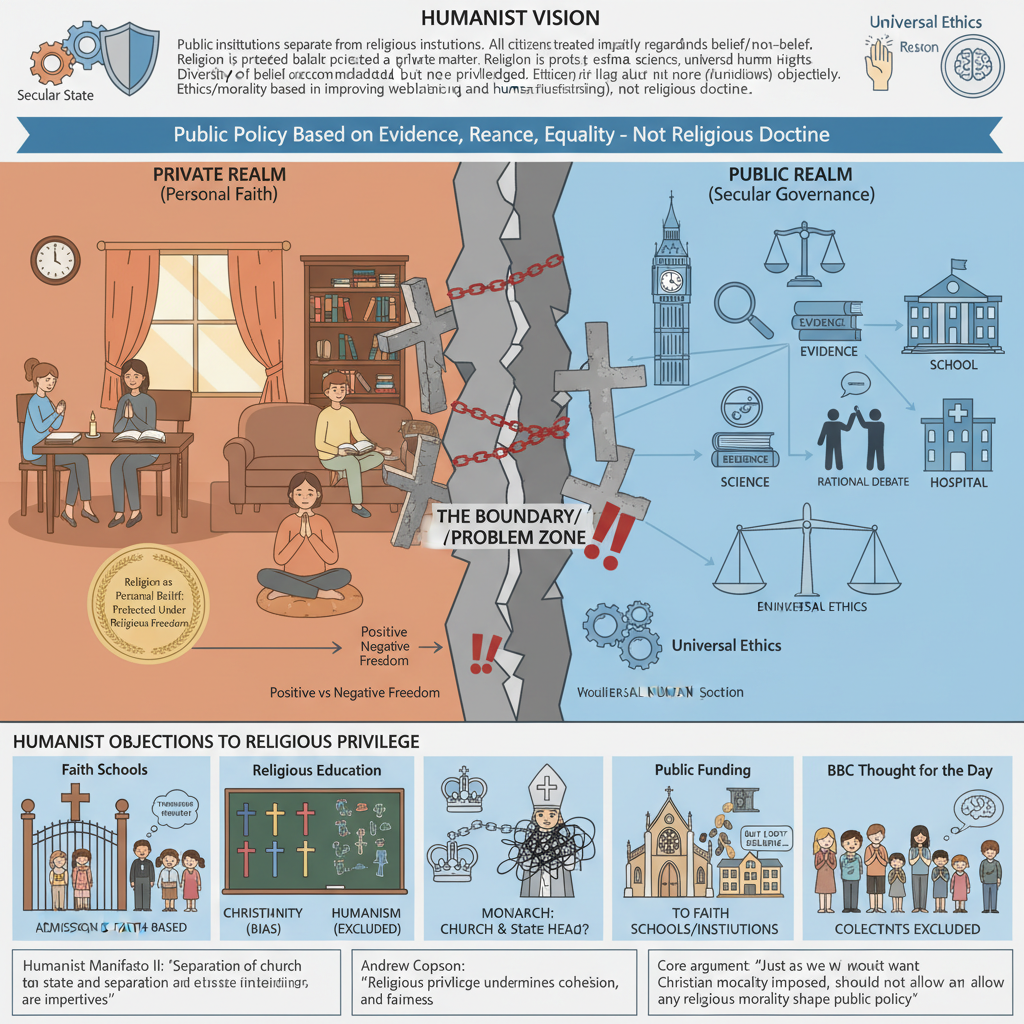
Introduction
The claim that Christianity should continue as a significant contributor to values and culture raises two distinct but connected questions: whether Christianity has been a major contributor to Western values and culture historically, and whether it should continue to be in an increasingly secular, pluralistic society. The secularist challenge — associated with Dawkins and Freud — holds that religion, including Christianity, should be progressively displaced from public life as society matures into rational, science-based self-governance; that Christian values are simply human values that do not require theological grounding; and that Christianity's historical contributions have been outweighed by the conflicts, oppressions and intellectual restrictions it has caused. The Christian response — drawing on Christopher Dawson, John Milbank's Radical Orthodoxy, and the lived evidence of the Church's continuing social contribution — holds that Western civilisation's foundational values (human dignity, universal rights, care for the poor, the common good) are not only historically derived from Christianity but cannot be sustained without theological grounding once their religious roots are severed. Significantly, even Dawkins described himself in 2024 as a "cultural Christian" — acknowledging that he values the cultural inheritance of Christianity even while rejecting its metaphysical claims — which concedes the historical contribution while contesting the continuing necessity. I will argue that the claim is substantially correct: Christianity's historical contribution to Western values and culture is massive and undeniable, secular society cannot simply inherit these values without their theological grounding indefinitely, and the secularist alternative faces its own crisis of moral foundations — but that the manner of Christianity's contribution in a pluralistic society must be dialogical rather than coercive.
Mark-scheme aim
PECREL 1 — The historical case for Christianity's cultural contribution and Dawson's moral vacuum
Christianity's historical contribution to Western values and culture is so foundational that even its critics cannot ignore it — and Christopher Dawson's moral vacuum thesis provides the most penetrating argument for why this contribution must continue.
The historical case for Christianity's cultural contribution encompasses virtually every foundational dimension of Western civilisation. In art and architecture, the great cathedrals, the tradition of choral music from Palestrina to Bach, Michelangelo's Sistine Chapel ceiling, Dante's Divine Comedy, Milton's Paradise Lost — all are products of Christian cultural imagination that continue to define Western aesthetic sensibility. In ethics and law, the concept of the sanctity and equal dignity of every human person — the philosophical foundation of universal human rights — derives directly from the Christian doctrine of the imago Dei: every person is made in the image of God and therefore possesses irreducible worth regardless of social status, race or capacity. In social care, the hospital, the university, and the tradition of organised charitable provision for the poor are all Christian institutional inventions. The abolition of slavery in the British Empire was driven primarily by evangelical Christians — Wilberforce, Clarkson and the Clapham Sect — and Martin Luther King's civil rights movement was explicitly grounded in Christian theology. Christopher Dawson, in Religion and the Rise of Western Culture (1950), argues that Western civilisation is now living off the inherited moral capital of its Christian past — but that without the theological roots that generated these values, secular society is producing a technological order resting on a moral vacuum: "If this were all, we should be forced to conclude that modern Western society does not possess a civilisation, but only a technological order." The moral principles that secular humanism affirms — human dignity, universal rights, the common good — are not self-sustaining on purely secular foundations; they require the theological grounding that only Christianity's continuing contribution can provide.
However, the secularist response to Dawson is powerful: Dawkins argues in The God Delusion that moral progress — the abolition of slavery, women's rights, the end of religious persecution — has consistently occurred against Christian institutional resistance rather than through it. The same Christian churches that Dawson credits with founding Western civilisation also ran the Inquisition, justified the Crusades, burned heretics, suppressed science (Galileo), and opposed the extension of democracy and rights to the poor, women and colonised peoples. Freud argues in Civilisation and its Discontents (1927) that religion's contribution to social cohesion was always achieved through repression — keeping the masses docile through fear of divine punishment and the promise of post-mortem reward — which is morally indefensible as a model for the contribution of values to a free society.
The Christian response is that the Church's historical failures — Inquisition, Crusades, colonial mission — are failures of faithfulness rather than evidence that Christianity's contribution is harmful: institutions corrupted by political power betray their own principles, which are the principles that generate the critique of those failures. Dawkins himself acknowledged in 2024 that he is a "cultural Christian" — that he values the cultural inheritance of Christianity even while rejecting its metaphysical claims. As the Premier Christianity article notes, this concession reveals a profound internal tension in Dawkins' position: "it is easier for atheists to give credit to Christianity for human rights and democracy, nice Bible stories and beautiful buildings — while leaving certain (vital) things out." The "vital things" left out are the theological roots that generated and sustained these cultural goods — which cannot simply be inherited without renewal.
Dawkins' cultural Christianity position is the most sophisticated secularist acknowledgment of Christianity's contribution, and it significantly concedes the historical case. However, the Premier Christianity response is correct that you cannot separate the cultural goods of Christianity from their theological roots indefinitely: a secularism that wants Christian cultural capital without Christian metaphysical commitment is living off an inheritance it is actively depleting rather than renewing. Dawson's moral vacuum thesis is empirically supported by the difficulty secular humanism has had in providing a non-theological foundation for universal human rights that is not ultimately reducible to cultural preference.
The historical contribution is undeniable and the moral vacuum thesis is compelling — but the Church's own failures demonstrate that contribution must be prophetic and self-critical rather than self-congratulatory, which is the form a continuing Christian contribution to culture should take.
Mark-scheme aim
PECREL 2 — Radical Orthodoxy, secularism's moral foundations crisis, and the dialogical model
Radical Orthodoxy (Milbank) and the observable crisis of moral foundations in secular society together provide the strongest contemporary theological case for Christianity's continuing necessary contribution — but the manner of contribution must be dialogical rather than coercive for it to be appropriate in a pluralistic democracy.
John Milbank's Radical Orthodoxy, developed in Theology and Social Theory (1990), argues that secular reason is not neutral but itself a theological position — a specific metaphysical account of reality (immanent, without transcendence) that makes claims about meaning, value and human nature that it cannot justify on its own terms. Secular political philosophy's foundational concepts — the equal dignity of persons, universal rights, the obligation to care for the vulnerable — all depend on premises (that persons have irreducible worth, that there are objective moral obligations) that secular reason cannot ground without implicitly borrowing from theological sources. The alevelphilosophyandreligion.com notes confirm: "secularism and Christianity disagree about the source of morality and values — is it God or human reason?" In practice, the secularisation thesis has not produced the flourishing, rational, morally progressive society Dawkins and Freud predicted: the most highly secularised societies show rising rates of mental health problems, social fragmentation, loss of community, and the vacuum of meaning that Christianity provided. The Seneca notes confirm: "secularism has given Christians the opportunity to look at what makes their religion distinctive in its values and what makes Christianity stand out from secular ideologies, such as valuing the sanctity and dignity of every human life." The most appropriate model for Christianity's continuing contribution in a pluralistic democracy is therefore dialogical: contributing distinctive Christian perspectives on justice, human dignity, care for the poor and environmental stewardship to public debate without seeking to impose specifically theological conclusions on those who do not share Christian premises.
However, the secularist responds that the dialogical model, while appealing, is in tension with Christianity's own historical self-understanding: the Church has rarely been content to offer one voice among many but has consistently sought to shape law, education and public morality according to specifically Christian norms — which is incompatible with genuine pluralistic democracy. Furthermore, Dawkins argues that any specifically Christian contribution to public values is problematic because it imports theological premises — divine commands, supernatural sanction, faith-based authority — into public deliberation that should be governed by reason and evidence alone. The Seneca notes confirm: "some Christian ethical stances are at odds with modern, progressive society" — on homosexuality, reproductive rights, gender roles — which suggests Christianity's contribution is as likely to generate conflict and exclusion as shared values.
The Christian response is that Dawkins' demand for purely secular public reason is itself a form of exclusion — it silences the voices of the majority of humanity (who hold religious beliefs) from public deliberation on the grounds that their deepest moral convictions are illegitimate. The dialogical model does not require coercive imposition but equal participation: Christians contribute to public debate from their own distinctive perspective, as do secular humanists, and the public deliberates together. On the "at odds with progressive society" objection, Christianity's contribution has historically included positions (on the equal dignity of all persons, care for the most vulnerable, critique of economic exploitation) that were initially at odds with society and later became the moral consensus — which suggests disagreement is not evidence of harm but of prophetic witness.
The dialogical model is the most defensible account of Christianity's continuing contribution: it acknowledges the legitimacy of plural voices in public life while preserving Christianity's specific contribution of the imago Dei foundation for human dignity, prophetic critique of power, and the vision of the common good. Milbank's point that secular reason cannot sustain its own foundational values without theological support is compelling as a philosophical challenge — even if the specific claims of Radical Orthodoxy are contested. The claim in the title is substantially correct: Christianity should continue to contribute, not because it should dominate but because the secular alternative faces a genuine and growing crisis of moral foundations that Christianity is uniquely positioned to address.
Radical Orthodoxy and the secular moral foundations crisis together make a compelling case for Christianity's continuing necessary contribution — in the dialogical mode that pluralistic democracy both requires and benefits from.
Mark-scheme aim
Conclusion (RJ)
The claim that Christianity should continue to be a significant contributor to values and culture is substantially correct but requires qualification about the manner of contribution. Christianity's historical contribution to Western civilisation — the imago Dei foundation for universal rights, the institutional invention of hospitals and universities, the artistic and intellectual tradition from Augustine to Bach — is so foundational that even Dawkins now describes himself as a "cultural Christian," acknowledging an inheritance he cannot abandon. Dawson's moral vacuum thesis correctly identifies that a secularised society living off Christian moral capital without renewing its theological roots faces a growing crisis of foundations — evident in the difficulty secular humanism has had grounding universal rights without the imago Dei premise. However, the Church's historical failures — Inquisition, Crusades, resistance to moral progress — show that its contribution must be prophetic and self-critical rather than self-congratulatory, and Milbank's Radical Orthodoxy is most defensible as a dialogical rather than a theocratic programme. The most defensible verdict is that Christianity's continuing contribution to values and culture is both justified and necessary — but its form in a pluralistic democracy must be the prophetic, dialogical witness of a community committed to the common good rather than the coercive imposition of theological norms on those who do not share them.