On This Page
Civil Disobedience in Christian Countries
"'Civil disobedience is never necessary for Christians who live in Christian countries.' Discuss."
Back to Paper 3 essays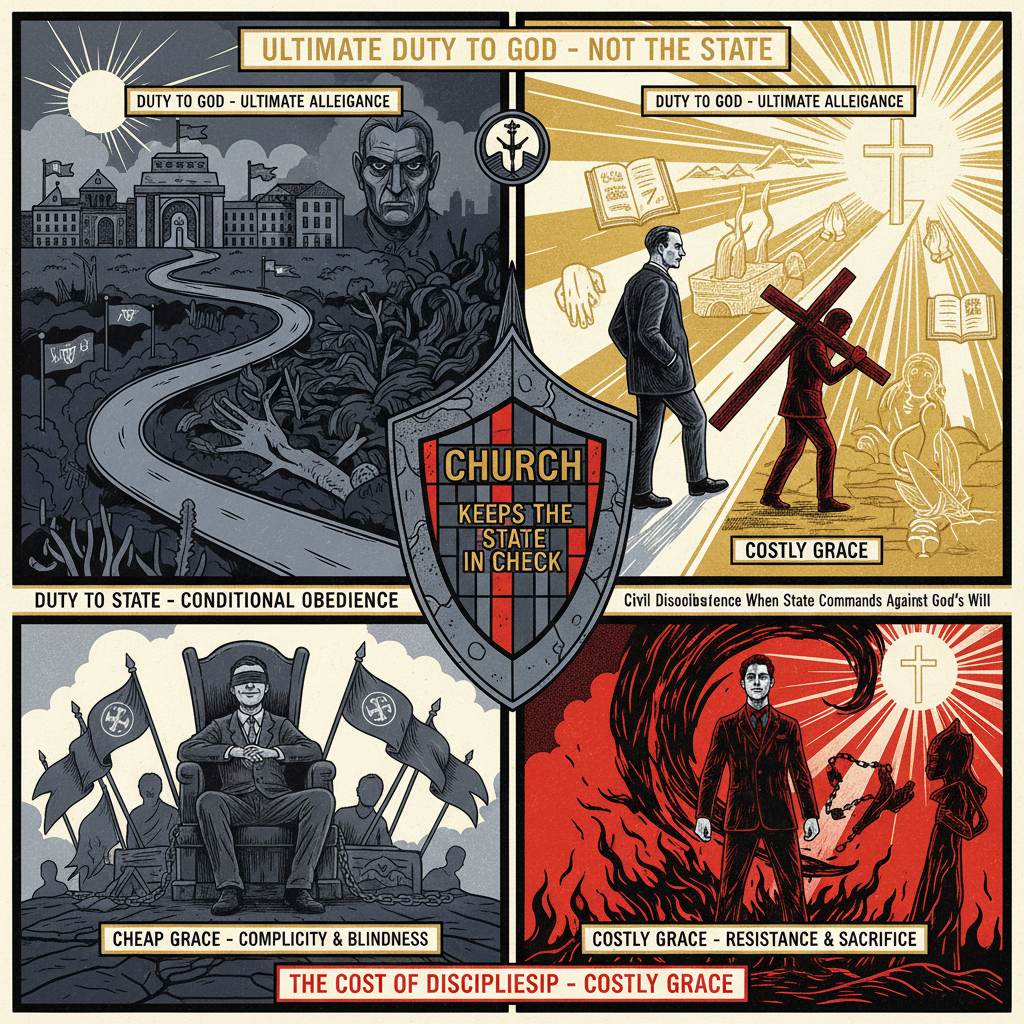
Introduction
The claim that civil disobedience is never necessary in Christian countries raises two connected questions: what constitutes a "Christian country," and what Bonhoeffer's theology — the primary OCR framework for this question — actually teaches about the relationship between church, state, and Christian moral obligation. The claim draws on the Pauline tradition of state obedience: Romans 13:1 — "all of you must obey the government rulers; everyone who rules was given the power to rule by God, and so whoever opposes the authorities is opposing what God has done" — presents obedience to the state as a Christian duty grounded in divine ordinance. The opposing tradition, developed most fully by Bonhoeffer, holds that the church has an obligation to oppose state injustice — to question the state's legitimacy, help its victims, and, in extreme cases, halt the wheel of the state itself through direct resistance. The claim's "never necessary in Christian countries" qualifier raises the further question of whether a nominally Christian state is automatically exempt from the conditions under which civil disobedience becomes obligatory. I will argue that the claim is not convincing: the concept of a genuinely Christian country is theologically dubious, Christian countries have historically been the site of serious injustice requiring civil disobedience, and Bonhoeffer's framework shows that the obligation to oppose state injustice is not conditional on the state being non-Christian but on its causing genuine harm to its people.
Mark-scheme aim
PECREL 1 — Romans 13, the duty to obey, and the theological case for the claim
The Romans 13 tradition and the two kingdoms doctrine provide the strongest theological case for the claim — but they are both textually and historically insufficient to establish that civil disobedience is never necessary even in Christian countries.
Paul's Romans 13 is the most direct biblical support for the claim: "whoever opposes the authorities is opposing what God has done… rulers are not a terror to those who do right, but to those who do wrong." The implication is that a properly constituted state — which in a Christian country is assumed to be broadly aligned with Christian moral principles — is an instrument of God's ordering of society, and that Christian citizens should therefore obey it as a matter of religious duty. Luther's two kingdoms doctrine reinforces this: the temporal kingdom (state and civil society) is governed by law and coercion to restrain sin, while the spiritual kingdom (church and gospel) is governed by love and grace — and Christians live in both kingdoms simultaneously, owing obedience to the state in temporal matters while owing obedience to God in spiritual matters. As the Seneca notes confirm: "civil matters governed by secular government; religious or spiritual duties are governed by the Church." In a Christian country — where the state's laws are broadly consonant with Christian moral principles — this framework suggests that the conditions for legitimate civil disobedience will rarely if ever arise: the state is already attempting to govern according to principles Christians affirm, making resistance unnecessary.
However, the Romans 13 tradition is contextually limited in a decisive respect: Paul wrote to a church living under Nero's Rome — a pagan, often persecuting empire — and yet still commands obedience, which suggests the text is not specifically addressed to Christian-country conditions but provides a general principle that must be qualified by other texts. The Revelation 13 tradition presents a directly contrasting view: the state as beast — demonic, idolatrous, persecuting — which must be resisted rather than obeyed. The tension between Romans 13 and Revelation 13 within the New Testament itself shows that the biblical tradition does not consistently support unlimited state obedience, even in explicitly Christian political contexts. Furthermore, the concept of a Christian country is itself theologically problematic: a country whose population is nominally Christian or whose constitution references Christianity is not thereby exempt from the possibility of unjust laws — Christian countries have historically produced slavery, colonialism, apartheid, religious persecution of minorities, and systematic inequality, all of which required Christian civil disobedience to address.
The claim's defender can respond that these historical injustices — slavery in the American South, apartheid in South Africa — were products of corrupted Christianity rather than genuine Christian governance, and that a truly Christian country, governed by genuine Christian principles of love, justice and human dignity, would not produce the conditions requiring civil disobedience. The Romans 13 obedience command presupposes a state that is genuinely acting as "God's servant for your good" — which a truly Christian state would do by definition.
The response is logically available but practically empty: no actually existing country has ever been "truly Christian" in the sense required, and the ideal of a state governed entirely by genuine Christian principles is both historically absent and theologically contested (Augustine argued that no earthly state can be truly just). The "never necessary" claim therefore requires an idealised Christian country that has never existed — which is not a convincing basis for a practical moral and political claim. The OCR mark scheme confirms: "it might be that only extreme situations (such as rule by a tyrant) justify extreme actions such as civil disobedience" — but this is an acknowledgment that the conditions for justified disobedience are real and possible, not foreclosed by Christian governance.
The Romans 13 tradition supports obedience as a general Christian duty but not as an absolute one — and the historical record of injustice within Christian countries shows that the conditions for necessary civil disobedience are not eliminated by a state's nominal Christian character.
Mark-scheme aim
PECREL 2 — Bonhoeffer's three-stage framework, tyrannicide, and the church as conscience of the state
Bonhoeffer's three-stage framework for Christian response to unjust state action — questioning, helping victims, halting the wheel — provides the most fully developed theological justification for civil disobedience and applies explicitly within nominally Christian societies as well as under overt tyranny.
Bonhoeffer argues that Christians have three escalating obligations when the state causes harm: first, question the state's legitimacy — call it to account publicly for its actions; second, help the victims of injustice regardless of their faith, since every person bears the image of God; and third, halt the wheel — actively engage in direct resistance to stop the state perpetrating injustice. As Lauren's notes confirm, "his justification is to be understood with the pretext that Christians have a responsibility that the state aligns with God's will… if a state is making reasonable people face unreasonable situations then it may be disobeyed." Crucially, Bonhoeffer did not restrict these obligations to explicitly non-Christian or anti-Christian states — Nazi Germany presented itself as a Christian nation (Hitler invoked Christianity in political speeches and the German church largely supported the regime), yet Bonhoeffer identified it as requiring the full three-stage resistance including, ultimately, tyrannicide. The OCR mark scheme confirms: "the role of the Church is to act as the conscience of the state; where the state resists moral guidance, then the Christian has a moral and religious duty to act against it." The Confessing Church — founded by Bonhoeffer and others in 1934 — represents the institutional expression of this: civil disobedience within a nominally Christian state through the refusal to accept Nazi control of the church.
However, the OCR mark scheme also records a significant tension within Bonhoeffer's own position: "Bonhoeffer himself argued that there is no moral justification for civil disobedience — ends do not justify the means; a justification for disobedience based on faith is irrational and dangerous." This is not a contradiction but a recognition that civil disobedience makes the disobedient person a sinner: Bonhoeffer knew that plotting to kill Hitler was morally wrong in the sense that it violated the absolute prohibition on murder — yet he proceeded, accepting the guilt of the action as something he would have to bear before God. This means civil disobedience, even when necessary, is never cost-free or straightforwardly justified — the Christian who engages in it takes on genuine moral burden, which is why it can only be justified in extreme circumstances.
The title's claim that civil disobedience is "never necessary" in Christian countries misunderstands Bonhoeffer's framework precisely: the necessity of civil disobedience is not determined by the religious character of the state but by whether the state is causing harm to people and resisting moral guidance. A Christian country that persecutes religious minorities, maintains unjust economic structures, or allows systematic racial discrimination is — in Bonhoeffer's framework — exactly the kind of state that requires the church to act as its conscience, potentially through civil disobedience. The Seneca notes confirm that Bonhoeffer's three-stage framework is understood to apply wherever "reasonable people face unreasonable situations" — a criterion that is not state-religion conditional.
Bonhoeffer's framework is the most theologically developed and historically tested account of Christian civil disobedience available, and its application to nominally Christian states — confirmed by the Confessing Church's resistance within Nazi Germany — directly refutes the claim in the title. The qualification that civil disobedience makes the actor a sinner is an important and honest acknowledgement that prevents the framework from being used to justify routine political agitation — but it confirms that in genuine extremity, the obligation to resist overrides the duty to obey, even in a country that calls itself Christian. The most defensible verdict is that civil disobedience is not routinely necessary in well-governed democratic societies, but the claim that it is never necessary in Christian countries cannot be sustained — both historically and theologically.
Bonhoeffer's three-stage framework, the Confessing Church's historical example, and the criterion of "reasonable people facing unreasonable situations" together demonstrate that civil disobedience may be necessary in Christian countries when the state causes genuine injustice — making the claim's "never" verdict indefensible.
Mark-scheme aim
Conclusion (RJ)
The claim that civil disobedience is never necessary for Christians who live in Christian countries is not convincing. The Romans 13 tradition provides a genuine and important basis for Christian obedience to state authority, and in well-governed democratic societies following broadly Christian principles, civil disobedience will rarely if ever be required. However, the concept of a "Christian country" provides no automatic exemption from the possibility of state injustice: Nazi Germany presented itself as a Christian nation, apartheid South Africa was explicitly framed in Christian theology, and slavery was institutionalised in Christian societies across three centuries. Bonhoeffer's three-stage framework — grounded in the church's obligation to act as the conscience of the state — applies wherever "reasonable people face unreasonable situations," regardless of the state's religious self-identification. The OCR mark scheme's own summary confirms the most defensible verdict: civil disobedience involves genuine moral cost (the actor becomes a sinner in the process) and must therefore be reserved for genuine extremity — but the "never necessary in Christian countries" claim confuses a state's nominal Christian character with genuine Christian governance, and no actually existing country has met that standard perfectly or could be guaranteed to do so in the future.