On This Page
Different Paths to Salvation
"'If different world religions offer different paths to salvation, then Jesus died on the cross for nothing.' Discuss."
Back to Paper 3 essays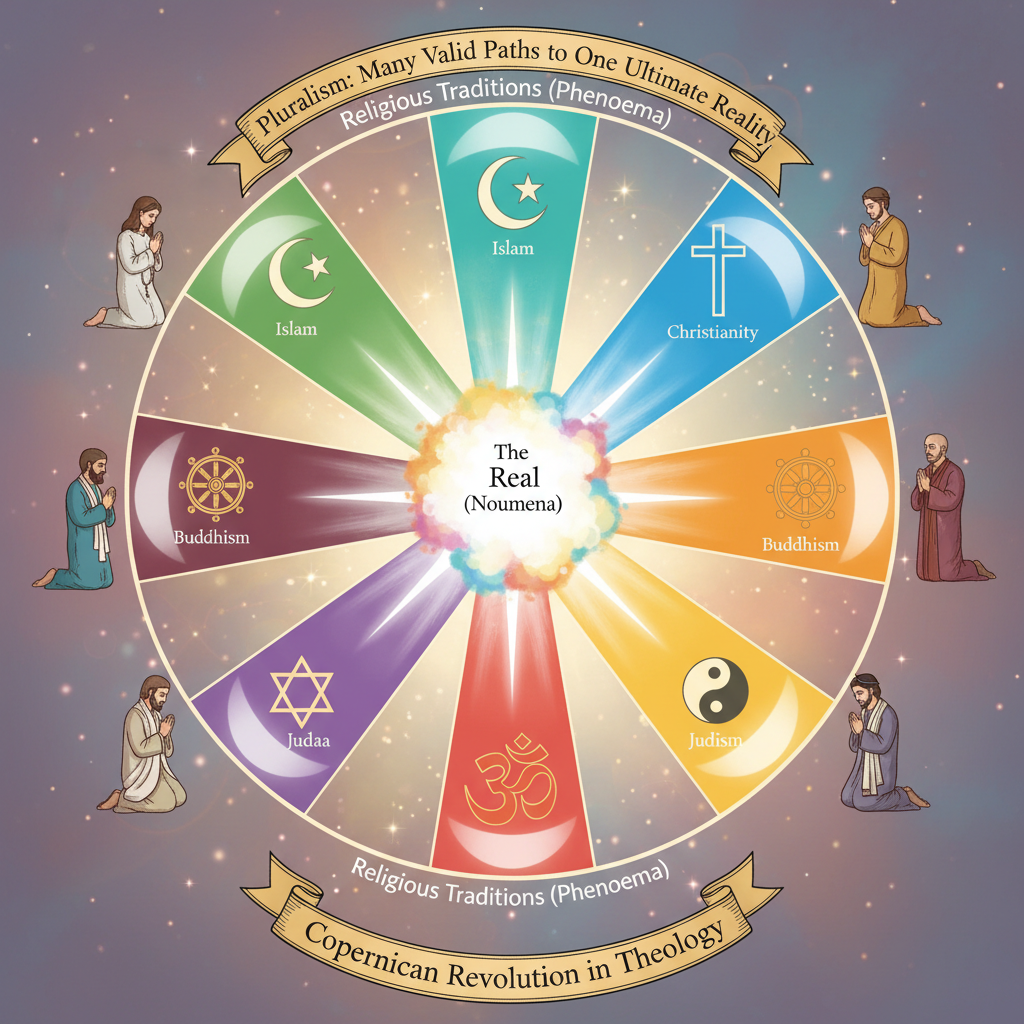
Introduction
The claim directly challenges theological pluralism — the view, most associated with John Hick, that all world religions are equally valid paths to the same ultimate salvific reality — by arguing that pluralism renders the crucifixion redundant. If salvation is available through Islam, Buddhism, Hinduism and Judaism independently of Christ's atoning death, then the specific event of the cross appears to be one contingent historical path among many rather than the unique and necessary act of universal redemption that orthodox Christianity proclaims. The claim draws on the exclusivist tradition — sola Christus ("through Christ alone") and nulla salus extra ecclesiam ("no salvation outside the Church") — and reflects Paul's assertion that "without the shedding of blood there is no forgiveness" (Hebrews 9:22) and that the cross is the unique act through which God reconciles the world to himself (2 Corinthians 5:19). Against this, inclusivist theologians (Rahner, Vatican II) argue that Christ's atoning work is universal in scope — it saves even those who do not explicitly know Christ, whose religious lives unknowingly participate in the grace of the cross — which preserves the cross's centrality while permitting religious diversity. I will argue that the claim is valid as a challenge to strict Hickian pluralism but not as a challenge to inclusivism, and that inclusivist Christology provides the most theologically adequate response.
Mark-scheme aim
PECREL 1 — The exclusivist case: the cross as unique and necessary, and Hick's pluralist challenge
The exclusivist tradition provides the strongest theological case for the claim — grounding the cross's necessity in atonement theology and the sola Christus principle — but exclusivism generates serious theological and moral problems that pluralism arises specifically to address.
The exclusivist case rests on three interconnected pillars. First, atonement theology: the cross is not an inspiring moral example but the unique act through which God, in Christ, takes the guilt of human sin upon himself and achieves the reconciliation between humanity and God that human beings cannot achieve alone — "God was reconciling the world to himself in Christ" (2 Corinthians 5:19). If salvation is available independently through other religions, this reconciliation was not necessary — which directly undermines both the doctrine of the atonement and the doctrine of original sin that grounds it. Second, the sola Christus principle: Acts 4:12 — "salvation is found in no one else, for there is no other name under heaven given to mankind by which we must be saved" — presents Christ's name as the unique and exclusive means of salvation in explicit contradiction of any pluralist account. Third, the historical particularity of the Incarnation: God's choice to become human in a specific person, at a specific time, in a specific culture, and to die a specific death is incompatible with pluralism's view that this event is merely one culturally particular expression of a universal salvific reality — if it were merely that, the Incarnation would be theologically arbitrary.
However, exclusivism generates the problem of moral fairness that drives Hick's pluralism: if salvation is available only through explicit faith in Christ, then the billions of people who lived before Christ, who never had access to the Gospel, or who were raised in other religious traditions through no fault of their own are condemned through no moral failing of their own. As the OCR mark scheme confirms: "a God of love and mercy would not condemn millions of people merely because they belonged to a non-Christian religion or because they lived before Christ or because although they lived a good moral life, it didn't happen to be an explicitly Christian one." Hick's pluralism responds to this directly: the Real — the ultimate divine reality — is encountered through all major world religions, each of which constitutes a genuine but culturally conditioned path to salvation. Using Kantian terminology, different religions represent different phenomenal expressions of the same noumenal ultimate reality — just as Kant argued that the world as experienced is shaped by the structures of human perception, so the world's religions shape how different cultures experience the same divine Real.
The exclusivist responds that Hick's The Real is a theological construction that no actual religion worships: it is not the personal God of the Bible, nor the impersonal Brahman of Advaita Vedanta, nor the dharma of Buddhism — it is a philosophical abstraction that real religious believers do not recognise as the object of their devotion. Hick's pluralism achieves universal salvation at the cost of evacuating the specific content of every religion it includes: by claiming that all religions are paths to The Real, it implicitly judges all their specific claims (the Trinity, the Qur'an as final revelation, the Buddha's Enlightenment) to be culturally conditioned approximations rather than truths. This is itself a form of religious imperialism — imposing a philosophical framework on all religions that none of them would accept on their own terms.
The exclusivist response to Hick is philosophically powerful: The Real is not the God any religion actually worships, and Hick's framework is self-defeating in that it claims to respect all religions while implicitly denying the truth of their most specific and important claims. However, the moral fairness problem that drives Hick retains genuine force: any account of salvation that condemns the morally sincere and spiritually serious non-Christian through no fault of their own conflicts with the Christian doctrine of divine omnibenevolence. The exclusivist dilemma — maintain the cross's uniqueness or maintain God's universal love — is real, and the claim in the title represents one horn of it.
The exclusivist case for the cross's uniqueness is theologically compelling but generates the moral fairness problem that requires inclusivist or pluralist responses — which is why the claim's challenge to pluralism, while valid, cannot simply be resolved by returning to strict exclusivism.
Mark-scheme aim
PECREL 2 — Rahner's inclusivism, anonymous Christians, and the cross as universally operative
Rahner's inclusivism — the doctrine of anonymous Christians — provides the most theologically adequate response to both the claim and the moral fairness problem, by showing how the cross can be the unique means of universal salvation while respecting the genuine salvific value of other religious traditions.
Karl Rahner, in Theological Investigations (1961), argues that the grace of Christ is universal in its scope — it operates wherever human beings genuinely open themselves to the transcendent, regardless of whether they have explicitly heard of Christ. Those who live according to the deepest moral and spiritual promptings available to them — including sincere members of non-Christian religions — are therefore anonymous Christians: they are unknowingly saved by the grace of Christ's atoning work even without explicit faith in him. As the alevelphilosophyandreligion.com notes confirm: "non-Christians might call Christ by other names or be doing the work of Christ without realising it — Muslims give money to the poor as part of zakah; they could be doing the work of Christ in helping the needy without realising." The OCR mark scheme confirms the inclusivist resolution: "what non-Christian religious people (anonymous Christians) desire is God's grace whether they are aware of it or not." Crucially, this preserves the uniqueness and necessity of the cross: Christ's atonement is the unique means of salvation, operating universally even for those who do not explicitly know it — which directly answers the title's claim. Vatican II's Nostra Aetate (1965) gives institutional expression to this: the Catholic Church recognises that other religions contain "a ray of that Truth which enlightens all men," while affirming that Christ is "the way, the truth and the life" — the definitive and complete revelation that other traditions partially but genuinely approach.
However, Rahner's anonymous Christian concept faces the condescension objection: it appears to tell sincere members of other religions that they are "really" Christians without knowing it — which is both patronising and fails to take seriously the genuine differences between religions. A devout Muslim does not consider themselves an anonymous Christian, and to insist that they are — while affirming Christ's cross as the means of their salvation without their knowledge or consent — is a form of theological imperialism that substitutes a Christian framework for their actual religious identity. Furthermore, inclusivism maintains Christian theological supremacy: it concedes that non-Christians may be saved, but only because and insofar as their religious life unknowingly participates in Christ's grace — which preserves the superiority of Christianity over all other religions in a way that many find incompatible with genuine respect for religious diversity.
Rahner can respond that the anonymous Christian concept is not condescending but theologically necessary: if Christ's atonement is universal in scope — as the title's own premise requires — then it must operate for all people, including those who do not know Christ explicitly. The concept does not deny the genuine religious identity of non-Christians but affirms that God's grace is operative through their sincere religious life — which is a claim about the universality of grace, not a dismissal of their specific tradition. On the supremacy objection, Rahner's framework does maintain that Christ is the fullest and most complete revelation of God — but this is not incompatible with genuine respect for the partial truths present in other traditions.
The condescension objection retains some force as a matter of interfaith relations: telling sincere members of other religions that they are anonymous Christians is unlikely to advance genuine dialogue or mutual respect, even if it is theologically defensible within a Christian framework. However, for the specific question of whether pluralism renders the cross redundant, Rahner's inclusivism is the most adequate available response: it preserves the cross's unique necessity while avoiding the moral unfairness of strict exclusivism, and it does so without the self-defeating abstraction of Hick's The Real. The title's claim — that pluralism renders the cross redundant — is therefore valid against Hick's strict pluralism but not against Rahner's inclusivism, which preserves the cross as the unique and universally operative means of salvation.
Rahner's inclusivism provides the most theologically adequate response to the title's claim: the cross is not rendered redundant by religious diversity but is affirmed as the universal means of salvation that operates across all genuine religious life — which answers the moral fairness problem without conceding to Hick's self-defeating pluralism.
Mark-scheme aim
Conclusion (RJ)
The claim that if different world religions offer different paths to salvation then Jesus died on the cross for nothing is valid as a challenge to strict Hickian pluralism but not to inclusivism. Against Hick's pluralism, the challenge is decisive: if The Real is the ultimate salvific reality and all religions are equally valid paths to it, then the cross is not the unique means of salvation but one culturally particular path among others — which does render it contingent rather than necessary. However, Hick's own pluralism is self-defeating: The Real is not the God any religion actually worships, and Hickian pluralism implicitly denies the specific truth claims of every religion it claims to affirm. Rahner's inclusivism provides the most theologically adequate response: the cross is the unique and universal means of salvation, operating across all genuine religious life for those who sincerely seek God, even without explicit knowledge of Christ. The condescension objection retains force for interfaith dialogue, but it does not undermine the theological adequacy of the inclusivist claim that Christ's death was not redundant but universally operative. The most defensible verdict is that the cross was not "for nothing" — but affirming its universal significance requires the inclusivist framework rather than strict exclusivism or Hickian pluralism.