On This Page
The Fall and Natural Knowledge of God
"'Because of the Fall, people can have no natural knowledge of God.' Discuss."
Back to Paper 3 essays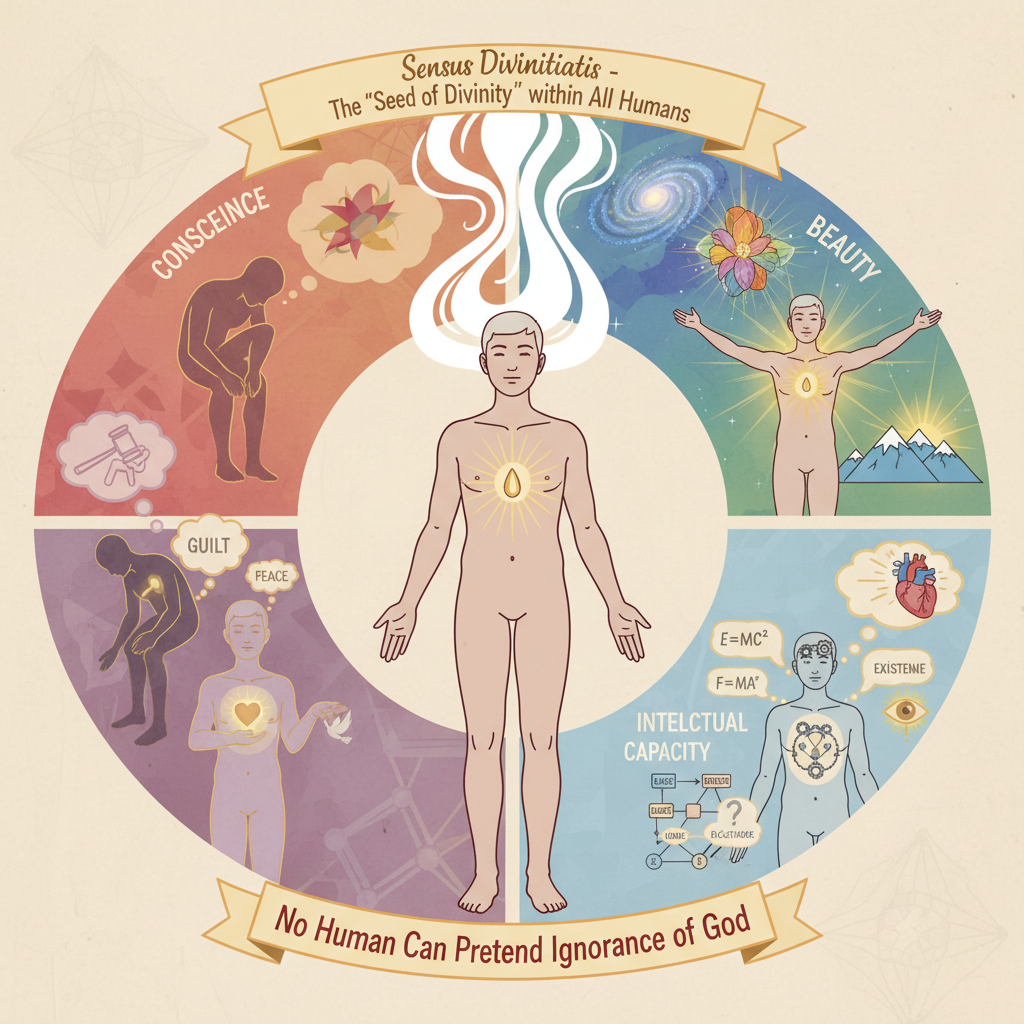
Introduction
The claim that the Fall completely eliminates natural knowledge of God sits at the intersection of three major theological debates: the extent of original sin's damage to human reason, the relationship between general and special revelation, and the question of whether natural theology — the project of using human reason and observation to know God — is possible at all. Natural knowledge of God refers to knowledge derived from human faculties — observation, reason, and the innate sense of the divine (sensus divinitatis) — without direct divine revelation. The claim is most powerfully associated with Karl Barth, who argues that the Fall has so completely corrupted human nature that no valid point of contact between the human mind and God remains, making natural theology not merely inadequate but fundamentally illegitimate. Against this, Aquinas argues that reason — though damaged by sin — retains sufficient capacity to know God's existence through the Five Ways; Calvin holds a nuanced middle position; and Brunner argues that some residual capacity for natural knowledge remains. I will argue that the claim is too absolute: while the Fall genuinely damages humanity's capacity for natural knowledge of God — and Barth correctly identifies the limits of natural theology as a path to salvation — Aquinas' Five Ways, Calvin's sensus divinitatis, and the biblical evidence of Romans 1 all show that some natural knowledge remains possible.
Mark-scheme aim
PECREL 1 — Barth's total rejection and the Barth–Brunner debate
Barth's argument that the Fall eliminates all natural knowledge of God — most fully developed in his debate with Brunner — is the strongest theological case for the claim, but it is overstated and theologically self-undermining.
Karl Barth, in Nein! (1934), responds to Brunner's argument that a residual "point of contact" (Anknüpfungspunkt) remains in fallen human nature for God's revelation. Barth's decisive response is threefold: first, the Fall has so completely corrupted human nature — including reason — that no reliable point of contact with God remains; second, if natural theology were possible, revelation would be unnecessary — but God clearly judged revelation necessary by sending Christ, which implies that unaided human reason cannot reach God; third, natural theology produces not knowledge of the true God but idols — projections of human desire and cultural assumption onto the concept of divinity. As Lauren's notes confirm: "Barth says Brunner does not take this far enough… only God can reveal himself if he so chooses." For Barth, all knowledge of God is revealed knowledge — the Word of God (Christ) is the sole legitimate point of contact between God and humanity, and any attempt to know God through reason or nature bypasses this and produces theology that is fundamentally about humanity rather than about God.
However, Barth's total rejection of natural theology is theologically self-undermining in an important respect: the very argument that natural theology is impossible and that revelation alone is the path to knowledge of God is itself a rational theological argument — it uses human reason to establish a conclusion about what human reason can and cannot do. If the Fall has destroyed human reason's capacity to know anything reliable about God, it is not clear how Barth's own theological argument can claim any validity. Furthermore, Barth's position implies that those who have never encountered the Word of God — in Christ and Scripture — have absolutely no knowledge of God and no basis for moral accountability, which appears to contradict Romans 1:20: "since the creation of the world God's invisible qualities — his eternal power and divine nature — have been clearly seen, being understood from what has been made, so that people are without excuse."
Barth can respond that Romans 1:20 does not vindicate natural theology but condemns natural humanity: the point of Paul's argument is not that humans can validly know God through nature but that they are without excuse for their idolatry precisely because enough of God's reality is visible to condemn them — not enough to save them. Natural knowledge, on this reading, is not a positive path to God but a confirmation of guilt. On the self-undermining charge, Barth can argue that theological reflection on the revealed Word — even when conducted in human language and reasoning — operates under the authority and illumination of the Spirit, not unaided fallen human reason.
Barth's Romans 1 response is exegetically defensible but creates a strange category: a knowledge that condemns but cannot save, that registers God's existence but provides no access to his character or purposes. This is not "no natural knowledge of God" but a severely limited form of it — which already concedes the title's absolute claim is too strong. The self-undermining charge is partially addressed by the Spirit-illumined theology response, but this move is unavailable to those who do not already accept the theological framework it presupposes — making Barth's position circular for apologetic purposes.
Barth's case for total elimination of natural knowledge is theologically powerful within a revealed theology framework, but its self-undermining character and its qualified reading of Romans 1 already suggest that "no natural knowledge" is too absolute even on Barth's own terms.
Mark-scheme aim
PECREL 2 — Calvin's sensus divinitatis, Aquinas' Five Ways, and the Fall's partial damage
Calvin's nuanced account of the sensus divinitatis and Aquinas' Five Ways together demonstrate that the Fall damages but does not eliminate natural knowledge of God — providing the strongest theological case against the claim in the title.
Calvin occupies a carefully calibrated position between Barth and Aquinas: he accepts that God has planted a sensus divinitatis — an innate sense of the divine — in every human being, and that general revelation through creation provides knowledge of God as creator accessible to all. However, the Fall has distorted this knowledge in two ways: the sensus divinitatis is suppressed or perverted by sin (hence the prevalence of idolatry rather than true worship), and the human mind's capacity to reason rightly from creation to God is severely limited by the noetic effects of sin. As the Calvin summary confirms: "natural knowledge condemns us because it removes our excuse of ignorance — we cannot say we were unaware that God exists." Calvin's conclusion is that natural knowledge provides enough to condemn (it removes the excuse of ignorance) but not enough to save (it cannot reveal the God of grace and redemption who is known only through Scripture). Aquinas is more optimistic: the Five Ways — cosmological, teleological, and ontological-style arguments from contingency, motion, causation, degrees of perfection, and order — demonstrate that reason, even in a fallen state, can validly infer God's existence from observation of the natural world. For Aquinas, the Fall damaged but did not destroy reason, and the truths accessible to unaided reason (God's existence, his power as first cause, his rational ordering of creation) are genuinely knowable — though the deeper truths of God's nature (Trinity, Incarnation, salvation) require revealed theology.
However, Hume challenges the validity of natural theological arguments from a secular direction: the design argument (Paley's watchmaker) infers a designer from observed order, but Hume argues in the Dialogues Concerning Natural Religion that the analogy between designed artefacts and the natural world is too weak to bear the conclusion — the world more resembles a growing organism than a manufactured machine, suggesting at best an immanent generative principle rather than a transcendent designer. The cosmological argument (Aquinas' First and Second Ways) infers a first uncaused cause, but Hume questions why the universe itself cannot be the uncaused cause — the "brute fact" objection. If natural reason cannot validly reach God through these arguments, then the Fall's damage to reason may be less relevant than the inherent limitations of natural theological reasoning even in its ideal form.
Aquinas responds that the Five Ways do not depend on the watchmaker analogy's weakness — his teleological argument (the Fifth Way) argues not from the appearance of design but from the directedness of non-rational things towards ends, which requires an intelligent orderer. On the brute fact objection, Aquinas' cosmological arguments distinguish between per se causal series (requiring a simultaneous sustaining cause) and per accidens series — the universe cannot be the uncaused cause of its own existence in the relevant sense because contingent being requires necessary being as its ground. Plantinga's sensus divinitatis account provides a further response: belief in God is a basic belief — properly grounded in the sense of the divine that God has built into human cognition — which does not require the natural theological arguments to succeed in order to be epistemically warranted.
Aquinas' response to Hume is philosophically sophisticated and the Five Ways remain serious arguments even after Hume's critique, though they are contested. Plantinga's properly basic belief account is particularly valuable: it shows that natural knowledge of God does not depend on the success of formal natural theological arguments but on the sensus divinitatis — which both Calvin and Plantinga identify as a genuine, if distorted, feature of fallen human cognition. The claim in the title is therefore too absolute: the Fall distorts and limits natural knowledge of God — Calvin and Barth are right about this — but Aquinas' Five Ways and Calvin's own sensus divinitatis account show that some natural knowledge remains available to fallen human reason.
Calvin's and Aquinas' accounts together establish that the Fall damages rather than eliminates natural knowledge of God — making the claim "no natural knowledge" too strong, even though "limited, insufficient-for-salvation natural knowledge" accurately captures what both Calvin and Aquinas actually teach.
Mark-scheme aim
Conclusion (RJ)
The claim that because of the Fall people can have no natural knowledge of God is too absolute to be convincing. Barth's powerful theological case — that revelation alone can bridge the gap between fallen humanity and God — correctly identifies the severe limitations of natural theology as a path to saving knowledge, and his critique of natural theology as prone to idolatry is a genuine and important warning. However, Romans 1:20, Calvin's sensus divinitatis, Aquinas' Five Ways, and Plantinga's properly basic belief all converge on the same conclusion: the Fall distorts, limits and corrupts natural knowledge of God without eliminating it entirely. The most defensible position — held by both Calvin and Aquinas — is that fallen human beings retain enough natural knowledge of God to be morally accountable (the knowledge condemns) but not enough to achieve saving knowledge of the God of grace (which requires special revelation). "No natural knowledge" is therefore an overstatement; "severely limited, distorted and insufficient for salvation" is the more theologically defensible and scripturally supported verdict.