On This Page
Family and Cultural Determination
"How convincing is the claim that the idea of family is entirely culturally determined?"
Back to Paper 3 essays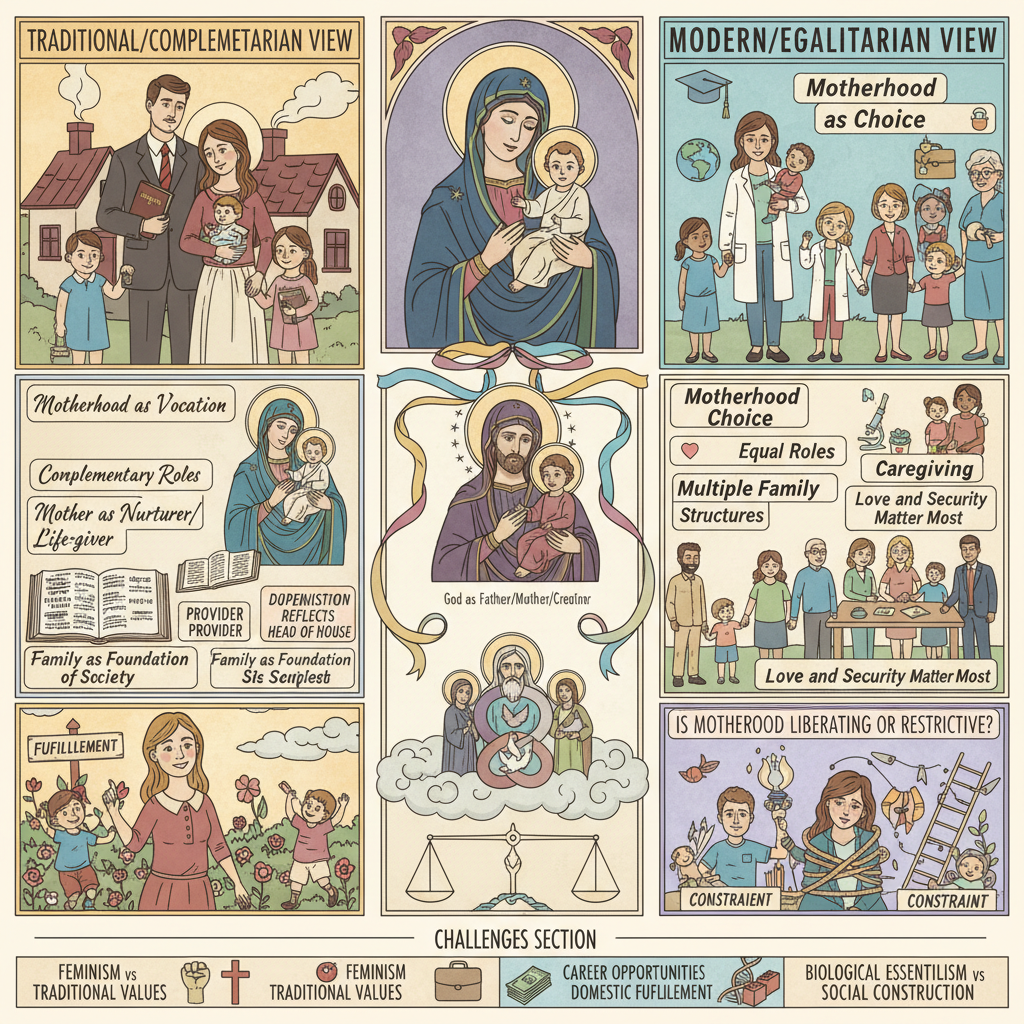
Introduction
The claim that the idea of family is entirely culturally determined — that there is no universal, natural or divinely ordained family structure, only historically contingent cultural arrangements that vary across time and place — challenges both the natural law tradition's account of the family as grounded in human biology and divine creation and the biblical tradition's affirmation of a normative family structure. The claim has empirical support: sociologists and anthropologists have documented enormous variation in family structures across cultures — extended families, matrilineal societies, polygamous arrangements, same-sex partnerships, single-parent families — which the "entirely culturally determined" claim takes as evidence that no single structure is natural or normatively privileged. Against this, conservative Christian theology (Catholic natural law, conservative Protestant complementarianism) holds that the nuclear family — husband, wife and children — reflects God's creational intention and the natural order of human society; and liberal Christian theology affirms that what matters is not the structure but the quality of relationships within any family form. I will argue that the claim is partially convincing — the specific cultural forms of family are genuinely variable and culturally shaped — but that "entirely" is too strong: there are cross-cultural constants (care, kinship, intergenerational obligation) that suggest family is not merely a cultural invention, and the Christian tradition's account of family as grounded in creation and covenant resists complete cultural determination.
Mark-scheme aim
PECREL 1 — The sociological and secular case for cultural determination
The sociological and secular feminist case for cultural determination of family is empirically substantial — and the critique of the nuclear family as a historically specific Western construct provides its strongest argument — but it conflates the cultural variability of family forms with the cultural determination of family itself.
The empirical case for cultural determination begins with the observation that family structures vary enormously across cultures and historical periods: matrilineal kinship systems, polygynous and polyandrous arrangements, extended clan-based households, and communal child-rearing practices all demonstrate that the nuclear family (two married heterosexual parents with dependent children) is far from a universal human arrangement. Lauren's notes confirm a decisive sociological point: "the nuclear family model is a Western, middle-class product of the mid-20th century" — making it a historically and geographically specific cultural product rather than a natural or divinely ordained structure. The feminist sociological critique reinforces this: the nuclear family's specific form — with a male breadwinner and female homemaker — was itself the product of specific economic conditions (industrialisation, wage labour, suburban development) that are already being reversed by women's financial independence and changing labour market patterns. The OCR mark scheme notes that "some secular feminist movements have completely rejected the idea and role of motherhood, regarding it as a form of slavery and product of patriarchy" — the most radical version of the cultural determination claim, which sees not just family forms but the specific valorisation of motherhood as ideological.
However, the cultural variability of family forms does not establish that family itself is entirely culturally determined — a crucial distinction the strong claim requires but rarely defends. Cross-cultural research consistently identifies certain universals across family structures: all known human societies have some form of regulated kinship system, some form of care for children that involves recognised obligations, and some form of intergenerational relationship that creates social stability. The variability is in how these constants are institutionalised and structured, not in whether they exist — which suggests that family answers to deep human needs (care, belonging, identity, intergenerational continuity) that are not themselves culturally variable even if their specific expressions are. The OCR mark scheme confirms this: "some significant secular research today shows that what matters to children is not the gender of their parents but whether they are loving, supportive and offer a stable environment" — which implicitly acknowledges that certain goods (love, stability, support) are cross-culturally necessary to family, even while their specific structural expression is variable.
The cultural determinist can respond that even the apparent universals — kinship regulation, child care, intergenerational obligation — are themselves culturally constructed categories: the boundaries of who counts as kin, what counts as adequate child care, and what intergenerational obligations exist are all defined differently across cultures. There is no culture-neutral standpoint from which to identify "cross-cultural constants" — the very categories used to compare family structures across cultures are themselves culturally shaped.
The cultural determinist response is philosophically sophisticated but ultimately unconvincing as an account of entirely cultural determination: the fact that the expression of human needs is culturally mediated does not establish that the needs themselves are cultural constructs. Children's need for stable, loving care — regardless of the specific structure that provides it — is not a cultural invention but a biological and psychological reality. The "entirely" in the title is therefore too strong even on purely secular grounds: some dimensions of family are genuinely cross-cultural in ways that resist complete cultural reduction.
The sociological case correctly shows that specific family structures are culturally variable, but the distinction between variable forms and cross-cultural constants shows that family is not entirely culturally determined — only partially.
Mark-scheme aim
PECREL 2 — Natural law, creation theology, and the liberal Christian response
The natural law and creation theology traditions provide the strongest theological case against entirely cultural determination — grounding family in human nature and divine ordinance — but the liberal Christian response shows that the quality of relationships rather than their specific structure is what the tradition most fundamentally commends.
Aquinas' natural law account holds that the family is grounded in the natural ends (telo) of human sexuality and procreation: sexual union between a man and woman is ordered by nature towards procreation, and the care of children requires the stable committed relationship of their parents — which grounds the nuclear family structure not in cultural convention but in the natural moral order accessible to human reason. The Catholic tradition systematises this: Humanae Vitae (1968), Familiaris Consortio (1981) and Amoris Laetitia (2016) all affirm the family grounded in the marriage of a man and a woman as the normative form ordained by God — not merely a cultural arrangement but a reflection of the Creator's design for human flourishing. The biblical foundation reinforces this: Genesis 1:27–28 ("male and female he created them… be fruitful and multiply") and Genesis 2:24 ("a man shall leave his father and mother and be united to his wife, and they shall become one flesh") present the complementary union of male and female as the creational basis of family — prior to culture and constitutive of human identity. Conservative Protestants draw on Ephesians 5:22–33 to present the family as a reflection of the relationship between Christ and the church — which elevates it from a cultural arrangement to a theological symbol of covenant love.
However, liberal Protestant and feminist theologians challenge the natural law account's equation of the normative family with the specific nuclear heterosexual structure. The OCR mark scheme explicitly confirms the liberal Protestant response: "some secular research today shows that what matters to children is not the gender of their parents but whether they are loving, supportive and offer a stable environment." If this is correct, then the goods that make family humanly and theologically valuable — love, stability, commitment, the nurture of children — can be realised in a variety of structural forms, which means the natural law tradition has over-specified what creation theology requires: the creation of humanity "male and female" grounds sexual complementarity without necessarily mandating a single specific family structure for all cultures and circumstances. Ruether's feminist theology argues that the patriarchal family — with male headship and female submission — is itself a cultural distortion of the authentic Christian family vision, not the natural order it claims to represent.
The natural law tradition responds that the liberal Protestant account reduces family to a set of functional goods (love, stability, support) that could in principle be provided by any stable human arrangement — but this loses the specifically theological account of what family is, not merely what it produces. The Genesis account presents the complementary union of male and female as constitutive of human identity — "it is not good for man to be alone" — not merely as one functional arrangement among others. The theological significance of the sexual differentiation of humanity — not merely its functional outcomes — grounds the family in creation rather than culture.
The natural law response is theologically serious, but the liberal Protestant challenge has significant empirical support: if loving, stable same-sex families produce equivalent outcomes for children as loving, stable opposite-sex families — as substantial research now suggests — then the functional goods account appears more empirically adequate than the natural law account's insistence on a single specific structure. The most defensible verdict is that the idea of family is partially culturally determined — the specific structures through which it is realised are genuinely variable — but not entirely, since both natural law theology and cross-cultural sociology identify certain goods (care, belonging, commitment, intergenerational continuity) that family serves across all cultures and which are not themselves cultural inventions.
Natural law grounds family in creation and resists complete cultural determination, but the liberal Protestant emphasis on relational quality shows that the tradition's core goods are structurally flexible — which confirms "partially but not entirely culturally determined" as the most defensible verdict.
Mark-scheme aim
Conclusion (RJ)
The claim that the idea of family is entirely culturally determined is partially convincing but ultimately overstated. The sociological evidence for the cultural variability of family structures is substantial and decisive against any account that presents a single specific family form — the mid-20th century Western nuclear family — as the universal natural order. However, the "entirely" in the claim is too strong: cross-cultural universals (care, kinship, intergenerational obligation, the stable nurture of children) demonstrate that family answers to human needs that are not themselves cultural constructs, even if their specific institutional expressions are. The natural law and creation theology traditions correctly identify that family is grounded in something deeper than culture — the complementary human capacity for love, commitment and intergenerational care — while the liberal Protestant emphasis on relational quality rather than structural form correctly shows that creation theology does not mandate a single specific cultural expression of these goods. The most defensible verdict is that family's specific forms are substantially but not entirely culturally determined, while family itself — as the human institution that provides stable care, belonging and identity across generations — answers to needs and goods that are cross-cultural, natural and, for Christian theology, divinely grounded.