On This Page
God Known Through Reason Alone
"Discuss critically the idea that the existence of God can be known through reason alone."
Back to Paper 3 essays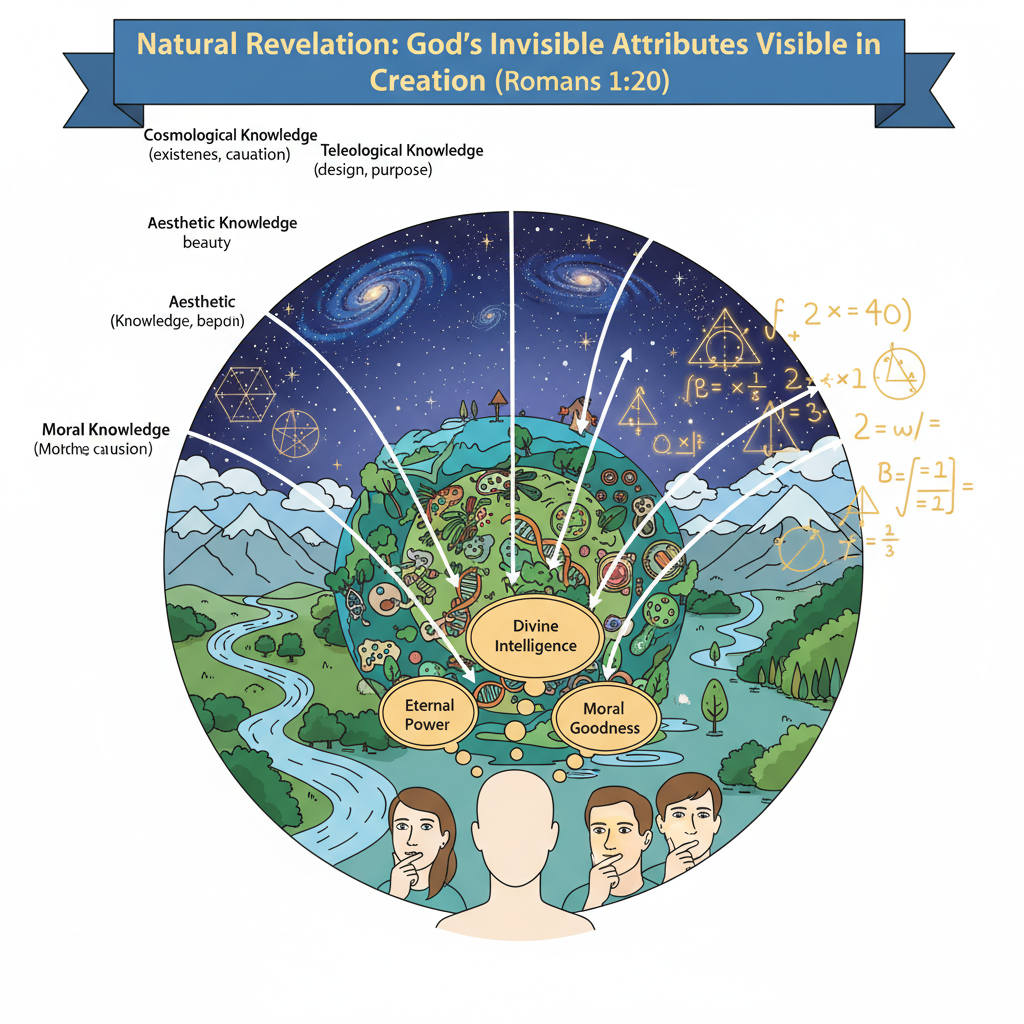
Introduction
The claim that God's existence can be known through reason alone is the aspiration of natural theology — the project of inferring God's existence from human reason and observation without recourse to divine revelation. The philosophical tradition offers three major families of argument: the cosmological argument (Aquinas' First, Second and Third Ways — from motion, causation and contingency), the teleological argument (Aquinas' Fifth Way and Paley's watchmaker — from order and design), and the ontological argument (Anselm, Descartes — from the concept of God alone, without observation). The ontological argument is uniquely relevant to the question: it claims to know God's existence through reason alone — a priori, without any empirical observation — while the cosmological and teleological arguments are a posteriori, drawing on experience of the world. Kant's critical philosophy presents the most systematic challenge to all three arguments, while Barth argues theologically that reason is insufficient even as a starting point. I will argue that the idea is partially but not fully convincing: the cosmological and teleological arguments show that reason can validly infer a first cause and designer from experience, but they cannot by reason alone establish the specifically Christian God; and the ontological argument — the only truly reason-alone argument — fails Kant's objection that existence is not a predicate.
Mark-scheme aim
PECREL 1 — The ontological argument: reason alone and Kant's decisive objection
The ontological argument is the only argument that genuinely claims to know God's existence through reason alone — without any empirical premises — but Kant's objection that existence is not a predicate presents a decisive challenge that Anselm and Descartes have not fully answered.
Anselm's ontological argument in the Proslogion (1078) proceeds entirely from the concept of God: God is "that than which nothing greater can be conceived." If God existed only in the mind, a greater being — one that existed in reality — could be conceived; but since God is by definition the greatest conceivable being, he must exist in reality as well as in the mind. This is a purely a priori argument: it moves from the definition of God to the conclusion that God exists, without appealing to any observation of the world. Descartes reformulates it: a perfect being must have all perfections; existence is a perfection; therefore God, as a perfect being, must exist. As the PEPED specification confirms, "the ontological argument is alone in maintaining that God's existence can be established a priori without recourse to empirical evidence… solely on the basis of an analysis of the concept of God."
Kant's objection — developed in the Critique of Pure Reason (1781) — is that existence is not a predicate. When we say "God is omnipotent" we add a predicate to the concept of God; but when we say "God exists," we are not adding anything to the concept but asserting that the concept has an instance in reality. The statement "God does not exist" is not a contradiction (as Anselm claims) but simply the denial that the concept of God has a real referent — which is a logically coherent denial. Kant's conclusion is that no purely conceptual analysis can establish existence: existence must always be established empirically, not deductively. Gaunilo's earlier objection reinforces this: if Anselm's argument were valid, it could be used to prove the existence of a perfect island — "the island than which none greater can be conceived must exist in reality" — which is clearly absurd.
Anselm responds to Gaunilo that the ontological argument applies specifically to necessary existence — God, as the greatest conceivable being, must exist necessarily (it is impossible for him not to exist), while a perfect island is a contingent being that could exist or not exist. Plantinga's modal ontological argument reformulates this: if God is possible (the concept of God is coherent), then God necessarily exists — since a necessary being, if possible, exists in all possible worlds. This avoids the Gaunilo objection since no contingent being has necessary existence as part of its concept.
Plantinga's modal reformulation is philosophically sophisticated, but Kant's objection retains force even against it: the claim that possibility entails necessary existence still smuggles existence into the analysis of a concept — it moves from "the concept of a necessary being is coherent" to "a necessary being exists," which is precisely the move Kant argues cannot be made by reason alone. The ontological argument, even in its strongest form, fails to demonstrate that the idea that God's existence can be known through reason alone is convincing — since the move from conceptual analysis to actual existence remains contested.
The ontological argument is the only genuinely reason-alone argument for God's existence, but Kant's existence-is-not-a-predicate objection shows it cannot validly move from the concept of God to God's actual existence — which is a decisive limitation on the claim that God can be known through reason alone.
Mark-scheme aim
PECREL 2 — The cosmological and teleological arguments: reason from experience, and the limits of natural theology
The cosmological and teleological arguments show that reason applied to experience can provide genuine grounds for belief in a first cause and designer — but they are a posteriori, not reason-alone arguments, and Hume's critiques and Barth's theological objection together show they cannot establish the specifically Christian God.
Aquinas' First Way (from motion) argues that everything that moves is moved by something else, and an infinite regress of movers is impossible — therefore there must be an unmoved mover, which everyone understands to be God. His Second Way (from causation) applies the same logic to efficient causes: everything has a prior cause, and the causal chain cannot regress infinitely — therefore there is a first uncaused cause. His Third Way (from contingency) argues that contingent beings — beings that might not have existed — cannot be the explanation of their own existence, and so there must be a necessary being whose existence is not contingent on anything else. Paley's watchmaker applies teleological reasoning: just as a watch's complexity and purposiveness imply a watchmaker, the complexity and apparent purposiveness of natural organisms imply a designer — God. These arguments use reason applied to empirical observation — they are a posteriori, not reason alone — but they represent the tradition's most developed case for knowing God through human rational capacities.
Hume's challenges in the Dialogues target both families of argument. On the cosmological argument, the brute fact objection: there is no logical necessity that the universe itself could not be the uncaused necessary being — applying the principle of sufficient reason to the universe's existence does not require going beyond it to a transcendent cause. On the teleological argument, Hume argues that the analogy between designed artefacts and the natural world is too weak — the world more resembles a growing organism than a machine, suggesting an immanent organising principle rather than a transcendent designer. Furthermore, even if the arguments succeed, they establish only a first cause or a powerful designer — not the omnipotent, omniscient, perfectly loving God of Christian theology. Barth makes this theological objection most sharply: the God reached by natural theology is not the God of Abraham, Isaac and Jacob — the personal, redeeming God who reveals himself in Christ — but an abstract philosophical principle that tells us little about the God who matters for salvation.
Aquinas responds that the cosmological arguments do not simply require a first cause but a necessary being that sustains all contingent beings in existence — which the universe cannot be, since it is manifestly contingent (it came into being and could cease to exist). On the designer objection, Aquinas' Fifth Way does not rely on the watchmaker analogy but on the directedness of non-rational beings towards ends — which requires an intelligent orderer whether or not the world looks like a machine. On Barth's theological objection, Aquinas' own position is that natural theology establishes only the preambles of faith (God's existence and some attributes) — the fuller knowledge of the specifically Christian God requires revealed theology, and Aquinas never claims otherwise.
Aquinas' responses are philosophically serious and partially address Hume's objections, though the brute fact response — and the possibility that quantum cosmology can describe a universe that is self-originating — continues to generate genuine philosophical dispute. The concession that natural theology establishes only preambles of faith is significant: it means that even the most successful cosmological and teleological arguments cannot by reason alone establish the Christian God — only a first cause or designer whose further attributes require revelation. The idea that God's existence can be known through reason alone is therefore partially justified — reason can establish grounds for theistic belief — but falls short of the full knowledge of God that the claim implies.
The cosmological and teleological arguments show that reason applied to experience can provide genuine grounds for theism, but they are a posteriori rather than reason-alone arguments, and Barth's theological objection correctly identifies that they cannot establish the specifically Christian God — which significantly limits the scope of the claim.
Mark-scheme aim
Conclusion (RJ)
The idea that God's existence can be known through reason alone is partially but not fully convincing. The ontological argument — the only genuinely reason-alone argument — provides an ingenious a priori case, but Kant's objection that existence is not a predicate remains the most powerful challenge to it, and even Plantinga's modal reformulation does not fully escape the charge of smuggling existence into conceptual analysis. The cosmological and teleological arguments provide serious grounds for theistic belief through reason applied to experience, but they are a posteriori rather than reason-alone arguments, and Hume's brute fact and analogy objections show they are genuinely contested. Even if successful, they establish only a first cause or designer — not the specifically Christian God — confirming Aquinas' own view that natural theology provides only the preambles of faith, with the fuller knowledge of God requiring revelation. The most defensible verdict is that reason can provide genuine and significant grounds for theistic belief — enough to make belief rational rather than irrational — but cannot by reason alone establish the existence of God with the certainty and specificity that the full claim requires.