On This Page
Inclusivism in Multi-Faith Society
"'The best response Christians can make to living in a multi-faith society is to take an inclusivist approach.' Discuss."
Back to Paper 3 essays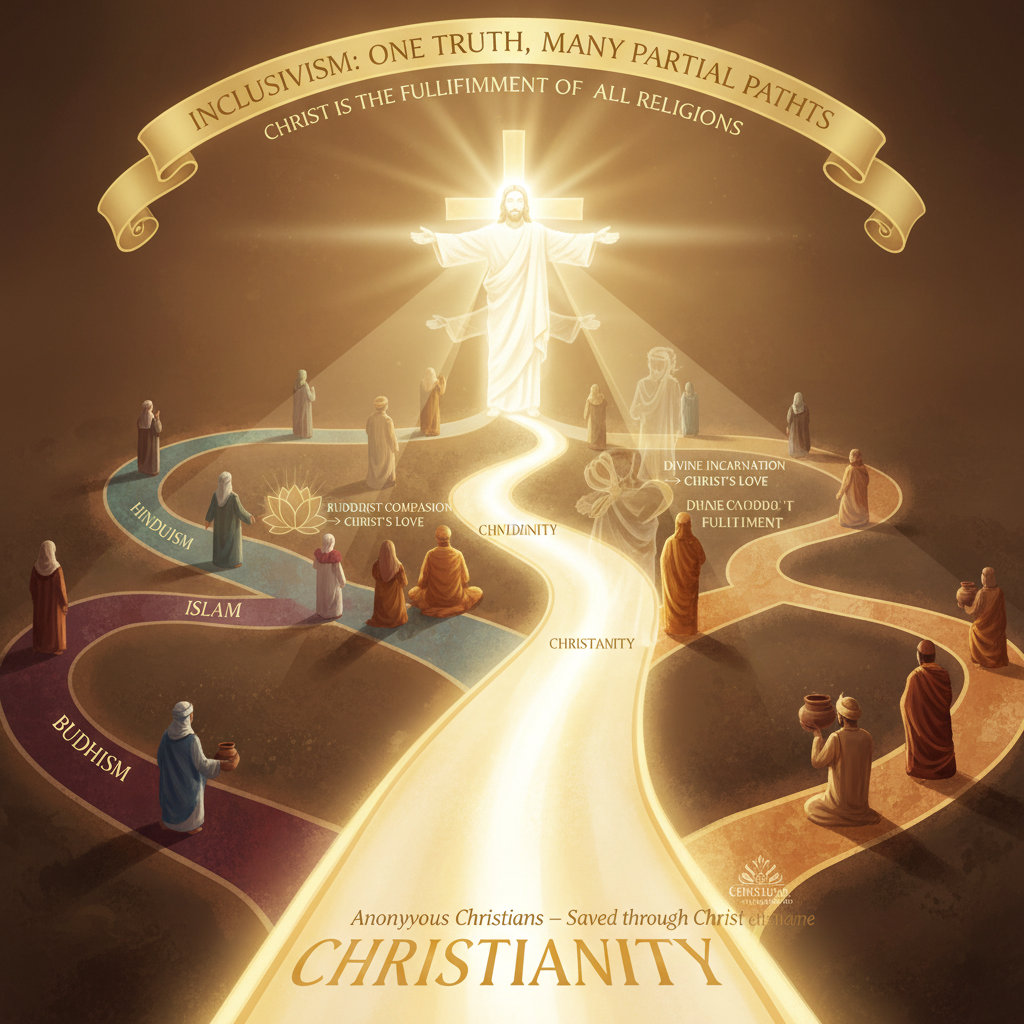
Introduction
The claim that inclusivism is the best Christian response to multi-faith society must be assessed against the three available frameworks — exclusivism, inclusivism and pluralism — and also against the specific question of what "the best response" means: the best theologically, the most practically adequate, or the most conducive to genuine interfaith dialogue and social cohesion. Inclusivism, as developed by Rahner and affirmed by Vatican II, holds that Christianity is the normative and most complete path to salvation, but that anonymous Christians in other faiths may receive the grace of Christ without explicitly knowing him — respecting the genuine spiritual value of other traditions while maintaining the unique centrality of Christ. Exclusivism holds that salvation is available only through explicit Christian faith — which challenges its adequacy for multi-faith social engagement. Pluralism (Hick) holds that all religions are equally valid paths — which challenges its theological coherence. The OCR sample question paper from H573/03 confirms this is a live examination question, with the mark scheme noting that "many inclusivists recognise that although Christianity is the normative means of salvation, other faith traditions are not without spiritual value." I will argue that inclusivism is a strong but not unambiguously the best response — it is theologically more adequate than either exclusivism or Hickian pluralism, but its condescension problem limits its usefulness for genuine interfaith dialogue, and a pneumatological pluralism or dialogical approach may supplement it more adequately in the specific context of multi-faith society.
Mark-scheme aim
PECREL 1 — Why exclusivism fails in multi-faith society and why inclusivism is better
Exclusivism is the least adequate Christian response to multi-faith society — both theologically and practically — and inclusivism's advantages over it are real and significant.
Restricted access exclusivism — the view that only those who explicitly accept Christ are saved, and that all other religions lead away from rather than towards God — generates serious practical problems in a multi-faith society. It implies that sincere, morally admirable members of other faith traditions — whose religious lives are characterised by genuine love, justice, and service — are nonetheless condemned, which most people find both morally counterintuitive and inconsistent with the Christian doctrine of a God who is love. As the OCR mark scheme notes, God's omnibenevolence appears incompatible with condemning those who have never had access to the Gospel through no fault of their own. In a multi-faith society, exclusivism creates the practical problem of demonisation of other faiths: if other religions are not merely incomplete but actively misleading, then Christian citizens cannot engage respectfully with their Muslim, Jewish, Hindu or Buddhist neighbours — which undermines the social cohesion and mutual respect that multi-faith democracy requires. The Seneca notes confirm that the inclusivist approach "allows people to be saved through their own religion while still maintaining that Christianity offers a better path" — which is both theologically defensible and socially more constructive.
However, universal access exclusivism — a softer form that argues God's grace reaches all people, but only through Christ, including post-mortem — partially addresses the moral fairness problem while maintaining Christ's uniqueness. This is not identical to inclusivism: it holds that salvation is through Christ alone even for those outside Christianity, but that God ensures all people have genuine access to this salvation through means beyond the ordinary preaching of the Gospel. This partially preserves exclusivism's theological commitments while avoiding the most morally troubling implications.
Rahner's inclusivism goes further than universal access exclusivism in a practically important way: it recognises that other religions have genuine positive spiritual value in themselves, not merely as contexts within which God secretly operates Christ's salvation. This allows Christians in multi-faith society to engage with other religions as sources of genuine insight and authentic spiritual life — not merely as contexts for covert evangelism — which is both more respectful and more honest about the actual experience of encounter with sincere religious believers of other traditions. As John Hick's own evolution confirms: after living in multi-faith Birmingham and encountering genuine holiness in mosques, synagogues, and temples, the claim that these communities had no genuine relationship with God became experientially implausible.
The inclusivist advantage over exclusivism is real: it enables genuine respect for other faiths while maintaining Christian theological identity, and it avoids the social and moral costs of exclusivism's condemnation of sincere non-Christians. Hick's experiential point — the encounter with genuine holiness in other traditions — is compelling as a motivation for moving beyond exclusivism, even if his own pluralist conclusion goes further than inclusivism warrants. The inclusivist approach is therefore a significant improvement on exclusivism as a response to multi-faith society.
Inclusivism is a substantially better response to multi-faith society than exclusivism — it respects genuine religious diversity, avoids moral condemnation of sincere non-Christians, and enables positive interfaith engagement — while preserving the Christian theological identity that exclusivism also maintains.
Mark-scheme aim
PECREL 2 — Inclusivism vs Hickian pluralism, the condescension problem, and the dialogical supplement
Inclusivism is theologically more adequate than Hickian pluralism — which is self-defeating — but the condescension problem limits its effectiveness in genuine interfaith dialogue, and a dialogical approach supplements it most adequately in the specific context of multi-faith society.
Against Hick's pluralism, inclusivism has a decisive theological advantage: it preserves the specific content of Christian faith — the Trinity, the Incarnation, the cross, the resurrection — without reducing them to culturally conditioned approximations of a philosophical abstraction (The Real) that no actual religion worships. As the theologynetwork.uk article confirms: "Pluralism parts company with both exclusivism and inclusivism by rejecting the premise that God has revealed himself in any unique or definitive sense in Jesus" — which is not a position that can be reconciled with orthodox Christian theology without abandoning its most specific and important claims. Inclusivism therefore allows Christians to engage respectfully with other faiths without the theological self-abandonment that Hickian pluralism requires. In the context of multi-faith society, this matters practically: Christians who adopt Hick's pluralism lose the distinctive theological identity that makes their contribution to interfaith dialogue a genuinely Christian one. Vatican II's Nostra Aetate — the most institutionally significant expression of the inclusivist approach — provides the practical framework: engaging other religions with respect, recognising the genuine goods they contain, while affirming the fullness of revelation in Christ.
However, the condescension problem remains a serious limitation of inclusivism as an interfaith response: when Christians engage with Muslims, Jews, Hindus and Buddhists on the assumption that these individuals are "anonymous Christians" whose religious life unknowingly participates in Christ's grace, they are not genuinely listening to those traditions on their own terms. Genuine interfaith dialogue requires what Hans Küng calls global responsibility — a willingness to learn from other traditions, acknowledge their genuine insights, and potentially allow them to challenge and enrich Christian understanding — which inclusivism's framework of Christian superiority structurally prevents. The dialogical approach — engaging other faiths with openness, learning from them, and seeking common ground on shared values (justice, compassion, human dignity) while maintaining honest disagreement about specific theological claims — may be more practically adequate for multi-faith society than inclusivism alone.
The inclusivist response is that the anonymous Christian concept does not prevent genuine learning from other traditions: Rahner himself emphasises the genuine spiritual value of other religions, and recognising that Christ's grace operates through them does not require condescension but theological humility — an acknowledgment that God's grace is larger than the explicit boundaries of the church. Furthermore, the dialogical approach requires a theological grounding to be distinctively Christian — dialogue without theological identity produces the Hickian problem of evacuating Christianity's specific content, while dialogue grounded in inclusivist theology maintains both genuine openness and genuine Christian identity.
The inclusivist response partially addresses the condescension problem: the recognition of genuine salvific value in other traditions is a real and important concession that moves well beyond exclusivism's dismissiveness. However, the condescension problem is not fully resolved by theological humility: it is structurally embedded in the framework itself, since inclusivism cannot avoid the implication that other religions are assessed and validated according to a Christian criterion (their participation in Christ's grace) that they themselves do not accept. The most adequate practical response to multi-faith society is therefore an inclusivist theology supplemented by a dialogical practice: maintaining the theological convictions of inclusivism while practising the genuinely open, listening, mutually learning engagement that the dialogical approach requires — and accepting that some theological questions may not be resolved before genuine shared life in multi-faith society can proceed.
Inclusivism is the best theologically grounded response but requires dialogical supplementation to be fully adequate for multi-faith society — making the claim that it is "the best response" partially correct but in need of qualification.
Mark-scheme aim
Conclusion (RJ)
The claim that inclusivism is the best Christian response to multi-faith society is substantially but not unqualifiedly correct. Inclusivism is clearly superior to exclusivism — it avoids the moral condemnation of sincere non-Christians, respects the genuine spiritual value of other traditions, and enables positive interfaith engagement while preserving Christian theological identity. It is also theologically more adequate than Hickian pluralism, which achieves universal religious respect at the cost of evacuating the specific content of every religion it claims to affirm — including Christianity's own most important claims about the Incarnation and the cross. However, the anonymous Christian concept's condescension problem limits inclusivism's effectiveness as a framework for genuine interfaith dialogue, since it assesses other traditions according to a Christian criterion they do not accept. The most defensible verdict is that inclusivism provides the best theological grounding for Christian engagement in multi-faith society — preserving both the uniqueness of Christ and the possibility of universal salvation — but must be supplemented by a genuinely dialogical practice that listens to other traditions on their own terms and seeks common ground across theological difference. The best response is not inclusivism alone, but inclusivist theology expressed through dialogical practice.