On This Page
Jesus as More than Political Liberator
"'Jesus was more than a political liberator.' Discuss."
Back to Paper 3 essays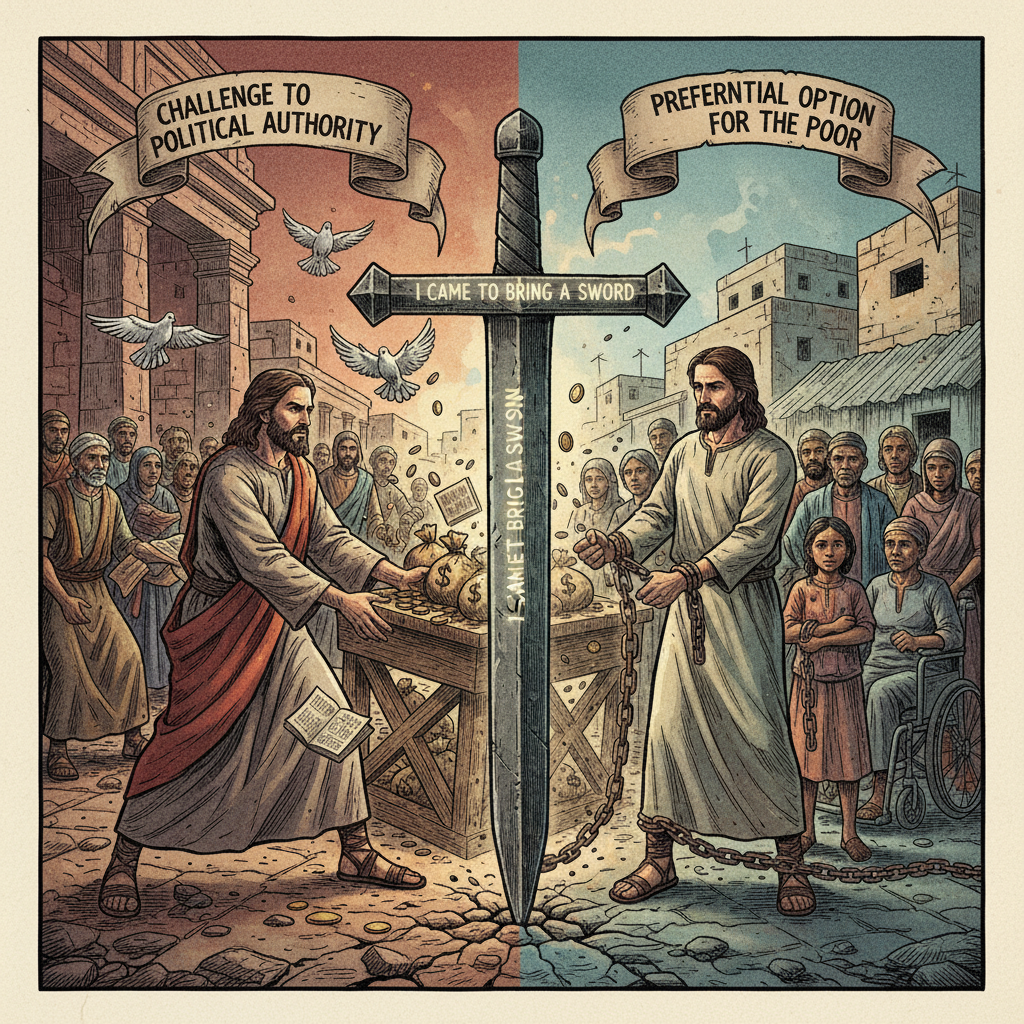
Introduction
The claim that Jesus was more than a political liberator requires both an assessment of whether Jesus was a political liberator in any meaningful sense and an examination of the theological claims — Son of God, Teacher of Wisdom, the incarnate Word — that the tradition offers as the fuller account of his identity. Liberation theology, developed by Gustavo Gutiérrez in A Theology of Liberation (1971), provides the most developed case for seeing Jesus as a liberator: it argues that Jesus identified with the poor and marginalised (preferential option for the poor), challenged structural sin in the socio-economic and political order, and that the Gospel's call to justice is inseparable from political and social transformation. However, the Christian tradition's Chalcedonian account of Jesus as fully human and fully divine — the second person of the Trinity incarnate — maintains that liberation theology, however valuable, captures only one dimension of Jesus' identity, and that his significance as Son of God, atoning sacrifice and risen Lord far exceeds any political category. I will argue that the claim is substantially correct: Jesus' identity cannot be reduced to political liberation, and the Chalcedonian Christology provides a richer and more adequate account — but that liberation theology correctly identifies a genuine and neglected dimension of Jesus' ministry that orthodox Christology must incorporate rather than dismiss.
Mark-scheme aim
PECREL 1 — Liberation theology's case and the biblical foundation
Liberation theology makes a biblically grounded and theologically serious case for Jesus as political liberator — but its own best arguments show that Jesus' liberation is simultaneously more and other than political, revealing the inadequacy of the purely political category.
Gutiérrez argues that Jesus' ministry is characterised by a preferential option for the poor: he consistently identifies with, heals, and defends the poor, marginalised, and socially excluded — tax collectors, women, Samaritans, lepers. His proclamation in Luke 4:18 — "the Spirit of the Lord is on me, because he has anointed me to proclaim good news to the poor… to set the oppressed free" — draws directly on Isaiah's language of liberation and is explicitly applied by Jesus to his own mission. The bishops at Medellín (1968) reaffirmed that God "sends his Son in the flesh, so that he might come to liberate everyone from the slavery to which sin has subjected them" — connecting the incarnation directly to the project of liberation from structural oppression. Gutiérrez makes the crucial theological move of extending the concept of sin: sin is not merely personal and individual but structural and socio-economic — poverty, exploitation and political oppression are forms of sin embedded in social structures, and liberation from these is therefore part of what salvation means. The philosopher kings notes confirm that liberation theologians argue "the outcome of individuals following his teachings is structural change — so Jesus' teachings should be seen as aiming at structural socio-economic change."
However, the liberation theology account faces two significant challenges. First, the historical Jesus challenge: the Gospels show Jesus consistently declining political roles — he refuses to be made king (John 6:15), declares "my kingdom is not of this world" (John 18:36), and instructs his followers to "render to Caesar the things that are Caesar's" (Matthew 22:21). As alevelphilosophyandreligion.com notes, "it is hard to see how Jesus could be considered a political figure… he never aimed his teachings at socio-economic structures… he did exclusively focus on individuals and their choices." Second, structural sin — while a theologically legitimate concept — risks reducing Jesus' liberating mission to a social programme in a way that loses its eschatological and redemptive core: the liberation Jesus proclaims includes but goes beyond freedom from socio-economic oppression to freedom from sin, death and estrangement from God.
Liberation theologians can respond that the distinction between spiritual and political liberation is itself a product of Western, middle-class theology that privatises the Gospel to protect existing social arrangements. When Jesus proclaims good news to the poor, heals on the Sabbath in defiance of religious authorities, drives traders from the Temple, and shares meals with outcasts, he is engaging in socially disruptive acts with direct political implications — his crucifixion was, after all, a Roman political execution, not a religious ceremony. The Magnificat (Luke 1:46–55) — "he has brought down rulers from their thrones and lifted up the humble" — is explicitly political language within the narrative of Jesus' coming.
The liberation theology response correctly identifies that Jesus' ministry has genuine political dimensions that traditional Christology has sometimes suppressed. However, the argument that Jesus' teaching produces structural change as a consequence of individual transformation is subtly but importantly different from claiming that Jesus was a political liberator: it means his political significance is derivative of his deeper identity as teacher, healer and Son of God — not constitutive of it. Rosemary Ruether's feminist Christology reinforces this: she argues that Jesus the liberator challenged the social, religious and spiritual assumptions of his day for both genders — but the gender of Jesus is ultimately not important because what defines his significance is his role as liberator of the full humanity of all people, which transcends political categories. The claim that Jesus was "more than" a political liberator is therefore not a dismissal of the political dimension but a recognition that the political is contained within a larger soteriological and Christological framework.
Liberation theology correctly identifies a genuine and important dimension of Jesus' ministry but cannot by itself provide an adequate account of his identity — precisely because the liberation Jesus brings transcends political categories and requires the fuller Christological framework of Son of God and atoning redeemer.
Mark-scheme aim
PECREL 2 — Chalcedonian Christology, the hypostatic union, and Jesus as Son of God
The Chalcedonian definition of Jesus as fully human and fully divine — the second person of the Trinity incarnate — provides the fuller account of Jesus' identity that the title's "more than" claims, but the two-natures doctrine generates its own philosophical difficulties.
The Council of Chalcedon (451 AD) defined Jesus Christ as "perfect in divinity and perfect in humanity… one person in two natures, without confusion, change, division or separation." This hypostatic union — the union of divine and human natures in one person — captures what is meant by "more than": Jesus is not merely a great political or moral leader but the second person of the eternal Trinity who became flesh, lived, died and rose again for the salvation of humanity. As the Seneca notes confirm, Jesus' authority as Son of God is demonstrated through: his knowledge of God ("the Father and I are one" — John 10:30; "whoever has seen me has seen the Father" — John 14:9); his miracles (power over nature demonstrating divine authority); and the resurrection — the ultimate demonstration of his divinity and the ground of Christian proclamation. The "I am" sayings in John's Gospel — "I am the bread of life," "I am the way, the truth and the life," "I am the resurrection and the life" — echo the divine name of Exodus 3 and present Jesus as making an explicit claim to unique divine identity. Lauren's notes confirm that these statements show Jesus knew himself to be "fully conscious of God's will" and in a relationship with the Father that is qualitatively different from that of any other human being.
However, the Chalcedonian definition generates the serious philosophical problem of coherence: how can one person be simultaneously omniscient (as God) and limited in knowledge (as a genuinely human being)? Mark 13:32 — "no one knows about that day or hour, not even the angels in heaven, nor the Son" — appears to show Jesus explicitly denying omniscience, which creates tension with the claim that he is fully divine. John Hick challenges the uniqueness of Jesus' divine sonship from a different direction: Jesus was not the Son of God in a unique ontological sense but a human being of extraordinary spiritual depth — a "guru" and moral "role model" whose significance lies in his teaching and example rather than his metaphysical constitution. Hick argues that the language of "Son of God" is mythological — a way of expressing the significance of Jesus' relationship with God in the culturally available idiom of first-century Judaism, not a literal metaphysical claim.
The Chalcedonian tradition responds to the coherence problem through the concept of kenosis (Phil 2:7 — Christ "emptied himself"): in the incarnation the Son voluntarily limited the exercise of divine attributes (omniscience, omnipotence) in order to become genuinely human — which means Jesus' limited knowledge in Mark 13:32 is precisely what the incarnation requires, not a contradiction of it. On Hick's mythological account, the tradition responds that the "I am" sayings, the resurrection appearances, and the theological reflection of the New Testament (John 1:1 — "In the beginning was the Word… and the Word was God") are not mythological embellishments but the earliest and most fundamental Christian testimony to Jesus' actual identity.
The kenosis response is theologically sophisticated and partially addresses the coherence problem, though it generates further questions about the nature of divine self-limitation. Hick's mythological account is important as a challenge but is widely regarded as inadequate to the full New Testament testimony: the Gospel of John's "I am" sayings and the Pauline Christ-hymns (Phil 2:6–11, Col 1:15–20) are not credibly read as merely metaphorical without doing significant violence to the texts. The Chalcedonian account, for all its philosophical complexity, remains the most adequate response to the full range of New Testament evidence about Jesus' identity — and the claim that Jesus was "more than" a political liberator is most convincingly grounded in this framework.
Chalcedonian Christology provides the most adequate theological account of Jesus' identity as Son of God, fully human and fully divine — and it is this framework, not any political category, that best explains both the specific character of Jesus' liberating activity and the claim that he is "more than" a liberator.
Mark-scheme aim
Conclusion (RJ)
The claim that Jesus was more than a political liberator is substantially correct and theologically important. Liberation theology — particularly Gutiérrez's preferential option for the poor and the concept of structural sin — correctly identifies a genuine and often neglected dimension of Jesus' ministry, and the Medellín bishops were right that the incarnation is inseparable from the project of human liberation. However, the political category is both too narrow and structurally derivative: Jesus consistently declined explicitly political roles, his teaching aims at the transformation of individuals whose changed lives then produce structural consequences, and his crucifixion and resurrection — the events that define his significance for Christians — are not political events in any primary sense but soteriological ones. The Chalcedonian account of Jesus as fully human and fully divine — the second person of the Trinity incarnate, whose "I am" sayings, miracles and resurrection demonstrate a uniquely intimate relationship with the Father — provides the most adequate framework for understanding both the character of his liberation and its transcendence of any purely political category. Jesus was a liberator, but the liberation he brings is of sin, death and estrangement from God — a liberation that encompasses the political without being reducible to it.