On This Page
Jesus' Unique Relationship with God
"How convincing is the claim that Jesus' relationship with God was unique?"
Back to Paper 3 essays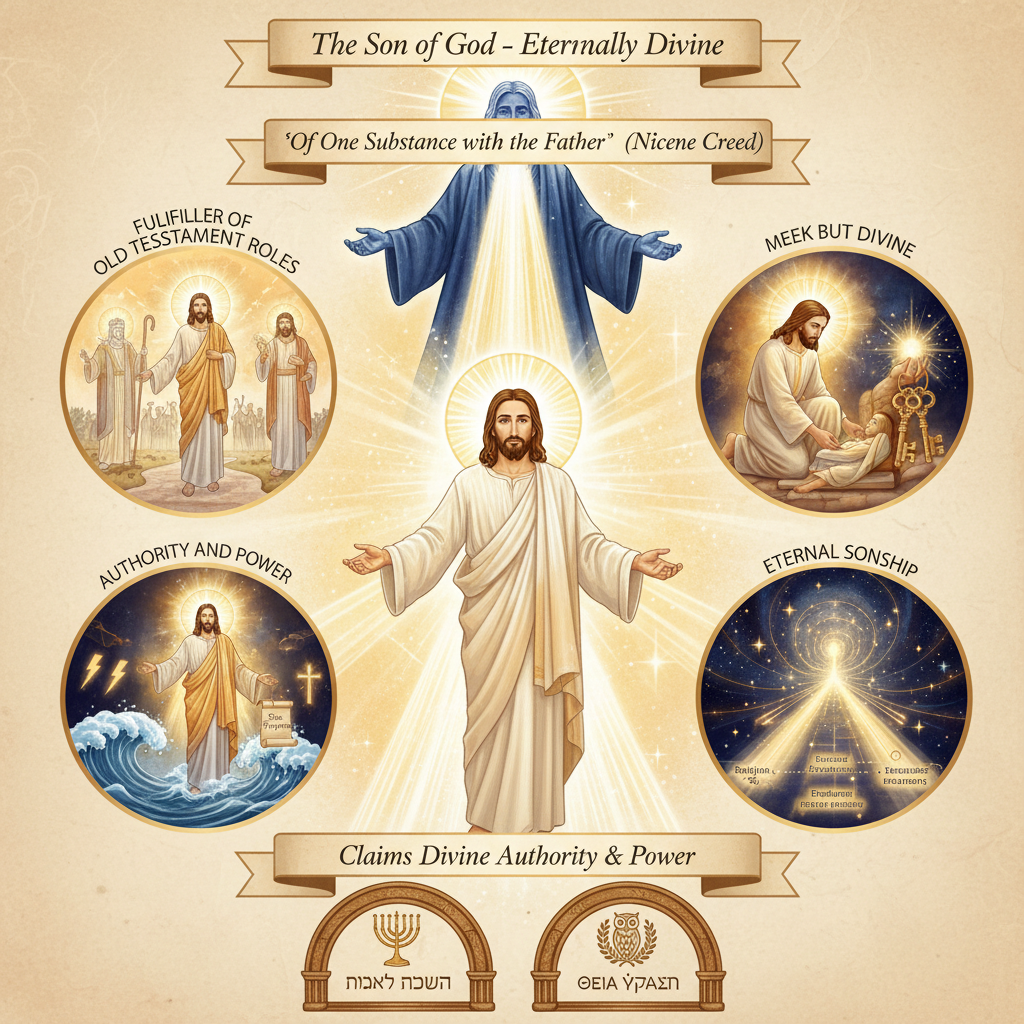
Introduction
The claim that Jesus' relationship with God was unique is at the heart of Christian Christology — the theological discipline that attempts to answer Jesus' own question "who do you say I am?" (Mark 8:29). The claim has both a functional and an ontological dimension: functionally, Jesus acted with divine authority — healing, forgiving sins, and commanding obedience — in ways no other human being claimed; ontologically, the Chalcedonian tradition claims that Jesus is the second person of the eternal Trinity, fully divine and fully human, whose sonship is not adoptive but eternal and constitutive of his being. The claim's convincingness must be assessed against: the biblical evidence for Jesus' unique relationship with God (the "I am" sayings, the baptism and transfiguration, the resurrection); the Chalcedonian theological framework that systematises this evidence; and the challenges from Hick's mythological account, Macquarrie's existential Christology, and the pluralist argument that Jesus' relationship with God is unique in degree but not in kind. I will argue that the claim is convincing in its functional dimension — Jesus' relationship with God was demonstrably unlike that of any other historical figure — but that the stronger ontological uniqueness claim (unique second-person-of-the-Trinity divine sonship) is convincing only within the theological tradition that accepts Chalcedonian Christology.
Mark-scheme aim
PECREL 1 — The biblical evidence for unique relationship: "I am" sayings, baptism, and resurrection
The biblical evidence — particularly the "I am" sayings, the baptism and transfiguration, and the resurrection — provides a compelling case for the functional uniqueness of Jesus' relationship with God, even before the stronger ontological claim is assessed.
In John's Gospel, Jesus uses the "I am" (egō eimi) formulation on multiple occasions — "I am the bread of life" (6:35), "I am the way, the truth and the life" (14:6), "I am the resurrection and the life" (11:25) — deliberately echoing the divine name revealed to Moses in Exodus 3:14 ("I AM WHO I AM"). This is a claim to unique divine identity: no prophet, teacher or religious figure in the Jewish tradition spoke in this way, and John 8:58 makes the claim most explicit — "before Abraham was, I am." At Jesus' baptism (Matthew 3:17), the voice from heaven declares "this is my Son, whom I love; with him I am well pleased" — a direct divine attestation of a unique filial relationship that the disciples also witness at the transfiguration (Matthew 17:5), where the same declaration is repeated. Jesus' habitual address of God as Abba (Father — Mark 14:36) — an unusually intimate term that Joachim Jeremias argued was unprecedented in Jewish prayer — suggests a distinctive awareness of personal intimacy with God that goes beyond the prophetic relationship. The resurrection is the defining confirmation: as Lauren's notes confirm, "even scholars who see Jesus as no more than an ordinary human being in his lifetime agree that the resurrection reveals Jesus as the Son of God" — the risen Christ is the ground of Christian proclamation that Jesus' relationship with God is uniquely validating and salvific.
However, the biblical evidence is hermeneutically contested in significant respects. The "I am" sayings are predominantly from John's Gospel — the most theologically developed of the four Gospels, written latest and most strongly shaped by early Christian Christological reflection. Scholars in the historical-critical tradition argue that the "I am" sayings and the explicit divine sonship claims in John represent the developed theology of the Johannine community rather than the ipsissima verba of the historical Jesus — the Synoptic Gospels present a Jesus who is more reticent about his identity (the "messianic secret" in Mark). Hick draws on this to argue that Jesus was a human being whose followers, after the resurrection experience, elevated him to divine status through a process of theological development — the uniqueness is attributed, not intrinsic.
The traditional response is that the historical-critical distinction between the historical Jesus and the Johannine Christ is itself methodologically contestable: the Synoptic Gospels contain implicit high Christology — Jesus' claim to forgive sins (Mark 2:5), his "but I say to you" authority over Torah (Matthew 5), and his use of Abba all suggest a unique relationship with God that is not a Johannine invention. Furthermore, as the Seneca notes confirm, the resurrection appearances — experienced by multiple witnesses across all Gospel traditions and Paul's letters — are not credibly explained as mere theological development: they ground the Christological claims in an event, not merely in reflection.
The traditional response is substantially persuasive: the breadth of Christological testimony across all four Gospels, Paul's letters, and the early church's witness is difficult to explain as a purely post-mortem theological construction. Hick's attribution theory — that uniqueness was conferred rather than intrinsic — is plausible as a sociological account of how a movement develops, but it cannot explain why the earliest Christians were prepared to die for the claim that Jesus was risen and divine if this was simply a metaphorical way of expressing his moral significance. The functional uniqueness of Jesus' relationship with God — his intimacy with the Father, his authority, his resurrection — is therefore convincingly established by the biblical evidence across the tradition.
The biblical evidence establishes functional uniqueness convincingly; the question is whether this grounds the stronger ontological claim of Chalcedonian uniqueness — which the next PECREL assesses.
Mark-scheme aim
PECREL 2 — Ontological uniqueness, Chalcedonian Christology, and the Hick/Macquarrie challenge
The ontological uniqueness claim — that Jesus is the second person of the eternal Trinity, fully divine and fully human — provides the most complete account of his unique relationship with God, but Hick's pluralism and Macquarrie's existential Christology present significant challenges to its persuasiveness as a universal claim.
The Chalcedonian definition of Jesus as one person in two natures — "co-equal and co-eternal" with the Father — grounds ontological uniqueness in the doctrine of the Trinity: Jesus' relationship with God is unique not merely in degree (he was an especially devout or spiritually aware human being) but in kind (he is the eternal Son whose relationship with the Father constitutes the second person of the Trinity). As the alevelphilosophyandreligion.com notes confirm: "Jesus' relationship with God was therefore unique in that Jesus is the second person of the holy trinity. Jesus is the Son of God and Jesus is God." The pre-existence of the Son — John 1:1 ("In the beginning was the Word… the Word was God"), Colossians 1:15–17 ("he is the image of the invisible God, the firstborn over all creation… all things have been created through him and for him") — grounds this uniqueness in eternity rather than in historical development. The hypostatic union means that Jesus is not a human being who achieved an unusually close relationship with God but God who became human — which makes the uniqueness constitutive rather than achieved.
Hick's pluralist account challenges ontological uniqueness directly: in The Myth of God Incarnate (1977), he argues that the incarnation is a mythological rather than a literal claim — "Son of God" is a metaphorical way of expressing Jesus' spiritual significance, not a literal ontological description. Multiple religious traditions have figures of exceptional spiritual significance, and the claim that Jesus' relationship with God is uniquely ontological — as opposed to uniquely significant within the Christian tradition — is religious imperialism that fails to take seriously the depth of relationship with God experienced and taught by other religious figures. Macquarrie offers a more nuanced challenge: every human life is unique in some respect, and what makes Jesus significant is not a metaphysical claim about his nature but his place in history — the events that led into his birth, his life and teachings, and the effects of these on human history constitute an existential uniqueness without requiring the Chalcedonian ontological claims.
The Chalcedonian tradition responds to Hick that the mythological reading cannot do justice to the full New Testament testimony: the Prologue of John, the Christ-hymn of Philippians 2, and the resurrection appearances are not credibly read as merely metaphorical without distorting the texts beyond recognition. Furthermore, Hick's pluralism is not itself theologically neutral — it presupposes that all religious traditions are equally valid paths to the same ultimate reality, which is itself a substantive theological claim that is not obviously more defensible than Chalcedonian Christology. On Macquarrie, the tradition concedes that historical uniqueness is real and important, but argues it is grounded in ontological uniqueness — Jesus' place in history is what it is because he is who he is.
The Chalcedonian response to Hick is persuasive on the textual evidence, but less persuasive as a universal claim: Hick's challenge — that the uniqueness claim is compelling within Christianity but not self-evidently valid across the full range of human religious experience — identifies a genuine epistemological limitation. The ontological uniqueness claim is convincing for those who accept the Chalcedonian framework and the New Testament's full testimony, but not straightforwardly convincing as a universal philosophical claim independent of that framework. Macquarrie's existential Christology is a more modest but more universally accessible account — and as Lauren's notes acknowledge, even Macquarrie concedes that "Christ is not just one amongst many because he defined what it means to exist as a human," which is a form of uniqueness claim even while rejecting the Chalcedonian ontology.
The ontological uniqueness claim is most convincing within the Chalcedonian tradition — grounded in the full New Testament testimony — but its persuasiveness as a universal claim is limited by Hick's pluralist challenge; Macquarrie's existential Christology provides a more accessible but thinner version of uniqueness that even pluralists can partially accept.
Mark-scheme aim
Conclusion (RJ)
The claim that Jesus' relationship with God was unique is convincing in its functional dimension and conditionally convincing in its ontological dimension. The biblical testimony across all four Gospels, Paul's letters, and the resurrection witness establishes a functional uniqueness — in authority, intimacy, self-identification with God, and post-mortem vindication — that is difficult to explain away as mere theological attribution. The Chalcedonian account that this functional uniqueness reflects the ontological uniqueness of the second person of the eternal Trinity provides the most comprehensive and textually adequate account of why Jesus' relationship with God is unique in kind rather than merely in degree. However, Hick's pluralist challenge correctly identifies that this ontological uniqueness claim is not self-evidently persuasive outside the Chalcedonian framework, and Macquarrie's existential Christology provides a more modest but more widely accessible account of uniqueness. The most defensible verdict is that Jesus' relationship with God was unique — functionally and very probably ontologically — but that the strength of the ontological claim's persuasiveness is proportional to the degree of acceptance of the Chalcedonian framework within which it is most fully intelligible.