On This Page
Love as Sufficient Christian Ethics
"How fair is the claim that the principle of love is all that is necessary for Christian ethics?"
Back to Paper 3 essays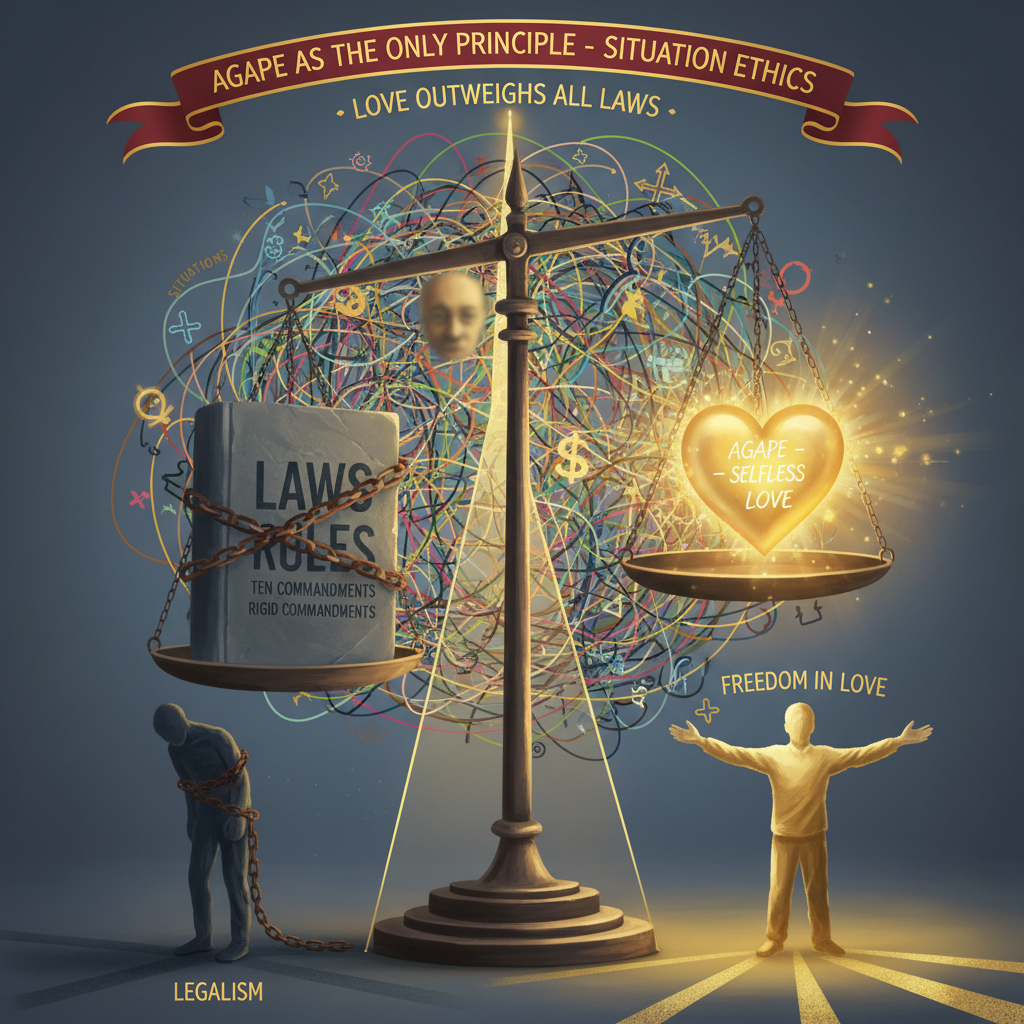
Introduction
The claim that the principle of love is all that is necessary for Christian ethics is most fully developed by Joseph Fletcher in Situation Ethics (1966), where he argues that agape — selfless, unconditional love of the neighbour — is the only intrinsic good, the ruling norm of moral decision-making, and the sole criterion by which actions are to be evaluated. Fletcher's claim has a powerful biblical foundation: Jesus himself summarises the whole of the Torah in the double commandment — "love the Lord your God… and love your neighbour as yourself" (Matthew 22:37–40) — and Paul declares that "love is the fulfilment of the law" (Romans 13:10). The question asks how fair this claim is — which requires assessing not only Fletcher's case but also the challenges from: the legalist tradition (the Ten Commandments, natural law, biblical precepts), the antinomian critique (love alone without rules provides insufficient guidance), Barth's Word of God theology, and the Roman Catholic synthesis of Bible, Church and reason. I will argue that the claim is partially fair — love is genuinely the central and irreducible principle of Christian ethics — but that "all that is necessary" is too strong: love requires grounding in a narrative of human nature, forgiveness and redemption, and needs reason and community to be practically applicable.
Mark-scheme aim
PECREL 1 — Fletcher's case for love as sufficient and the antinomian objection
Fletcher's situationist case for agape as the sole sufficient principle has compelling biblical roots and genuine moral insight — but its sufficiency claim fails the antinomian and practical adequacy tests.
Fletcher's six propositions develop the sufficiency claim systematically: love is the only intrinsic good; love is the ruling norm that replaces all laws; love and justice are the same thing ("justice is love distributed"); love wills the neighbour's good regardless of personal feeling; love is the end that justifies any means; and love decides each situation without pre-established rules. The biblical grounding is strong: in Matthew 22:37–40, Jesus explicitly identifies love as the principle on which "all the Law and the Prophets hang" — making love not merely one principle among others but the foundation of the entire moral and religious tradition. Fletcher points to Jesus' own situationist practice: healing on the Sabbath (Mark 3:1–6), forgiving the adulterous woman (John 8:1–11), and dining with outcasts — all cases where love overrides legalistic rules. As the Seneca notes confirm, "the most loving thing to do is always the right thing to do" — the simplicity of this criterion is both its theological appeal (love is what the Gospel is about) and its practical appeal (it does not require mastery of complex rule systems).
However, antinomianism — the charge that love without rules provides insufficient moral guidance — is a serious objection. Fletcher's own illustrative cases — the "sacrificial adultery" case (a wife sleeping with a prison guard to secure her husband's release) and the justification of lying to protect the innocent — show that agape can justify virtually any action, including serious moral violations, if the agent sincerely believes a loving outcome will follow. This creates two problems: first, epistemic: how does the agent know what outcome will actually be most loving in a complex situation? — the consequences of actions are frequently unpredictable, and sincere agapeic intention does not guarantee wise judgement. Second, manipulative: the flexibility of love as the sole criterion means it can be used to justify almost anything — individuals can convince themselves that their preferred action is "the most loving" when it actually serves self-interest. Lauren's notes capture this: "it seems to give too much discretion to the individual… how do we know whether we have enough wisdom to make the right decision in each situation?"
Fletcher responds that the alternatives — legalism and rule-based ethics — are worse: rigid rules applied without reference to the specific situation frequently produce worse outcomes than compassionate situational reasoning, and the history of legalistic religion is full of instances where rules were used to excuse hardness of heart and cruelty in the name of principle. Jesus' own practice shows that love regularly overrides rules when they conflict — and that this is not moral licence but moral maturity. Furthermore, agape is not arbitrary preference but a specific, demanding kind of love: unconditional, selfless, oriented towards the genuine good of the other rather than personal satisfaction.
Fletcher's response is partially persuasive: the legalist alternative of rigid rule-application is genuinely inadequate as a complete account of Christian ethics, and his identification of love as the central principle is biblically grounded and morally important. However, the antinomian objection retains force: the sufficiency claim assumes a level of moral wisdom and epistemic access to consequences that fallen human beings do not reliably possess. Lauren's notes provide the definitive evaluation: "love is a motivating factor which humans must use with their reason on how best to apply it" — which is not the same as love being sufficient on its own. The Sermon on the Mount supports this: it does not dispense with law but guides how to fulfil it, showing that Jesus' ethics are not reducible to love alone but require the fuller narrative of human nature, forgiveness and redemption that love presupposes.
The claim is partially fair in identifying love as the central and most important principle of Christian ethics — but the antinomian objection and the epistemic problem show that love alone, without reason and narrative grounding, is insufficient for reliable moral guidance.
Mark-scheme aim
PECREL 2 — Barth's Word of God, Aquinas' natural law synthesis, and the Roman Catholic three-legged stool
Barth's Word of God theology and the Roman Catholic synthesis of Bible, Church and reason both argue that Christian ethics requires more than love alone — and together they show that love, to function adequately, must be grounded in revealed narrative and guided by reason and community.
Barth argues that Christian ethics cannot be grounded in any human principle — including love — independently of the revealed Word of God in Christ. Any attempt to reduce Christian ethics to a single human principle, however noble, risks replacing the God who commands with a human construction of what God's commands should be. For Barth, God's command is specific, particular, and given in the specific encounter of the believer with the Word — not derivable from any general principle, even love. The Roman Catholic tradition represents the most developed alternative framework: the "three-legged stool" of Bible, Church tradition, and reason provides a comprehensive and mutually correcting framework in which no single element is sufficient alone. As the Seneca notes confirm: "Christian ethics must be a combination of biblical teaching, Church teaching and human reason… Catholics use reason alongside the Bible and Sacred Tradition in natural law ethics." Aquinas' synthesis is the theological foundation: human reason can access the natural law (the moral order built into creation by God), Scripture provides the revealed commands that reason alone cannot discover (the specifically Christian moral vision), and the Church's tradition applies both to specific historical circumstances. The Roman Catholic principle that love must be guided by reason and community is Pauline in origin: "the law written on their hearts" (Romans 2:15) and Paul's instruction to "test everything" (1 Thessalonians 5:21) both imply that love requires rational discernment, not simple situational intuition.
However, both Barth's and the Catholic framework have their own limitations as responses to the love-sufficiency claim. Barth's Word of God ethics is vulnerable to the charge of fideism: if the only source of Christian moral guidance is the specific encounter with the revealed Word, it provides no public, accessible criterion for moral discernment that can be shared with non-Christians or applied in pluralistic public life. The Catholic three-legged stool is more publicly accessible through natural law reasoning, but it generates the risk of tradition-encrustation: Church tradition, over two millennia, has produced moral teachings (on usury, slavery, religious persecution) that later generations of Christians have recognised as profoundly wrong — which shows that tradition is not a reliable supplement to love but may actively distort it.
The Catholic tradition can respond that the tradition-encrustation objection proves the need for all three legs of the stool together, not the sufficiency of love alone: the moral errors of Church tradition were corrected precisely through the application of reason and biblical re-reading — which is the three-legged stool functioning as designed, with each element correcting the excesses of the others. On Barth, the Barthian can respond that the specificity of God's command is a theological strength rather than a weakness: it prevents Christian ethics from becoming a human projection, however loving.
The Catholic response is substantially persuasive: the tradition of moral correction through reason and biblical re-reading shows that the three-legged stool can be self-correcting in ways that love alone — which depends on individual situational judgement — cannot. Barth's contribution is important as a theological warning against idolising any human principle, including love — but his framework is too narrowly revelational to provide practical moral guidance for the full range of Christian ethical decisions. The most defensible account is that love is the motivating centre and irreducible core of Christian ethics — without it, rules become legalistic and tradition becomes self-serving — but love must be guided by reason, Scripture and community to be adequately applied, making it necessary but not sufficient.
Barth and the Catholic tradition converge on the conclusion that love alone is not sufficient for Christian ethics — love must be grounded in the revealed narrative of Scripture, guided by reason, and corrected by community — which shows that the claim, while identifying the indispensable core, overstates love's self-sufficiency.
Mark-scheme aim
Conclusion (RJ)
The claim that the principle of love is all that is necessary for Christian ethics is partially fair but ultimately overstated. Fletcher correctly identifies agape as the central and irreducible principle of Christian moral life — it is what the double commandment, the Sermon on the Mount, and the Pauline letters all point to as the foundation of Christian moral living. However, "all that is necessary" fails on three grounds: epistemically, love requires reason to be practically applied, since fallen human beings cannot reliably calculate the most loving outcome in complex situations; narratively, love presupposes the fuller Christian account of human nature, sin, forgiveness and redemption that cannot itself be reduced to love; and ecclesially, love requires community correction through Scripture and tradition to guard against self-deception and manipulation. The most defensible formulation — suggested by Lauren's notes and the Catholic tradition — is that love is the motivating centre that all other sources of Christian moral guidance serve and are judged by, but not a self-sufficient criterion that renders those sources unnecessary. Love without reason is blind; reason without love is cold — Christian ethics requires both.