On This Page
Liberation Theology and Greater Marxism
"Discuss critically the view that liberation theology would be more successful if it became more Marxist in its outlook."
Back to Paper 3 essays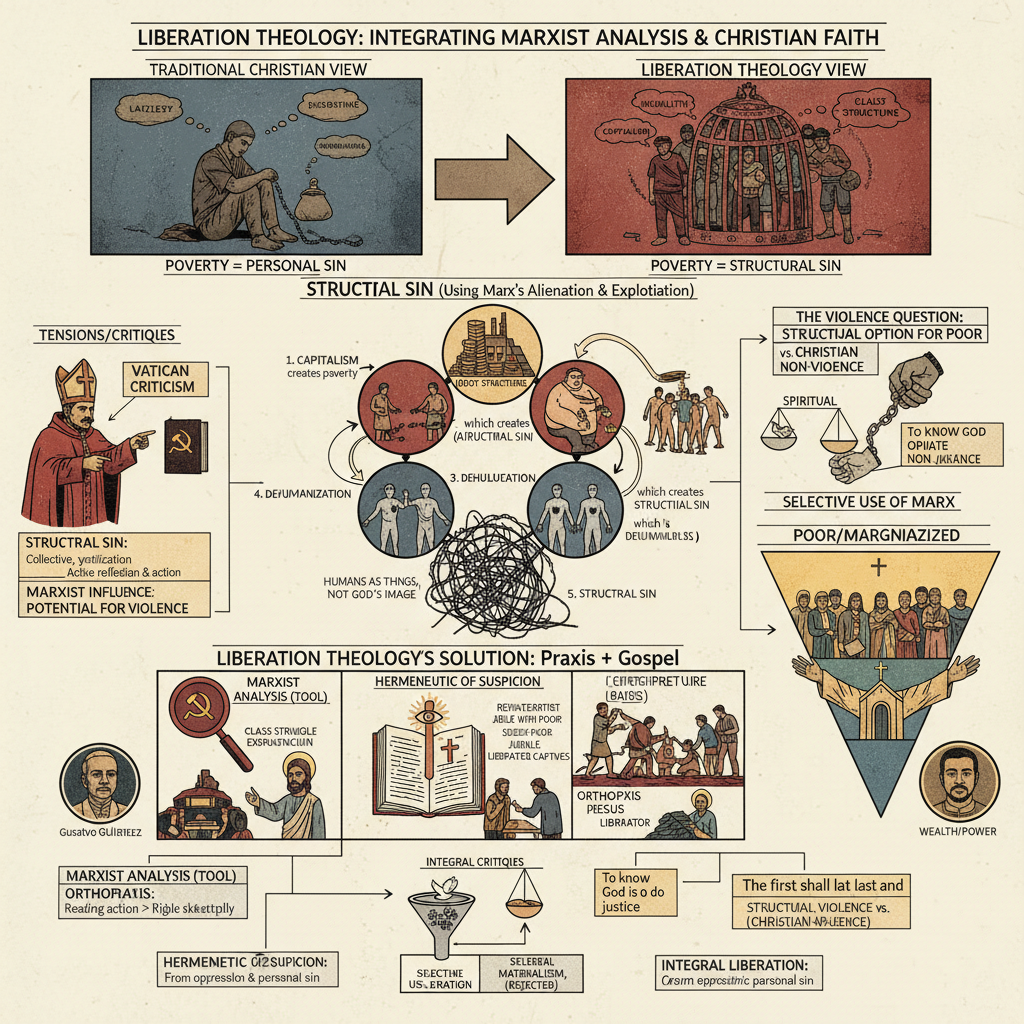
Introduction
Liberation theology's relationship with Marxism is already one of the most contested features of its theological identity — the view that it should become more Marxist in its outlook therefore requires assessing both what liberation theology currently takes from Marx, what it deliberately distances itself from, and whether greater Marxist commitment would produce the success it aims at or the theological and practical failures its critics predict. Liberation theology's current relationship with Marx is explicitly instrumental and partial: Gutiérrez uses Marx's social analysis (structural sin, alienation, the ideological function of religion as an opium of the people) as an analytical tool while grounding his theological conclusions in Scripture, the preferential option for the poor, and the prophetic tradition. A "more Marxist" liberation theology would presumably involve: greater commitment to class struggle as the mechanism of liberation; adopting historical materialism (the primacy of economic forces in determining social relations) as a theological framework; and potentially endorsing revolutionary violence as the means of structural change. The claim must be assessed against: the Vatican's theological objections; the empirical record of Marxist regimes; the theological incoherence of adopting historical materialism within a Christian framework; and the question of whether liberation theology's greatest successes — basic ecclesial communities, the preferential option for the poor, the development of structural sin — are specifically its non-Marxist elements. I will argue that the view is not convincing and potentially self-defeating: the elements that make liberation theology successful are precisely its distinctively Christian elements, and greater Marxist commitment would replace theological authenticity with a programme that both the Vatican's critique and the empirical failure of Marxist regimes show to be inadequate.
Mark-scheme aim
PECREL 1 — What liberation theology already takes from Marx, and why greater adoption would undermine its theological identity
Liberation theology's current partial and critical use of Marx is already its most theologically contested element — and greater Marxist commitment would replace the distinctively Christian theology that grounds its moral authority with a secular ideology that cannot sustain it.
Liberation theology currently uses four Marxist analytical tools: first, structural sin — sin is not only personal but embedded in systems of economic and political power, particularly capitalism, which systematically oppresses the poor; second, alienation — capitalism separates workers from the fruits of their labour and from their own humanity, producing poverty as a structural rather than accidental feature; third, ideological critique — the ruling class uses religion and culture to legitimise its position and prevent the poor from recognising and challenging their oppression; fourth, praxis — theological reflection must begin from and return to transformative action rather than remaining at the level of theory. These tools are used instrumentally: they illuminate the mechanisms of poverty without committing liberation theology to Marx's atheist metaphysics, his account of religion as merely ideological (the opium of the people), or his advocacy of violent revolution. As the studyrocket.co.uk notes confirm: "liberation theology views the poor as a group to be protected and assisted, not a means to an end" — the theological goal is the dignity and flourishing of actual poor persons, not the revolutionary transformation of economic structures as a historical end in itself. A more Marxist liberation theology would need to adopt historical materialism — the view that social relations are ultimately determined by economic forces — which directly contradicts the Christian account of human beings as spiritual creatures created in God's image whose ultimate liberation is from sin, not from capitalism. As the Gospel Coalition notes: liberation theology's "ultimate goal is that of Marx: not to understand the world, but to change it" — but the Christian account of what the world needs to be changed into is fundamentally different from Marx's classless material society.
However, the "more Marxist" advocate can respond that liberation theology's current half-measures are precisely what limits its effectiveness: by accepting Marx's analysis of capitalism's structural oppression while refusing his conclusion that only revolutionary transformation of economic structures can address it, liberation theology produces a theology of protest without a programme of change. Gutiérrez himself endorsed class struggle as the mechanism of liberation in 1973 — "I noted with approval Marx's admonition that class struggle is a fact and neutrality in it is impossible" — and his endorsement of the Cuban and Nicaraguan revolutions suggests that a more consistently Marxist programme was his actual aspiration. The argument is that half-hearted engagement produces half-hearted results: if the structural causes of poverty are what liberation theology identifies them as, then only structural solutions of the kind Marx advocates can address them adequately.
Liberation theologians respond that greater Marxist commitment would destroy rather than enhance liberation theology's effectiveness by replacing its moral authority with a discredited secular ideology. The moral authority of Gutiérrez, Boff and Cone derives not from their Marxist analysis but from their grounding in Scripture, the prophetic tradition, and the basic ecclesial communities — the network of poor Christian communities in Latin America who experience the preferential option for the poor as an expression of the Gospel, not of class struggle. As the Seneca notes confirm, liberation theology's key innovation over Marxism is precisely its non-Marxist element: "orthopraxis before orthodoxy" — right action motivated by the love of God and neighbour — which is a specifically Christian rather than Marxist account of what transforms the world.
The "half-measures" objection has genuine force as a political critique but misunderstands what liberation theology is: it is a theology, not a political programme, and its distinctive contribution is the transformation of the Christian tradition's understanding of sin, salvation and the poor — not the provision of a revolutionary manifesto. A liberation theology that became more Marxist would gradually cease to be theology and become a religious veneer over a political ideology — which is precisely what the Vatican's 1984 Instruction warned against: the "disastrous confusion between the 'poor' of Scripture and the 'proletariat' of Marx."
Liberation theology's theological identity and moral authority are grounded in its distinctively Christian elements — Scripture, preferential option, structural sin — and greater Marxist commitment would progressively replace these with a secular ideology that cannot sustain the theological vision.
Mark-scheme aim
PECREL 2 — The empirical record of Marxist regimes, the Vatican's critique, and liberation theology's actual successes
The empirical failure of Marxist regimes and the Vatican's sustained critique together demonstrate that a more Marxist liberation theology would be both practically less successful and theologically less credible — and liberation theology's actual documented successes confirm that its Christian distinctives, not its Marxist borrowings, are the source of its effectiveness.
The empirical case against greater Marxist commitment is direct: the Marxist-influenced regimes that Gutiérrez endorsed — Cuba and Nicaragua — have produced poverty, repression and human rights abuses that, as the Juicy Ecumenism notes confirm, "exponentially exceeded problems in capitalist countries." A liberation theology committed to Marxist revolutionary transformation as its programme would be committed to advocating for regimes of this type — which produces not the liberation of the poor but their further subjugation under a different kind of structural power. The Vatican's two instructions — the 1984 Instruction on Certain Aspects of the Theology of Liberation and the 1986 Instruction on Christian Freedom and Liberation — provide the most authoritative theological assessment of this risk: the first warns against the importation of Marxist class struggle categories; the second affirms the authentic theological core of liberation theology (the preferential option, structural sin, the dignity of the poor) while insisting these are grounded in the Gospel rather than in Marxist ideology. Crucially, the Vatican's position is not the total rejection of liberation theology but the affirmation of its Christian elements and the critique of its Marxist borrowings — which implicitly confirms that the Christian elements are the successful part. Liberation theology's actual documented successes — the basic ecclesial communities that organised millions of poor Latin Americans into communities of mutual support, prayer, Scripture reading and political advocacy — are specifically Christian rather than Marxist in character: they work through community building, spiritual formation and the application of Scripture to daily life, not through class mobilisation.
However, the empirical failure of Marxist regimes objection can be countered: these failures are not the result of Marxist analysis but of its implementation under authoritarian political conditions that distorted the original vision. Marx's analysis of capitalism's structural oppression of the poor may still be correct even if the political programmes associated with Marxism have failed in practice — and liberation theology could use the analytical framework without endorsing the political implementations that produced tyranny. Furthermore, the basic ecclesial communities' success, while real, has not produced the structural economic transformation that the continuing poverty of Latin America demonstrates is still necessary — which suggests that the pastoral success of liberation theology's Christian elements has not been matched by the political success needed to address structural poverty.
Liberation theologians can respond that the distinction between analytical framework and political implementation is precisely the distinction that the current partial use of Marx already makes — and that this is a reason for maintaining the current balance rather than for adopting a more comprehensive Marxist commitment. The basic ecclesial communities' pastoral success is not a failure of the Christian elements but a different kind of success: the transformation of individuals, communities and the Church's self-understanding, which the juicyecumenism analysis confirms has been liberation theology's most lasting contribution. The structural poverty of Latin America is real, but it is not clear that a more Marxist liberation theology would have addressed it more successfully — the evidence of Marxist regimes suggests it might have made it worse.
The "current balance is already the right balance" response is the most defensible position: liberation theology's success in transforming the Church's understanding of the poor, in inspiring basic ecclesial communities, and in developing the theologically authentic concept of structural sin are all products of its Christian distinctives rather than its Marxist borrowings. Greater Marxist commitment would risk replacing these genuine theological achievements with a political programme that has failed wherever it has been implemented and that the Vatican's authoritative theological critique correctly identifies as incompatible with the Gospel's own account of liberation. The OCR examiner's report confirms the key evaluative point: the best candidates understood that liberation theology is more than Marx and that its specifically theological contribution — the preferential option, structural sin, orthopraxis — is what gives it lasting significance.
Liberation theology's actual successes are its Christian elements; its Marxist borrowings are its most contested features; and the empirical failure of Marxist regimes demonstrates that greater Marxist commitment would not enhance but undermine the success the view claims to seek.
Mark-scheme aim
Conclusion (RJ)
The view that liberation theology would be more successful if it became more Marxist in its outlook is not convincing and potentially self-defeating. Liberation theology's actual documented successes — the development of the preferential option for the poor, the theological concept of structural sin, and the basic ecclesial communities that have transformed millions of poor Christians' lives — are all products of its distinctively Christian elements: Scripture, the prophetic tradition, and orthopraxis rooted in the Gospel. Its Marxist borrowings — structural analysis, alienation, ideological critique — have served as useful analytical tools when used critically and instrumentally, but the Vatican's 1984 warning about the "disastrous confusion" between Scripture's poor and Marx's proletariat correctly identifies the theological damage that would result from adopting Marxist categories as presuppositions rather than tools. The empirical failure of the Marxist-influenced regimes that Gutiérrez endorsed demonstrates that the political programme of a more Marxist liberation theology has not produced the liberation of the poor it promises. Greater Marxist commitment would progressively replace the theological authenticity and moral authority that give liberation theology its genuine power — grounded in the Gospel's own demand for justice for the poor — with a secular ideology that cannot sustain the theological vision and has failed wherever it has been politically implemented. The most defensible verdict is that liberation theology's current partial and critical use of Marx represents the appropriate balance — and that the OCR examiner's own endorsement of "liberation theology as more than Marx" reflects the correct assessment of where its real significance lies.