On This Page
More than Just the Bible
"'In order to lead a moral Christian life, Christians need more than just the Bible for guidance.' Discuss."
Back to Paper 3 essays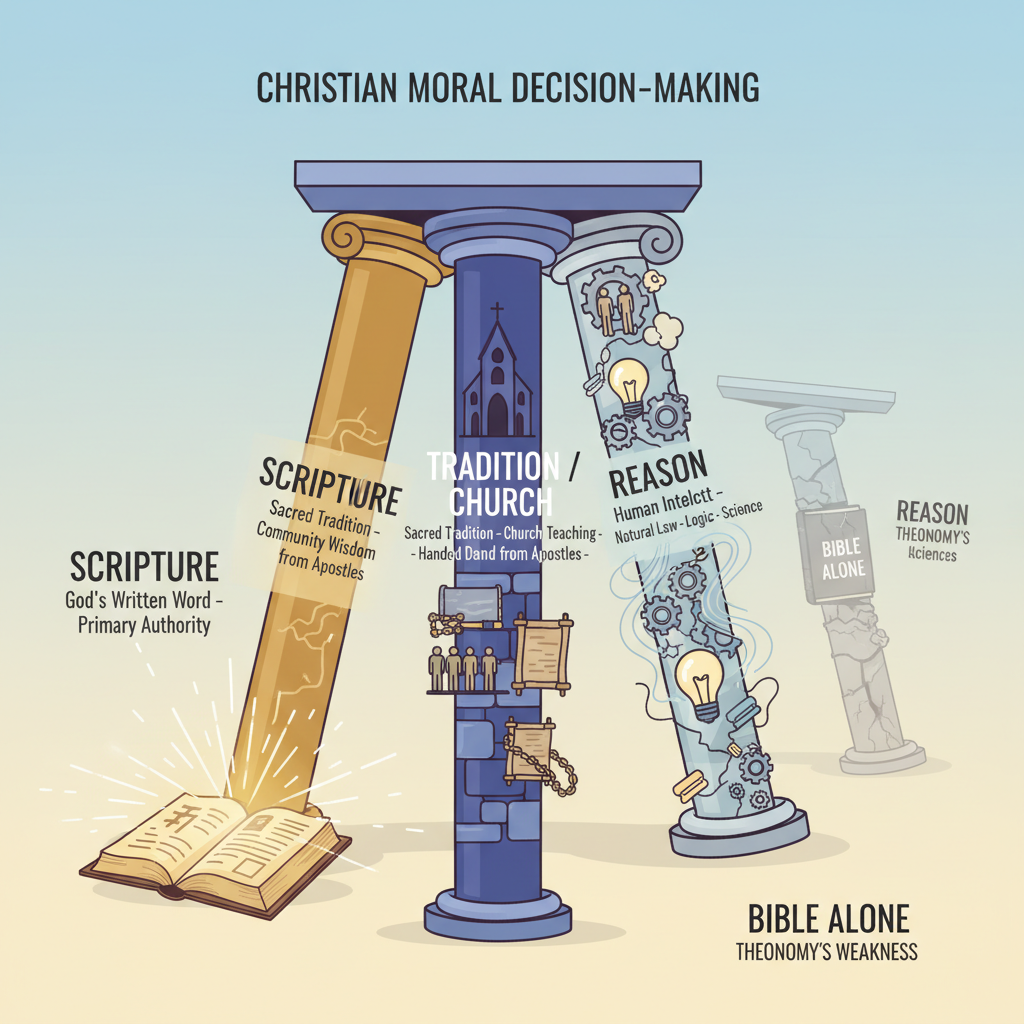
Introduction
The claim that Christians need more than just the Bible for moral guidance challenges the sola Scriptura principle — the Reformation doctrine that Scripture alone is the sufficient, authoritative source of Christian life and doctrine. The opposing tradition, most fully developed in Roman Catholicism, holds that Christians require a three-legged stool of Scripture, Church tradition, and reason — each correcting and supplementing the others. The question has both a theological dimension (is the Bible divinely authoritative in a way that makes other sources secondary or irrelevant?) and a practical dimension (is the Bible sufficient in practice to guide moral decision-making in a modern pluralistic world?). The OCR mark scheme explicitly identifies the key positions: "the Bible is traditionally understood to be the revealed word of God and therefore has divine authority… the primary source of moral commands for Christians to follow" — but also that "human sinfulness means that reason is insufficient to discern from natural law or conscience alone" and that tradition and reason are needed to interpret Scripture in an ever-changing world. I will argue that the claim is substantially correct: while the Bible has unique and irreplaceable authority as the primary source of Christian moral guidance, its interpretation requires reason, its application requires community tradition, and its limitations in addressing modern ethical questions require supplementation — making the three-legged stool the most adequate framework.
Mark-scheme aim
PECREL 1 — The case for sola Scriptura and its limitations
The sola Scriptura tradition provides a powerful theological case for the Bible's sufficiency as moral guidance — grounding it in divine authority and the sufficiency of Christ's revelation — but faces decisive practical and hermeneutical limitations that reveal the need for reason and tradition.
The sola Scriptura position holds that Scripture is the divinely inspired Word of God — "God-breathed and profitable for teaching, for correction, for training in righteousness" (2 Timothy 3:16–17) — and therefore intrinsically authoritative and sufficient for moral guidance. The Reformers argued that the Church's tradition had distorted rather than transmitted the biblical moral vision, adding human accretions (indulgences, Marian doctrines, purgatory) that obscured the Gospel — and that the Reformation principle of returning to Scripture alone was therefore a purification rather than an impoverishment of Christian moral guidance. Barth provides the most theologically rigorous defence of Scripture's priority: the Word of God is not merely a collection of moral rules but the living self-revelation of God in Christ, who addresses the believer through Scripture with a specific and authoritative command. As the Thinka notes confirm: in the sola Scriptura approach "every answer is in the Book. If the Bible says it, you do it." The Sermon on the Mount provides a concrete example of biblical moral teaching that is comprehensive, penetrating, and potentially sufficient as a guide to Christian moral life: the Beatitudes, the commands on anger, lust, divorce, oaths, love of enemies, and prayer together cover the full range of personal moral life.
However, the sola Scriptura position faces three decisive practical limitations that the claim in the title identifies. First, the hermeneutical problem: the Bible must be interpreted, and different Christian communities interpreting Scripture alone have reached radically different moral conclusions on slavery, women's leadership, just war, capital punishment, and homosexuality — demonstrating that "the Bible alone" does not produce a single clear moral guidance but requires interpretive frameworks that are themselves derived from reason and tradition. Second, the silence problem: the Bible does not directly address many modern moral questions — genetic engineering, environmental ethics, economic globalisation, AI ethics — leaving Christians who rely on Scripture alone without specific guidance in precisely the areas where ethical decision-making is most urgently needed. Third, internal inconsistencies: Old Testament moral commands (genocide, slavery, dietary laws) appear to conflict with the New Testament's moral vision, requiring interpretive principles — drawn from reason and tradition — to resolve.
A sola Scriptura defender can respond that the hermeneutical problem reflects not the inadequacy of Scripture but the inadequacy of human interpreters — a more faithful reading of Scripture, guided by the Spirit, produces convergence rather than diversity. On the silence problem, the defender argues that Scripture provides principles — justice, love, the image of God in every human person — that can be applied to novel situations even when direct commands are absent. On internal inconsistencies, the progressive revelation principle — that God accommodated his commands to human weakness in earlier periods, with the New Testament's moral vision being the fuller and more definitive revelation — provides a principled resolution within Scripture itself.
The sola Scriptura responses are theologically available but practically insufficient: the Spirit-guided convergence response does not explain the actual divergence of Spirit-guided Christian communities; the principles-application response effectively concedes that reason is required to derive specific guidance from general principles; and the progressive revelation principle is itself a hermeneutical framework imported from reason and tradition. The OCR mark scheme confirms the decisive point: "human sinfulness means that reason is insufficient to discern from natural law or conscience alone what is morally good" — but equally, sinful human interpreters cannot read Scripture without the corrective of reason and tradition. The sola Scriptura position is therefore most defensible as a claim about Scripture's authority (the Bible is the primary and irreplaceable source) rather than its sufficiency (the Bible alone is all that is needed).
Sola Scriptura is theologically powerful as an account of biblical authority but practically inadequate as a claim to sufficiency — the hermeneutical, silence and inconsistency problems all demonstrate that reason and tradition are necessary even for a biblically grounded Christian moral life.
Mark-scheme aim
PECREL 2 — The three-legged stool: Bible, Church, and reason as the adequate framework
The Roman Catholic and Anglican "three-legged stool" of Bible, Church tradition and reason provides the most adequate framework for Christian moral life — but the risk of tradition-encrustation and the Catholic-Protestant divergence on tradition's authority require careful assessment.
The Roman Catholic tradition holds that Scripture, Sacred Tradition, and the Magisterium (teaching authority of the Church) together constitute the complete rule of faith for Christian moral life. As the Seneca notes confirm: "Catholics use reason alongside the Bible and Sacred Tradition in natural law ethics… over 2,000 years, the Church has interpreted the Bible and this interpretation should guide people in their moral lives." Aquinas' natural law synthesis provides the philosophical framework: human reason can access the moral order built into creation (natural law), Scripture provides the specifically revealed moral commands that supplement natural law, and the Church's tradition applies both to specific historical circumstances. This is a genuinely comprehensive framework: reason ensures that moral guidance is accessible to all rational persons (not merely those with direct access to Scripture), tradition ensures continuity and community correction, and Scripture ensures that the distinctively Christian moral vision — centred on love, forgiveness and the imitation of Christ — remains the foundation. The Anglican tradition captures this in the "three-legged stool" image attributed to Richard Hooker: Scripture is primary, but reason and tradition are necessary for interpretation and application — without them, biblical guidance cannot be reliably received.
However, the three-legged stool faces the tradition-encrustation problem identified in Essay 1: the Church's traditional moral teaching has included the defence of slavery, religious persecution of heretics, and the systematic subordination of women — all supported by biblical interpretation — which undermines the claim that Church tradition reliably supplements rather than distorts biblical moral guidance. The Catholic-Protestant divergence on tradition's authority also generates the problem: if tradition is co-equal with Scripture (the Catholic position), it can override Scripture's moral vision; if tradition is merely interpretive (the Anglican/Protestant position), its authority is derivative and contested. Furthermore, if reason is required to supplement Scripture, whose reason? — the Enlightenment and Christian tradition have frequently reached different rational moral conclusions, suggesting that "reason" is not a neutral supplement but a culturally shaped faculty whose deliverances are as contested as biblical interpretation.
The Catholic tradition responds that the tradition-encrustation objection proves the need for the full three-legged stool rather than undermining it: the moral errors of Church tradition (on slavery, persecution, women) were corrected by the application of reason and biblical re-reading together — showing that when all three elements of the stool are properly functioning, self-correction is possible. On reason's contested character, the Catholic response draws on Aquinas: reason is not purely subjective but is oriented by human nature's God-given telos towards the genuine goods of human flourishing — which provides an objective grounding for rational moral reflection beyond mere cultural preference.
The self-correction response is substantially persuasive: the history of Christian moral development does show that Scripture, tradition and reason, operating together over time, have produced genuine moral progress — the abolition of slavery, the recognition of human rights, the revision of attitudes towards women and homosexuality are all examples of biblical re-reading guided by reason correcting traditional error. Aquinas' grounding of reason in natural law provides a more objective account of rational moral reflection than the cultural-shaping objection assumes, though the persistence of reasonable disagreement about natural law's deliverances shows it is not self-interpreting. The most defensible conclusion is that the three-legged stool, despite its complexity and internal tensions, provides a more adequate framework for Christian moral guidance than Scripture alone — precisely because it builds in the self-correcting mechanisms that sola Scriptura lacks.
The three-legged stool is the most adequate available framework for Christian moral guidance — more comprehensive than sola Scriptura, more self-correcting than either Bible or tradition alone — and together with reason provides the resources that the title correctly identifies as necessary for leading a moral Christian life.
Mark-scheme aim
Conclusion (RJ)
The claim that Christians need more than just the Bible for moral guidance is substantially correct and well-supported by both theological argument and historical evidence. The Bible retains unique and irreplaceable authority as the primary source of Christian moral teaching — the Sermon on the Mount, the double commandment, the Pauline moral vision and the imitation of Christ provide the central content of Christian ethics that no other source can supply. However, sola Scriptura as a claim to sufficiency — rather than primacy — fails on three grounds: the hermeneutical problem of interpretive divergence, the silence problem regarding modern ethical questions, and the progressive revelation problem requiring external principles for resolution. The Roman Catholic and Anglican three-legged stool of Bible, Church tradition and reason provides the most adequate framework precisely because it combines the primary authority of Scripture with the interpretive resources of tradition and the applicative resources of reason — and because the history of Christian moral development shows that genuine moral progress has consistently required all three elements working together. The most defensible verdict is that the Bible is both necessary and irreplaceable for Christian moral life, but not sufficient on its own — a conclusion that the Reformation tradition's own hermeneutical diversity quietly confirms.