On This Page
Purgatory as Universal State
"'Purgatory is a state through which everyone goes.' Discuss."
Back to Paper 3 essays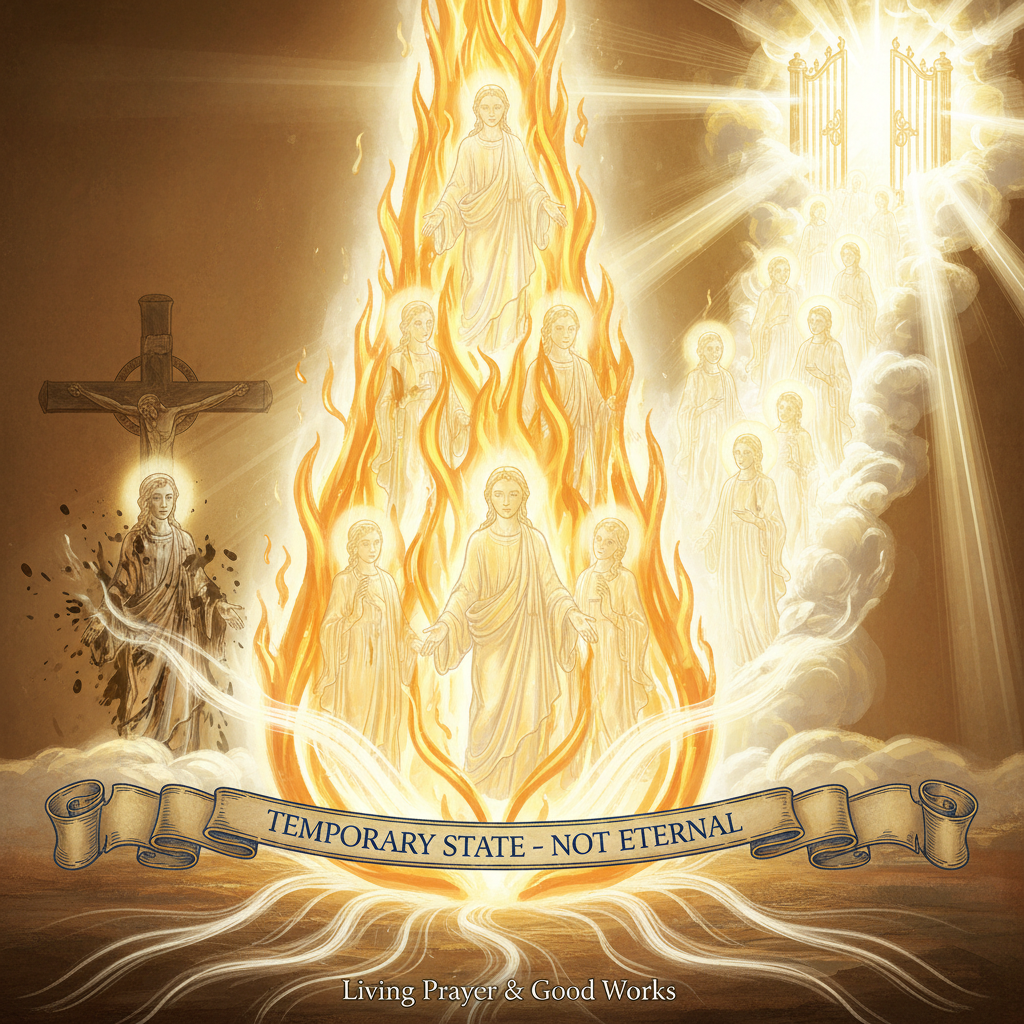
Introduction
Purgatory — understood broadly as a post-mortem state of purification, development or completion — is one of the most contested doctrines in Christian eschatology. The Roman Catholic Church teaches purgatory as an actual state through which those who die in God's grace but imperfectly purified must pass before entering heaven — but emphatically not as a state through which everyone passes, since those already perfectly holy go directly to heaven and those who die in unrepented mortal sin go directly to hell. The claim in the title — that purgatory is a state through which everyone goes — is therefore a significant departure from the Catholic position, and must be assessed against three alternative interpretations: (i) the Catholic particular/selective view; (ii) Hick's universalist soul-making eschatology in which some form of purgatorial development applies to all; and (iii) the Protestant rejection of purgatory entirely. I will argue that the claim is not convincing in its strong universal form — neither Catholic tradition nor most Protestant theology supports it — but that Hick's soul-making eschatology and Karl Rahner's reformulation provide the strongest case for a purgatorial state that, in a modified sense, applies universally, and that this modified claim has significant theological force.
Mark-scheme aim
PECREL 1 — The Catholic position: purgatory is selective, not universal, and the biblical basis
The Catholic doctrine of purgatory — the most developed theological account available — explicitly rejects the universal claim in the title: purgatory is not a state everyone goes through but a selective purification for those dying in God's grace but imperfectly sanctified.
The Catholic Catechism (1030–1031) is explicit: "All who die in God's grace and friendship, but still imperfectly purified, are indeed assured of their eternal salvation; but after death they undergo purification, so as to achieve the holiness necessary to enter the joy of heaven." The crucial qualifier — "those who die in God's grace and friendship" — immediately restricts purgatory to those who are already saved but not yet perfectly holy. Those who die in unrepented mortal sin go directly to hell; those already perfectly purified (the saints) go directly to heaven. The Council of Florence (1439) and Council of Trent (1563) both defined purgatory as a doctrine of the Church, explicitly against both universal applicability and Protestant rejection. The biblical basis is indirect — 2 Maccabees 12:44–46 supports prayer for the dead (a practice that presupposes post-mortem purification), and 1 Corinthians 3:10–15 describes a fire through which a person's work is tested — but no text explicitly teaches universal purgatorial experience. The Catholic practice of prayers and masses for the dead presupposes a purgatorial state in which the living can assist the deceased — a deeply pastoral and community-grounding aspect of the doctrine.
However, the Catholic selective purgatory faces the objection that the distinction between those dying perfectly and imperfectly purified is difficult to apply with any clarity: the criteria for perfect purification are unclear, and the pastoral reality is that virtually all people die in states of incomplete sanctification — which would, in practice, make purgatory near-universal for the saved. Furthermore, the Catholic doctrine is rejected by Protestant traditions who argue that purgatory is not clearly taught in Scripture, contradicts the Reformation doctrine of justification by faith alone (since purgatory implies post-mortem sanctification that supplements Christ's completed work of salvation), and introduces a conception of grace that is more transactional than relational. Luther and Calvin both argued that purgatory undermines the sufficiency of Christ's atoning death: if the cross is the complete and final act of salvation, there is no post-mortem purification still to be accomplished.
The Catholic response to the Protestant objection is that purgatory does not supplement Christ's atoning work but applies it: the purification of purgatory is the work of grace, not of human merit — it is God's love completing in the soul what Christ's death made possible. Pope John Paul II made this explicit: purgatory is "not a place but a condition" — the condition of encountering the purifying love of God in a way that is simultaneously painful (confronting one's sinfulness) and redemptive. As the Seneca notes confirm, this removes the transactional element that Protestants object to: purgatory is not a debt to be paid but a transformation to be undergone.
The Catholic response is theologically sophisticated and partially addresses the Protestant objection, but does not overcome the basic Protestant concern: any post-mortem process of purification implies that persons are not fully justified at death by faith alone, which remains a fundamental Reformation objection. The near-universality of the saved passing through purgatory (given the rarity of perfect sanctification at death) is a further problem: if virtually all saved persons require purgatorial purification, the distinction between selective and universal purgatory becomes practically negligible — which inadvertently supports the title's claim, at least for the saved.
The Catholic position establishes that purgatory is not universal in the strong sense the title claims — it applies only to the saved and imperfectly purified — but the practical near-universality of imperfect sanctification at death significantly softens this distinction.
Mark-scheme aim
PECREL 2 — Hick's soul-making universalism, Rahner's reformulation, and Origen's probationary school
Hick's soul-making eschatology and Karl Rahner's reformulation together provide the most theologically significant case for a modified universalism in which purgatory — understood as continued moral and spiritual development — applies to all, but the universalist implication generates the same problems as in Essay 1.
Hick argues that the "gap between the individual's imperfection… and the perfect heavenly state… has to be bridged" — and that this bridging cannot occur for most people in a single earthly life. He therefore posits a series of post-mortem environments in which every person continues the soul-making process, guided by God's love towards the ultimate fulfilment of the divine likeness. On this account, a form of purgatorial development applies to everyone — not as punishment but as continuation of the moral and spiritual formation that constitutes what it means to be human. Origen (3rd century) and Gregory of Nyssa similarly understood the intermediate state as a "probationary school" or purifying process oriented towards the restoration of all creation (apokatastasis) — the eventual redemption of every soul, including possibly the devil. Karl Rahner reformulates purgatory without a temporal dimension: it is not a period of time after death but the soul's immediate, complete encounter with its own reality in God's presence — a confrontation that is simultaneously purifying and perfecting. The "pain" of purgatory, on Rahner's account, is not externally imposed punishment but the self-inflicted recognition of the distance between what one is and what one is called to be.
Hick's universalism generates the same theological objections identified in Essay 1: it appears to undermine genuine human freedom by guaranteeing that everyone eventually chooses God, and it contradicts the clear New Testament warnings of permanent judgement and exclusion from the Kingdom. Augustine's massa peccati — and his doctrine of limited election — stands in direct opposition: only the predestined receive grace sufficient for salvation, and the many are excluded permanently from both purgatory and heaven. Furthermore, the Protestant rejection of purgatory is not merely a doctrinal preference but a principled theological argument: if Christ's work of salvation is complete and sufficient, then the purgatorial development Hick and Origen describe either repeats what Christ has done or implies his work was insufficient.
Hick and Rahner can respond that the Protestant objection misunderstands the relationship between Christ's atonement and post-mortem development: the soul-making process is not a supplement to Christ's work but its ongoing application in the personal transformation of each soul. The cross makes salvation possible; purgatorial development is how that salvation is personally appropriated and completed in each individual life — which is not a denial of grace but its fullest expression. On Augustine's limited election, Hick argues that a God who is truly omnipotent and omnibenevolent cannot ultimately be defeated by human sin — and that Augustine's predestination, rather than reflecting divine justice, reflects the theological limitations of a 5th-century mind deeply influenced by Roman jurisprudence.
Hick's and Rahner's accounts are the strongest available arguments for a universally applicable purgatorial state — and the OCR mark scheme implicitly acknowledges this by identifying Hick's soul-making eschatology as the most developed modern theological alternative to traditional purgatory. However, the universalist implication creates genuine theological tension with human freedom and the New Testament's judgement language, and Rahner's non-temporal reformulation — while philosophically innovative — is so abstracted from the traditional purgatory doctrine that it is questionable whether it is purgatory in any meaningful sense. The title's claim is therefore best supported by Hick and Rahner in a modified form, but the strong universal claim requires accepting a universalism that most Christian traditions, including Catholicism, explicitly reject.
Hick's and Rahner's accounts support the title's claim in a modified form — that some purgatorial process of completion applies universally to those in God's grace — but the strong universal claim requires a universalism that is theologically contested and which most traditions, Catholic and Protestant alike, do not accept.
Mark-scheme aim
Conclusion (RJ)
The claim that purgatory is a state through which everyone goes is not convincing in its strong universal form but has significant modified force. The Catholic doctrine explicitly restricts purgatory to those who die in God's grace but imperfectly purified — making it selective rather than universal — and the Protestant tradition rejects purgatory entirely on the grounds that it undermines justification by faith alone and the sufficiency of Christ's atonement. Augustine's limited election provides the strongest theological case against universality: for Augustine, most of humanity is excluded from salvation entirely — making purgatory applicable to a minority, not everyone. However, Hick's soul-making eschatology and Rahner's reformulation provide theologically serious arguments for a form of purgatorial development that applies to all: if every person dies in moral and spiritual incompleteness, some process of post-mortem completion — whatever we call it — is required by the demands of justice and divine love. The most defensible conclusion is that purgatory in the strong Catholic sense is not universal; but some form of purgatorial moral completion, in Hick and Rahner's sense, applies to all who are ultimately saved — and if universalism is true, that means everyone.