On This Page
Ruether vs Daly
"'Rosemary Radford Ruether's feminist theology is more acceptable than the thinking of Mary Daly.' Discuss."
Back to Paper 3 essays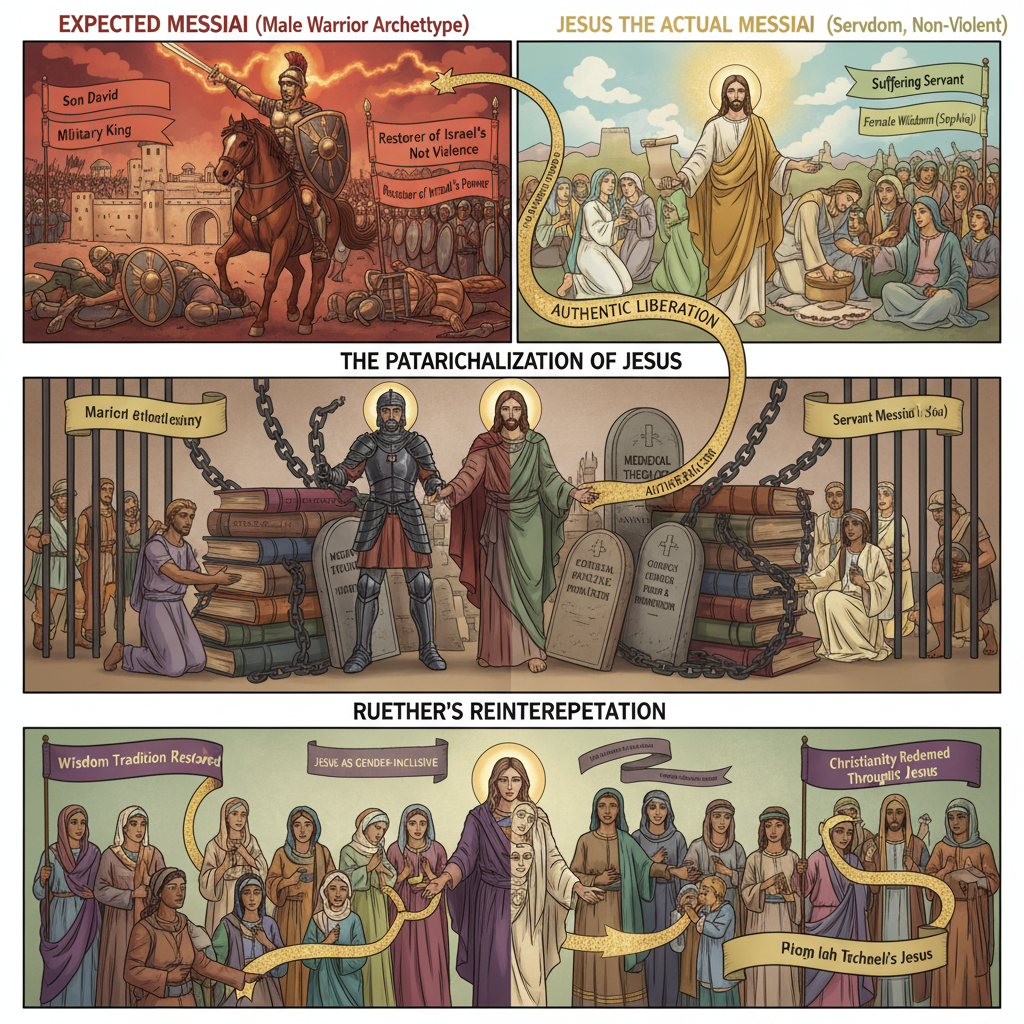
Introduction
Both Rosemary Radford Ruether and Mary Daly begin from the same diagnosis: Christianity has been deeply and systemically patriarchal — male language about God, male-dominated church leadership, and the marginalisation of women's experience have together produced a religious tradition that has sanctioned rather than liberated the oppression of women. However, their responses to this diagnosis diverge radically. Ruether, in Sexism and God-Talk (1983), argues that Christianity contains a liberating thread — the prophetic tradition, Galatians 3:28, Jesus' treatment of women, the feminine wisdom tradition — that can be recovered and developed to produce a genuinely inclusive Christian theology, without abandoning the tradition. Daly, beginning as a reform feminist in The Church and the Second Sex (1968) but developing into a post-Christian radical in Beyond God the Father (1973) and Gyn/Ecology (1978), concludes that Christianity is irredeemably patriarchal — that God the Father must be abandoned altogether, that women must move "beyond God the Father" to a new female-centred spirituality, and that the transvaluation of Christianity rather than its reform is necessary. The OCR mark scheme confirms both possibilities: "Ruether's feminist theology is successful because she shows… her case against sexism" but also "her theology does not go far enough, especially when compared to Mary Daly's transvaluated notion of God." The question asks about acceptability — which has both theological (is it consistent with Christian tradition and revelation?) and practical (is it more effective as a strategy for change?) dimensions. I will argue that Ruether's theology is more acceptable on both dimensions: it is more internally consistent with the Christian tradition, more politically and ecclesiastically effective, and avoids the self-undermining of Daly's post-Christian radicalism — but that Daly's uncompromising critique correctly identifies a genuine limitation in Ruether's approach.
Mark-scheme aim
PECREL 1 — Ruether's golden thread and the case for reform theology
Ruether's golden thread argument is the most theologically defensible account of Christian feminist theology — grounding the demand for gender equality in the tradition's own liberating core rather than in external secular standards.
Ruether's central methodological claim is that Christianity contains two distinct threads: a patriarchal thread (male God-language, Pauline household codes, historical male-dominated church) and a liberating/prophetic thread (the prophets' critique of power, Jesus' inclusive ministry, Galatians 3:28 — "there is neither Jew nor Greek, slave nor free, male nor female, for you are all one in Christ Jesus"). The golden thread is not a modern feminist imposition but Christianity's own authentic core — evidenced in Jesus' post-resurrection appearance to women (making them the first evangelists), his violations of purity codes in speaking with the Samaritan woman, and his defence of the adulterous woman. On God-language, Ruether argues that the consistent use of exclusively male pronouns and titles for God is theologically unjustified — the Hebrew Bible contains feminine imagery of God (Isaiah 42:14 — "I will cry out like a woman in labour"; Isaiah 49:15 — "Can a mother forget the baby at her breast?"), the concept of Sophia (hokhmah) in the wisdom tradition is grammatically feminine and presents divine wisdom as a feminine figure, and the Holy Spirit (ruach in Hebrew) is feminine. As the PEPED essay confirms: Ruether argues that the incarnate second person of the Trinity "does not necessarily need to be male" — Christ's salvific significance lies in his identification with the marginalised and oppressed, not in his biological sex. Her method is apophatic in orientation: God is ultimately beyond all human language and gender, and the use of feminine alongside masculine terms is a corrective against the idolatry of treating the masculine as the literal description of God.
However, Daly argues that Ruether's golden thread is hermeneutically naïve: the liberating thread Ruether identifies is itself embedded in and inevitably contaminated by the patriarchal tradition from which she is trying to extract it. You cannot simply extract the "good" parts of a patriarchal tradition because the tradition's patriarchal assumptions permeate even its most apparently egalitarian moments — the women at the resurrection, the Samaritan woman, Mary Magdalene are all still presented through a male-authored text within a male-controlled tradition that has systematically marginalised their witness for two millennia. Furthermore, the OCR mark scheme notes Ruether's own admission of a limitation: "even by her own admission her case against sexism" is incomplete — and the practical evidence of the Catholic Church's continued refusal to ordain women suggests that reform from within has not achieved the transformation she hoped for.
Ruether responds that Daly's post-Christian solution — moving beyond Christianity to a women-centred spirituality — abandons rather than solves the problem: the majority of Christian women worldwide are not going to leave Christianity, and a feminist theology that demands departure from the tradition is not a practical resource for the billions of women whose spiritual lives are embedded in Christian communities. The golden thread approach, even if imperfect, provides a basis for genuine internal reform — evidenced in the ordination of women in Anglican, Lutheran and many Protestant churches — that Daly's post-Christian alternative cannot produce from outside the tradition.
Ruether's practical response is substantially persuasive: reform feminist theology has produced real institutional change — women's ordination, feminist liturgy, inclusive language Bibles — that Daly's post-Christian radicalism has not generated within Christian communities. The golden thread is also more hermeneutically sophisticated than Daly's critique allows: it does not claim to extract pure egalitarianism from a patriarchal text but to identify the tradition's own internal criterion (the prophetic challenge to unjust power) that can be used to critique patriarchal distortions from within. The OCR mark scheme endorses this: Ruether "shows that Christianity has emerged from its more gender inclusive roots" — which is a historical and textual claim that can be evaluated independently of Daly's post-Christian alternative.
Ruether's golden thread is more theologically adequate than Daly's post-Christian position — grounding reform in the tradition's own internal criteria — and more practically effective as a resource for the vast majority of Christian women who remain within the tradition.
Mark-scheme aim
PECREL 2 — Daly's post-Christian radicalism, the Unholy Trinity, and the self-undermining thesis
Daly's post-Christian radicalism — the Unholy Trinity, female be-ing, and the move beyond God the Father — captures the depth of Christianity's patriarchal distortion more honestly than Ruether, but is self-undermining as a theological programme and less acceptable on the specific terms the title sets.
Daly's theological evolution represents an increasingly radical diagnosis. In Beyond God the Father (1973), she argues that "if God is male, then the male is God" — the male monopoly on God-language is not a theological accident but a self-reinforcing ideological mechanism that sanctifies male dominance and makes it appear divinely ordained. God must therefore be reconceptualised as the Verb rather than a noun — "Be-ing" rather than a Being — to strip away the anthropomorphic male projections and reveal the dynamic, creative force that genuine divinity represents. In Gyn/Ecology (1978), Daly's post-Christian analysis is complete: she identifies Christianity's Unholy Trinity — rape, genocide and war — as the expressions of patriarchal violence that Christianity has historically sanctioned, and concludes that women need to move beyond religion entirely into a women-centred spirituality of Biophilia (love of life) against patriarchy's Necrophilia (death-worship). The Chase Terrace notes confirm: "women need to get beyond religion because female oppression is a product of the cultural and historical Christianity's Unholy Trinity." Daly's specific critique of God-language is uncompromising: not only male language but even feminine God-language is inadequate — God must not be referred to in either male or female terms but transcended altogether in the affirmation of authentic female existence.
However, Daly's approach is self-undermining in three respects that make it less acceptable than Ruether's. First, exclusion of men: the women-centred spirituality Daly advocates requires the exclusion of men from the theological and spiritual community — which, as the PEPED essay confirms, "seems counterproductive" and ultimately reproduces the exclusionary logic it claims to oppose. Ruether explicitly rejects this: "Daly advocates a women-centred approach to society, but Ruether does not believe that it is right to side-line men." Second, loss of theological accountability: by moving beyond Christianity, Daly loses the internal criteria — Scripture, tradition, the prophetic challenge — that Ruether uses to evaluate and critique patriarchal distortions; Daly can only appeal to women's experience, which is not a shared basis for theological argument. Third, practical ineffectiveness: Daly's post-Christian spirituality has not reformed any church, changed any liturgy, or produced the institutional change that the ordination of women in Protestant churches represents.
Daly can respond that the institutional changes Ruether points to — women's ordination, inclusive language — are insufficient because they leave the patriarchal theological structure of Christianity intact: ordaining women into a fundamentally patriarchal institution does not challenge patriarchy but accommodates women to it. True liberation requires not accommodation to but transformation of the entire theological framework — which the compromise of reform theology is structurally incapable of achieving. Furthermore, the exclusion of men from women-centred spirituality is not an arbitrary prejudice but a practical necessity: women cannot do the liberating theological work they need to do in mixed spaces where male authority inevitably reasserts itself.
Daly's response correctly identifies a real limitation in Ruether's reform strategy — ordaining women into a patriarchal structure is not the same as transforming that structure. However, the charge that reform is structurally impossible is empirically overstated: the transformation of Christian churches' gender teaching over the last century — from no women preachers to female bishops, from exclusively male God-language to inclusive liturgies — demonstrates that structural transformation is possible from within, however slow. Daly's self-undermining move of excluding men and abandoning theological accountability makes her theology less acceptable both within Christian theology (it is no longer Christian) and within mainstream feminist theory (the separatist strategy has been widely criticised even within secular feminism). The OCR mark scheme's verdict is precise: Ruether's theology "does not go far enough" compared to Daly's — but this is an acknowledgment of Daly's radicalism, not of her acceptability.
Daly's post-Christian radicalism is more honest about the depth of Christianity's patriarchal distortion but is self-undermining as a theological programme — Ruether's reform theology is more acceptable precisely because it works within the tradition to transform it rather than abandoning it for a separatist spirituality that cannot reform what it has left behind.
Mark-scheme aim
Conclusion (RJ)
Ruether's feminist theology is more acceptable than Daly's on both theological and practical grounds, but the verdict must be precisely calibrated. Ruether's golden thread is grounded in the tradition's own liberating core — the prophetic critique, Galatians 3:28, the feminine wisdom tradition — and provides a basis for genuine institutional reform that has produced real changes in Christian churches. Her apophatic account of God-language — that God is beyond all gender and that feminine alongside masculine terms corrects the idolatry of treating the masculine as literal divine description — is the most theologically defensible account of inclusive language within the Christian tradition. Daly's post-Christian radicalism correctly identifies the depth of Christianity's patriarchal distortion and provides the most uncompromising critique of male God-language, but is self-undermining: by abandoning theological accountability, excluding men, and leaving the tradition it claims to liberate, it forfeits the resources and the audience it needs to produce genuine transformation. The OCR mark scheme's observation that Ruether's theology "does not go far enough" compared to Daly is not a vindication of Daly but an identification of the genuine tension between the depth of diagnosis and the practicability of response. Ruether navigates this tension more successfully — making her theology not only more acceptable but more effective as an account of genuinely Christian feminist theology.