On This Page
Secular Views of Gender Equality
"'Secular views of gender equality have undermined Christian gender roles.' Discuss."
Back to Paper 3 essays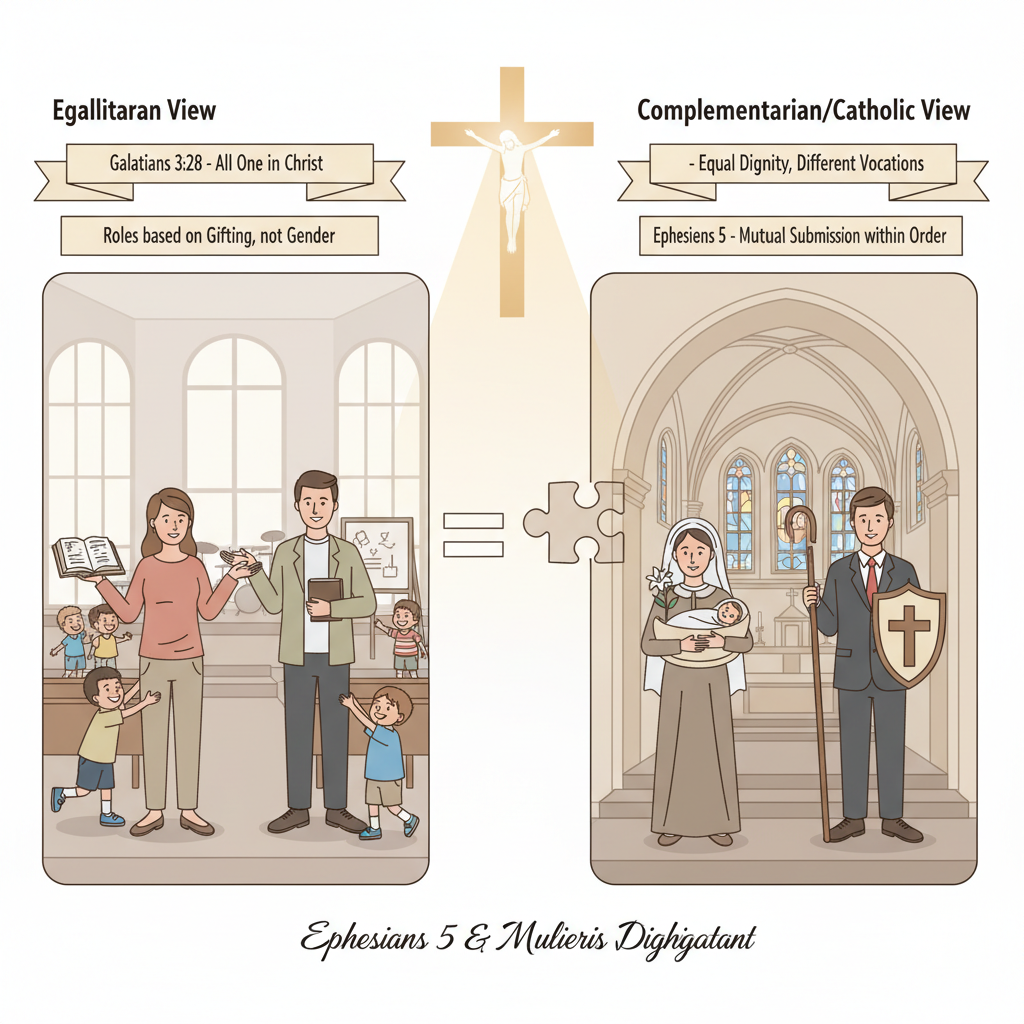
Introduction
The claim that secular views of gender equality have undermined Christian gender roles requires both an account of what traditional Christian gender roles are and an assessment of whether secular feminist movements have genuinely destabilised them or merely prompted their legitimate re-examination. The traditional complementarian position — grounded in Ephesians 5:22–23 ("wives, submit to your husbands as to the Lord, for the husband is the head of the wife as Christ is head of the church") and Genesis 2 — holds that God created men and women with distinct, complementary roles: male headship and female submission within the family, and distinct roles in church leadership. Against this, secular feminist movements — arguing from the equality of rational personhood — have challenged gender roles as socially constructed, historically contingent, and oppressive to women; and Christian feminist theologians Rosemary Radford Ruether and Daphne Hampson have developed internal theological critiques arguing that the Church's gender teaching reflects patriarchal cultural distortion rather than divine ordinance. The OCR mark scheme confirms the range of positions: "some Christians might consider secular views of gender that are at odds with traditional Christian teaching destabilising… but liberal Protestants might argue that secular views of gender equality do not undermine Christian gender roles." I will argue that the claim is partially but not entirely fair: secular feminism has genuinely challenged and changed some traditional gender teachings, but this represents a legitimate purification of the Christian tradition rather than its undermining — and the distinction between culturally conditioned patriarchal accretion and genuine theological teaching about gender is itself the central question.
Mark-scheme aim
PECREL 1 — The complementarian case and Ruether's golden thread challenge
The complementarian tradition provides the strongest theological case for the claim — arguing that male headship is a divinely ordained order that secular feminism has destabilised — but Ruether's golden thread analysis shows that the patriarchal elements of Christian gender teaching are cultural accretions rather than authentic divine revelation.
The complementarian case is grounded in three biblical pillars. First, Genesis 2: the creation order — man created first, woman from his rib as a "helper" — is interpreted by Paul (1 Timothy 2:12–13) as the basis for distinct male and female roles. Second, Ephesians 5:22–23: the husband is the "head" of the wife as Christ is head of the church, establishing a hierarchical but loving ordering of the marriage relationship. Third, 1 Corinthians 14:34 and 1 Timothy 2:12: women should remain silent in church and are not permitted to teach or have authority over men — which grounds male-only church leadership in the complementarian tradition. The OCR mark scheme confirms the complementarian response to secular feminism: "gender-role distinction reflects the natural God-given order of creation; God created women and men as different and complementary, both made in the image of God… the Church has a duty to uphold the dignity of motherhood and gendered roles against secular views which have marginalised its value." Pope John Paul II's Theology of the Body provides the most developed modern complementarian account: men and women are created with distinct but equally dignified modes of being — masculine and feminine — that are not social constructions but expressions of how God made humanity.
However, Ruether's golden thread analysis in Sexism and God-Talk (1983) provides the most important internal theological challenge: she argues that the Bible contains two distinct threads — a liberation thread (the prophetic tradition of justice, the New Testament's "in Christ there is neither male nor female" — Galatians 3:28, Jesus' equal treatment of women) and a patriarchal thread (the Pauline household codes, male-only priesthood) — and that the patriarchal thread represents the cultural distortion of the authentic message rather than its content. This is not an external secular challenge but an internally Christian one: Ruether argues that secular feminism has not undermined the authentic Christian tradition but has helped the Church identify which elements of its gender teaching reflect the Gospel and which reflect the patriarchal culture of the Mediterranean world. As the alevelphilosophyandreligion.com notes confirm: "Jesus and the Bible can be interpreted in a feminist way and therefore Christianity has the potential to be compatible with feminism" — the reform is a recovery of authentic Christianity, not its abandonment.
The complementarian responds that Ruether's distinction between liberation and patriarchal threads is hermeneutically arbitrary: it uses secular feminist assumptions to decide which parts of Scripture are authentic and which are cultural distortions — which effectively makes secular feminism the criterion by which Scripture is judged rather than allowing Scripture to judge culture. The Pauline household codes and the 1 Timothy restrictions are not obviously distinguishable from the liberation passages as cultural rather than theological — both are part of the canonical text, and the decision to treat one as timeless and the other as culturally conditioned is itself driven by prior commitments. Pope Francis addresses this in Amoris Laetitia (2016): he acknowledges that "the language of headship and submission from St Paul's letter to the Ephesians is part of the cultural matrix of the time" — which is a partial concession to the cultural distortion argument while maintaining the importance of gendered complementarity.
Pope Francis' Amoris Laetitia concession is significant: one of Christianity's most senior authorities acknowledges that at least the language of submission is culturally conditioned — which partially vindicates Ruether's approach while stopping short of her full conclusion. The complementarian charge of hermeneutical arbitrariness is partially valid: any process of distinguishing authentic from culturally conditioned Scripture uses interpretive principles that come from somewhere, and the question is whether secular feminism or Christian liberation theology provides the more appropriate lens. Ruether's golden thread is more defensible as a theological rather than merely secular move: it grounds the gender equality principle in Galatians 3:28 and the prophetic tradition rather than in secular rights discourse alone — which means it is an internal theological reform, not an external secular imposition.
The complementarian tradition correctly identifies that some secular feminist views do conflict with Christian teaching — particularly the rejection of gendered difference altogether — but Ruether's golden thread shows that the reform of patriarchal gender roles is as much an internal theological imperative as a secular one.
Mark-scheme aim
PECREL 2 — Hampson's irredeemable sexism thesis, egalitarianism, and the spectrum of responses
Hampson's claim that Christianity is irredeemably sexist — and the secular feminist argument that gendered roles are entirely socially constructed — present the strongest versions of the "undermining" thesis, but both go further than the evidence warrants and generate their own theological problems.
Daphne Hampson, in Theology and Feminism (1990), argues that Christianity is not merely accidentally but irredeemably patriarchal: sexism is so deeply embedded in the tradition — in the maleness of God, the maleness of Christ, the male-dominated history of the church — that no amount of feminist reinterpretation can remove it. She concludes that women committed to gender equality must leave Christianity rather than reform it. Secular feminist theory — drawing on Beauvoir's "one is not born, but rather becomes, a woman" — argues that gender roles are entirely socially constructed, the product of historical power relations rather than natural or divine ordinance. The OCR mark scheme confirms that some secular feminist movements have "completely rejected the idea and role of motherhood, regarding it as a form of slavery and product of patriarchy" — a position that is in direct and sharp conflict with the Christian tradition's affirmation of motherhood as both natural and spiritually significant. The practical impact is measurable: in the UK, the ordination of women in the Church of England (1994, with female bishops from 2015), equal marriage legislation, and the declining acceptance of male headship in mainstream Protestant churches all reflect the influence of secular equality norms on Christian practice.
However, Hampson's irredeemable sexism thesis is theologically rejected by most Christian feminists: Ruether, Elisabeth Schüssler Fiorenza, and the majority of feminist theologians argue that the tradition can be reformed rather than abandoned — and that the identification of its authentic liberating core is itself a theological task, not a secular one. Furthermore, the OCR mark scheme's own guidance confirms that "some significant secular research indicates that families function better where women and men recognise their gendered roles" — suggesting that the complementarian tradition's account of gendered difference is not simply ideological but may reflect genuine empirical observations about human flourishing. Liberal Protestants represent the egalitarian Christian position that does not concede the undermining thesis: they argue that secular views of gender equality do not undermine Christian gender roles because authentic Christianity has always affirmed the fundamental equality of all persons in Christ — Galatians 3:28 being the foundational text.
Secular equality advocates respond that the liberal Protestant affirmation of gender equality still leaves the institutional reality of most Christian churches deeply patriarchal — women's ordination remains denied in Catholic and many Orthodox churches, female leadership is restricted in conservative evangelical traditions, and the Pauline household codes continue to be cited against women's equality. The gap between the theological principle of equality (Galatians 3:28) and the institutional practice of most churches suggests that secular feminist pressure has been necessary to actualise a principle that the tradition affirmed in theory but denied in practice.
The secular equality response correctly identifies a real gap between theological principle and institutional practice — and the history of women's ordination debates confirms that external secular pressure accelerated changes that internal theological reflection alone was not producing at adequate speed. However, this shows that secular views have prompted the Christian tradition to recover an authentic principle rather than undermining it — which is the key distinction. Hampson's irredeemability thesis is the strongest version of the undermining claim, but it is rejected by the majority of Christian feminists who continue to find the liberating thread of the tradition worth recovering. The most defensible verdict is that secular views have genuinely challenged and changed some traditional gender teaching, but the change represents an enrichment and purification of the tradition rather than its undermining.
Hampson's irredeemability thesis and secular social constructionism represent the strongest undermining claims but are rejected by most Christian feminists — the egalitarian Christian position shows that gender equality is recoverable from within the tradition, making the "undermining" verdict too strong.
Mark-scheme aim
Conclusion (RJ)
The claim that secular views of gender equality have undermined Christian gender roles is partially but not entirely fair. Secular feminism has genuinely challenged and changed specific traditional gender teachings — male headship language, restrictions on women's ordination, Pauline household code interpretations — and this challenge has accelerated changes that the institutional church was producing too slowly on its own. However, the framing of this as "undermining" misrepresents what has occurred: Ruether's golden thread demonstrates that gender equality is not an imposition from secular culture but a recovery of Galatians 3:28's authentic principle, and Pope Francis' own Amoris Laetitia concession that Ephesian submission language is culturally conditioned confirms that the reform is theologically internal rather than externally imposed. Hampson's irredeemability thesis — the strongest version of the undermining claim — is rejected by most Christian feminists precisely because it fails to distinguish between the tradition's authentic liberating core and its patriarchal cultural accretions. The most defensible verdict is that secular equality norms have challenged the patriarchal distortions of Christian gender teaching while leaving its authentic theological core — the equal dignity of all persons created in God's image — not undermined but more clearly articulated.