On This Page
Sin and Moral Goodness
"How fair is the claim that sin means humans can never be morally good?"
Back to Paper 3 essays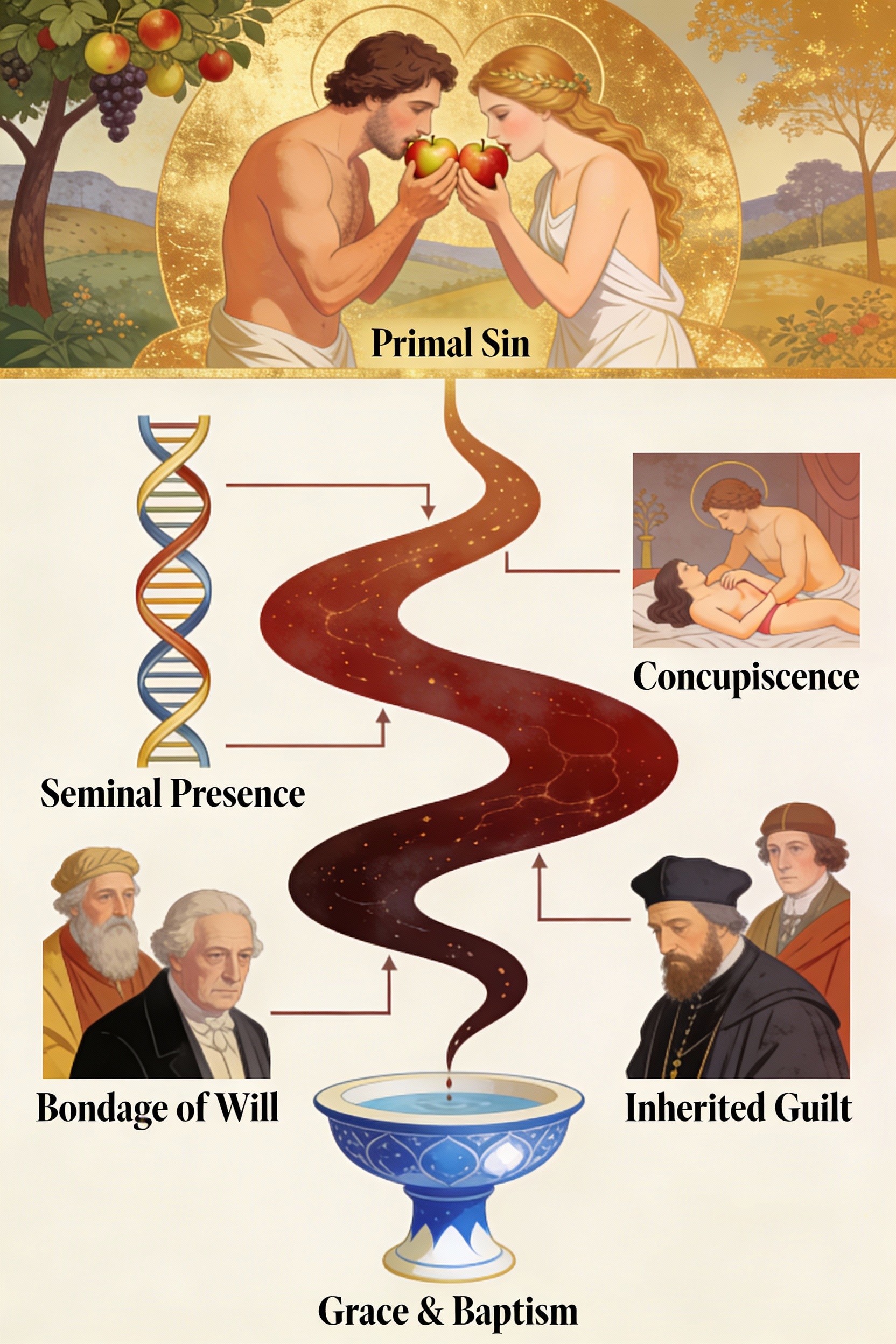
Introduction
Augustine's account of original sin and its consequences for human nature constitutes one of the most influential and most contested claims in Christian theology: that the Fall of Adam and Eve in Genesis 3 corrupted human nature so profoundly that unaided human beings are incapable of genuine moral goodness, and can only be restored through God's grace. Before the Fall, Augustine argues, there was perfect harmony — between God and humanity, between human beings, between the body and the will — grounded in caritas (selfless, outward love) and the free exercise of the good will. After the Fall, cupiditas (selfish, inward love of earthly things) replaces caritas; concupiscence (disordered desire) corrupts the will; and the massa peccati (mass of sinners) describes humanity's collective condition of inherited guilt and moral incapacity. The claim that sin means humans can never be morally good is the strongest version of Augustine's position — it requires assessing both Augustine's own account (including the qualifications introduced by grace and predestination) and the challenges from Pelagius, modern psychology, and the empirical observation of genuine human moral achievement. I will argue that the claim is partially fair — Augustine is right that fallen human nature is structurally oriented towards self rather than God — but that "never" is too absolute: Augustine himself qualifies it through grace, and the empirical evidence of genuine moral goodness in fallen human beings requires a more nuanced account.
Mark-scheme aim
PECREL 1 — Original sin, concupiscence, and the structural case for moral incapacity
Augustine's account of original sin and concupiscence provides a structurally compelling case that fallen human beings cannot achieve genuine moral goodness without divine grace — and the evidence of persistent human moral failure supports this analysis.
Augustine argues that at the Fall, the will — which before the Fall freely chose the good — became enslaved to concupiscence: the disordered desire for earthly, temporary things that now competes with and frequently overrides rational moral intention. This is not merely a tendency to occasional moral error but a structural corruption of the will: even when humans attempt to do good, the concupiscent will pursues self-interest, pride and sensory satisfaction in ways that undermine the purity of motivation required for genuine moral goodness. Augustine's famous confession captures this: "our heart is restless, until it rests in Thee" — the fundamental human orientation post-Fall is away from God and towards created things, which means that even apparently virtuous acts are infected by the pride (superbia) and self-love (amor sui) that the Fall introduced. The privatio boni (privation of good) framework reinforces this: evil is not a positive force but an absence of good — and sin, as a privation of the good that God's grace would supply, means that fallen humans are structurally deficient in the moral goodness they would otherwise possess. As the PEPED specification confirms, one of Augustine's central claims is that "sin means humans can never be morally good" without grace — which is the direct subject of the title.
However, the claim that sin means humans can never be morally good is directly challenged by the empirical observation of genuine human moral achievement by non-Christians and unregenerate persons. Augustine himself acknowledges the existence of civic virtue — Romans like Regulus who exhibited extraordinary moral courage — but dismisses these as "splendid vices" (splendida vitia): apparently virtuous acts that are in reality motivated by pride or desire for glory rather than by genuine love of God. This move is logically available but philosophically unsatisfying: it is unfalsifiable, since any act of apparent goodness can always be re-described as a disguised vice. Furthermore, it implies that the criterion for genuine moral goodness is not the quality of the act or its consequences for others but the subjective motivation of the agent — which is inaccessible and unverifiable.
Augustine can respond that the splendid vices analysis is not unfalsifiable but reflects a genuine theological insight: genuine moral goodness, for Augustine, means acting rightly for the right reason — and the right reason, for a being whose telos is union with God, is the love of God. An act that is outwardly virtuous but motivated by pride or self-interest is not genuinely good in the same sense that an act motivated by genuine love of God is good — just as a gift given to impress others is not genuinely generous, however beneficial. The standard Augustine sets for "genuine moral goodness" is simply higher than the standard his critics apply.
Augustine's response clarifies the criterion but reveals its consequence: by setting genuine moral goodness as requiring God-directed motivation, he effectively restricts genuine moral goodness to Christians in a state of grace — which is a highly specific and theologically loaded definition that most secular moral philosophers and many Christians would not accept. The empirical observation of morally admirable non-Christians — people who sacrifice for strangers, live with integrity, and act compassionately — suggests that the definition itself is the problem: Augustine has set the bar for "moral goodness" so high that it excludes most of what ordinary moral experience recognises as genuine goodness. The claim that sin means humans can never be morally good is therefore fair within Augustine's specific theological definition, but not on broader moral definitions.
The structural case for moral incapacity is compelling on Augustine's own terms, but the "never" claim depends on a theologically specific definition of moral goodness that restricts it to God-directed motivation — a restriction that many would contest on both theological and philosophical grounds.
Mark-scheme aim
PECREL 2 — Grace, Pelagius, and the qualified optimism of Augustine's full account
Augustine's own account of grace and redemption qualifies the "never" claim internally — and the Pelagian controversy reveals that even within Augustinian theology, the extent of sin's moral damage is contested — suggesting the claim is partially but not entirely fair.
Augustine explicitly teaches that grace restores what sin corrupted: those predestined by God receive the gift of grace that re-orients the will towards God, overcomes concupiscence, and enables genuine moral goodness. On this account, sin means humans by nature alone can never be morally good — but grace, not unaided human effort, achieves the restoration. This is not a denial of human moral capacity but a redirection of its source: moral goodness is possible, but only as a gift of grace. The claim in the title therefore needs to be read carefully: Augustine does not claim that moral goodness is metaphysically impossible for humans, but that it is impossible without divine grace — which is a significantly different and more nuanced position. Pelagius directly challenged Augustine by arguing that humans retain the free will and moral capacity to choose good without grace — original sin is a bad example rather than an inherited ontological corruption, and moral goodness is achievable through human effort. Pelagius was condemned as a heretic, but his challenge reveals that Augustine's position is one contested account within Christianity, not an unqualified consensus.
The predestination dimension of Augustine's account creates a further, more serious problem: if only the predestined receive grace, and grace is necessary for moral goodness, then the majority of humanity — those not predestined — are by definition incapable of moral goodness, not through any personal fault but through God's inscrutable decision. This makes the "never" claim not merely about the consequences of sin but about divine decree — which raises profound problems about justice, free will, and the coherence of a God who condemns people for a moral incapacity he has effectively imposed. The OCR mark scheme identifies this as a key evaluative issue: "the problem of predestination — if God has predetermined who is saved, then human free will and moral responsibility seem undermined."
Augustine responds to the predestination objection by maintaining that human free will is real, even in a fallen state: fallen humans still make choices, and their choices are genuinely their own even if structurally inclined towards sin. The paradox of predestination and free will is not a contradiction but a mystery: God's foreknowledge of who will respond to grace does not compel the response, just as knowledge of a future event does not cause it. On Pelagius, Augustine insists that the empirical evidence — the persistent universality of human sinfulness across all cultures and history — confirms that sin is not merely a bad example but an inherited ontological condition.
Augustine's free will response is philosophically sophisticated but widely regarded as insufficient: the compatibility of predestination and genuine free will is one of the most contested questions in Christian philosophy, and Augustine's resolution — that God foreknows but does not compel — does not fully explain how genuinely free choices can be foreknown with certainty. Pelagius' empirical observation — that humans demonstrably can choose good — is dismissed by Augustine as pride, but as a straightforward empirical claim it has significant force: the existence of moral heroes, self-sacrificial love, and consistent moral integrity in non-Christian lives is very difficult to explain away as merely "splendid vices." The "never" claim is therefore partially but not entirely fair: fair in identifying the structural orientation of fallen human nature towards self, unfair in its absolute denial of any genuine moral goodness in unregenerate persons.
Augustine's own account, through grace and the Pelagian controversy, reveals that "never without grace" is the more defensible formulation — not "never absolutely" — which shows the claim in the title is partially but not entirely fair to Augustine's own nuanced position.
Mark-scheme aim
Conclusion (RJ)
The claim that sin means humans can never be morally good is partially fair — fair in capturing the central thrust of Augustine's teaching about the structural incapacity of fallen human nature, and fair in reflecting the genuine insight that human moral achievement is persistently undermined by self-interest and concupiscent desire. However, it is unfair in three respects: it rests on a theologically specific definition of moral goodness (as requiring God-directed motivation) that excludes what most ethical frameworks recognise as genuine goodness; Augustine himself qualifies "never" to mean "never without grace" — not an absolute metaphysical impossibility; and the splendid vices argument, while internally available, is unfalsifiable and dismisses genuine human moral achievement in a way that the empirical evidence of non-Christian moral heroism makes difficult to sustain. The most defensible verdict is that Augustine is right to insist on the structural seriousness of sin's damage to the will, but wrong — or at least significantly overstated — in his absolute denial of any genuine moral goodness in human beings apart from grace.