Hick's Theodicy
Summary
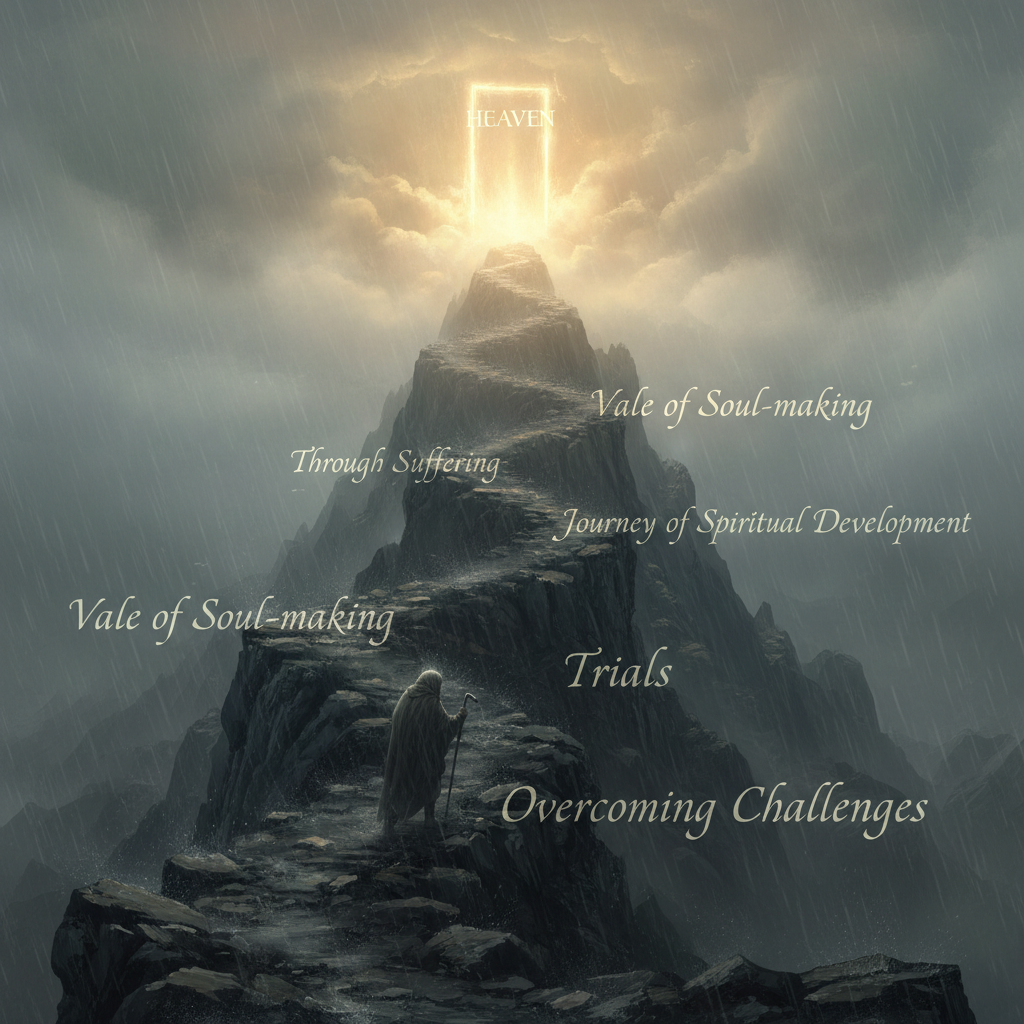
John Hick developed a modern version of Irenaeus' soul-making theodicy to explain evil and suffering. The key claim: humans were created imperfect and immature, not perfect like Augustine's Adam and Eve. God intentionally created us this way so that through struggling with evil, suffering, and moral challenges, we can develop into morally and spiritually mature beings—"children of God." The world is a "vale of soul-making" (a training ground for souls), not a hedonistic paradise. Epistemic distance (God's hiddenness) is necessary so we can freely choose good without being coerced by obvious divine presence. Through an afterlife of continued development, all humans eventually achieve salvation and maturity. While suffering sometimes fails to ennoble people (dysteleological suffering), Hick argues that without the possibility of pointless evil, genuine freedom and moral growth would be impossible.
The Two-Stage Creation Model
Unlike Augustine, who believed God created humans perfect and they fell into sin, Hick argues for a two-stage model:
Stage 1: Humans Created in God's "Image"
- Humans are created imperfect and spiritually immature
- We have the potential for goodness but not yet actualized goodness
- We are biologically sophisticated animals with moral and spiritual capacity
- But we lack spiritual development, maturity, and genuine moral virtue
Stage 2: Humans Growing into God's "Likeness"
- Through moral struggle and spiritual development, humans grow toward God's likeness
- This is an active process of choosing good over evil, repeatedly, in difficult circumstances
- Over a lifetime (and potentially in an afterlife), souls develop and mature
- The goal is becoming "children of God"—fully developed moral and spiritual beings
Why This Two-Stage Model Matters
Creating humans fully developed (perfectly virtuous from the start) would be logically impossible or morally undesirable. Why? Because true virtue requires having made a free choice to do good over evil. A being created virtuous has never chosen virtue—it was given virtue without effort.
Hick's Key Quote:
"One who has attained to goodness by meeting and eventually mastering temptations, and thus by rightly making responsible choices in concrete situations, is good in a richer and more valuable sense than would be one created ab initio in a state of either innocence or virtue."
In other words: someone who struggles with temptation and chooses good is more virtuous than someone programmed to be good.
The Vale of Soul-Making: The Purpose of the World
Hick's Central Metaphor
The world is not designed to maximize pleasure or comfort (a hedonistic paradise). Rather, the world is a "vale of soul-making"—a training ground, a school for spiritual and moral development.
Why a "Vale"?
- "Vale" means valley or low place
- It suggests a place of trials, challenges, and struggles—not a paradise
- The metaphor comes from Romantic poet John Keats, who wrote: "Do you not see how necessary a World of Pains and troubles is to school an Intelligence and make it a soul?"
The Classroom Analogy
Imagine a school designed to develop moral and intellectual character. This school cannot be a place of constant comfort and ease. It must present challenges and obstacles that students must overcome to develop wisdom, courage, perseverance, and other virtues. Similarly, the world must contain suffering, pain, and difficulties for souls to develop.
The Role of Suffering and Evil in Soul-Making
How Does Suffering Develop Character?
Through suffering and adversity, humans develop virtues that wouldn't otherwise develop:
- Courage develops through facing fear and danger
- Compassion develops through experiencing or witnessing pain
- Patience develops through enduring trials
- Perseverance develops through struggling toward difficult goals
- Self-denial develops through resisting temptation and selfish desires
- Trust in God develops through facing uncertainty and darkness
Without Evil, Virtue Is Impossible
If there were no suffering or evil to overcome:
- Courage would have no meaning (no fears to face)
- Compassion would be unnecessary (no one suffering)
- Forgiveness would not be needed (no one committing wrongs)
Hick's Logic:
Virtues are meaningful only in a world where their opposites are possible. Therefore, a loving God who wants to create virtuous beings must create a world where evil and suffering are real possibilities.
Epistemic Distance: God's Hiddenness
The Problem
If God's existence and presence were obvious and undeniable, humans wouldn't freely choose to love and obey God. They would obey God out of fear or coercion, not free choice and love.
Hick's Solution: Epistemic Distance
Epistemic means "related to knowledge" (from Greek episteme). Epistemic distance is the distance between God and humans in terms of knowledge—we cannot have obvious, irrefutable knowledge of God's existence.
Why This Is Necessary
- If God were directly and obviously present, we would be compelled to believe and obey
- But this would undermine free will and make genuine love impossible
- Real love must be freely chosen, not coerced
How Epistemic Distance Works
The world presents ambiguous evidence for God's existence:
- Natural beauty suggests divine creation, but natural disasters suggest indifference
- Moral goodness exists, but so does horrendous evil
- Religious experiences occur, but can be psychologically explained
This ambiguity means humans can reasonably believe or disbelieve in God. You can't be forced to believe in God; you must choose to believe.
The Role of Evil in Epistemic Distance
Evil and suffering contribute to epistemic distance by making God's benevolence unclear. If God were obviously good and powerful, He would prevent all suffering. But since suffering exists and God's existence is ambiguous, His goodness cannot be assumed. This ambiguity preserves human freedom.
Universal Salvation and the Afterlife
The Problem
If this world is for soul-making but many people die before achieving spiritual maturity (infants, the severely disabled, those dying in suffering), then their suffering is pointless and unjustified.
Hick's Solution: Universal Salvation
All humans will eventually be saved and achieve spiritual maturity. Why? Because a loving God would not consign anyone to perdition. And because soul-making continues after death.
Hick's Quote:
"Christian theodicy must point forward to that final blessedness, and claim that this infinite future good will render worthwhile all the pain and travail and wickedness that has occurred on the way to it."
Continued Development in the Afterlife
Those who die before achieving full spiritual development can continue their development in the afterlife. Even those who reject God in life can eventually be persuaded to accept God's love.
The Replica Theory: Personal Identity in the Afterlife
The Problem
How can "I" survive death if my body dies? Hick needs to show that the same person continues in the afterlife to benefit from soul-making.
Hick's Solution: The Replica Theory
God can create a perfect replica of me in heaven. If the replica has:
- My physical appearance
- My character and personality
- My memories (up to the point of death)
Then the replica is me in a meaningful sense.
The Philosophical Basis
Just as you might consider yourself the "same person" despite cellular regeneration throughout your life, a perfect replica would be you.
Criticisms of the Replica Theory
If God could create one replica, couldn't He create multiple replicas of me? Would the replica really be "me" or just a copy that looks and acts like me? This raises deep questions about personal identity that Hick's theory doesn't fully resolve.
Teleological vs. Dysteleological Suffering
Hick acknowledges an important distinction:
Teleological Suffering (Purposeful)
Suffering that contributes to soul-making and spiritual development. When someone faces adversity and grows stronger, more compassionate, or more virtuous as a result.
Example: A person overcoming addiction and becoming more empathetic, helping others.
Dysteleological Suffering (Pointless)
Suffering that does NOT contribute to soul-making and instead damages the person. When suffering crushes, embitters, or traumatizes someone without building character.
Example: A child tortured and murdered before having any chance to develop—this suffering serves no purpose.
Hick's Problem
Much suffering in the world appears to be dysteleological—it doesn't develop souls but destroys them. Holocaust victims, severely abused children, and animal suffering often seem to serve no soul-making purpose.
Strengths of Hick's Theodicy
- ✓
Addresses Soul-Making Intuition
Many people intuitively believe suffering can develop character and virtue. Hick's theodicy captures this genuine insight.
- ✓
Compatible with Modern Science
Unlike Augustine's theodicy (which conflicts with evolutionary biology), Hick's theodicy is compatible with science. Humans can be understood as having evolved from less developed beings and developing spiritually.
- ✓
Preserves Human Freedom
Epistemic distance allows genuine free will without coercion.
- ✓
Addresses the Logical Problem
By showing it's logically possible for God to create imperfect beings who grow through adversity, Hick helps defeat the logical problem of evil.
Criticisms of Hick's Theodicy
Criticism 1: Excessive Evil (Ivan's Objection)
Dostoevsky's Ivan Argument: Even if soul-making justifies some evil, the amount and intensity of evil seems excessive. Ivan in The Brothers Karamazov argues that the suffering of innocent children is so horrendous that no future good could justify it.
Hick's Weakness Here: Hick doesn't adequately address why God couldn't achieve soul-making with less intense suffering. The problem of horrendous evils (Marilyn McCord Adams) remains challenging.
Criticism 2: The Replica Theory Problem
If God creates a replica of me in heaven, is it really me? Or just a copy that thinks it's me? If personal identity can't survive death, then soul-making in the afterlife can't be my soul-making.
Problem for the Theodicy: If I can't be sure I'll exist in the afterlife, then I can't be sure my suffering in this life will lead to my salvation. This undermines Hick's justification for allowing suffering.
Criticism 3: Dysteleological Evil Undermines the Theodicy
Much suffering fails to develop character—it destroys it. Severe trauma, torture, and abuse often lead to bitter, damaged people, not virtuous ones. If this is true, then suffering isn't reliably soul-making, and the claim that evil is justified for soul-making is weakened.
Example: "Baby P" (Peter Connelly), a toddler tortured and killed by his stepfather, could not possibly develop spiritually from this experience. His suffering was pure dysteleology.
Criticism 4: The Epistemic Distance Argument Cuts Both Ways
Hick argues we need epistemic distance to preserve freedom. But if God is too distant, we might reasonably disbelieve in God entirely and dismiss religious claims.
Undesirable Consequence: If massive suffering is needed to maintain epistemic distance, then God permits enormous harm just to keep His existence ambiguous. This seems like an odd moral priority for a benevolent God.
Criticism 5: The Free Will Explanation May Not Work
Hick uses free will to explain why God doesn't simply create a world without suffering. But why not create free beings who, through countless generations, gradually chose to be less evil, naturally reducing suffering? Why allow as much evil as exists? Why couldn't God create humans with free will and then gradually guide them toward goodness through history? This would preserve freedom while reducing unnecessary suffering.
Scholarly Perspectives
"To say that the world is a 'vale of soul-making' is to say that it is a place in which human life is being fundamentally transformed. Man is not ready-made; he has to be made. In the process of 'making,' suffering and sorrow play a key role, along with joy and happiness. For it is through the challenges and obstacles in life that virtues are developed, such as compassion, courage, perseverance, and self-denial."
"The value judgment that is implicitly being invoked here is that one who has attained to goodness by meeting and eventually mastering temptations, and thus by rightly making responsible choices in concrete situations, is good in a richer and more valuable sense than would be one created ab initio in a state of either innocence or virtue."
Key Takeaways
- ✓Hick developed a modern soul-making theodicy based on Irenaeus
- ✓Two-stage creation: humans created imperfect, develop into God's likeness
- ✓World is a 'vale of soul-making'—a training ground for spiritual development
- ✓Suffering develops virtue: courage, compassion, perseverance, etc.
- ✓True virtue requires struggling with evil and freely choosing good
- ✓Epistemic distance: God's hiddenness preserves free will and genuine love
- ✓Universal salvation: all humans eventually achieve maturity and heaven
- ✓Replica theory: God creates replicas to allow personal survival after death
- ✓Acknowledges dysteleological (pointless) suffering exists
- ✓But pointless evil is necessary to maintain world's moral ambiguity
- ✓Compatible with modern science (unlike Augustine)
- ✓Criticisms: excessive evil, replica theory problems, dysteleology undermines theodicy
- ✓Ivan's objection: even universal salvation doesn't justify child suffering