Plato's View of the Immortal, Immaterial Soul
Summary
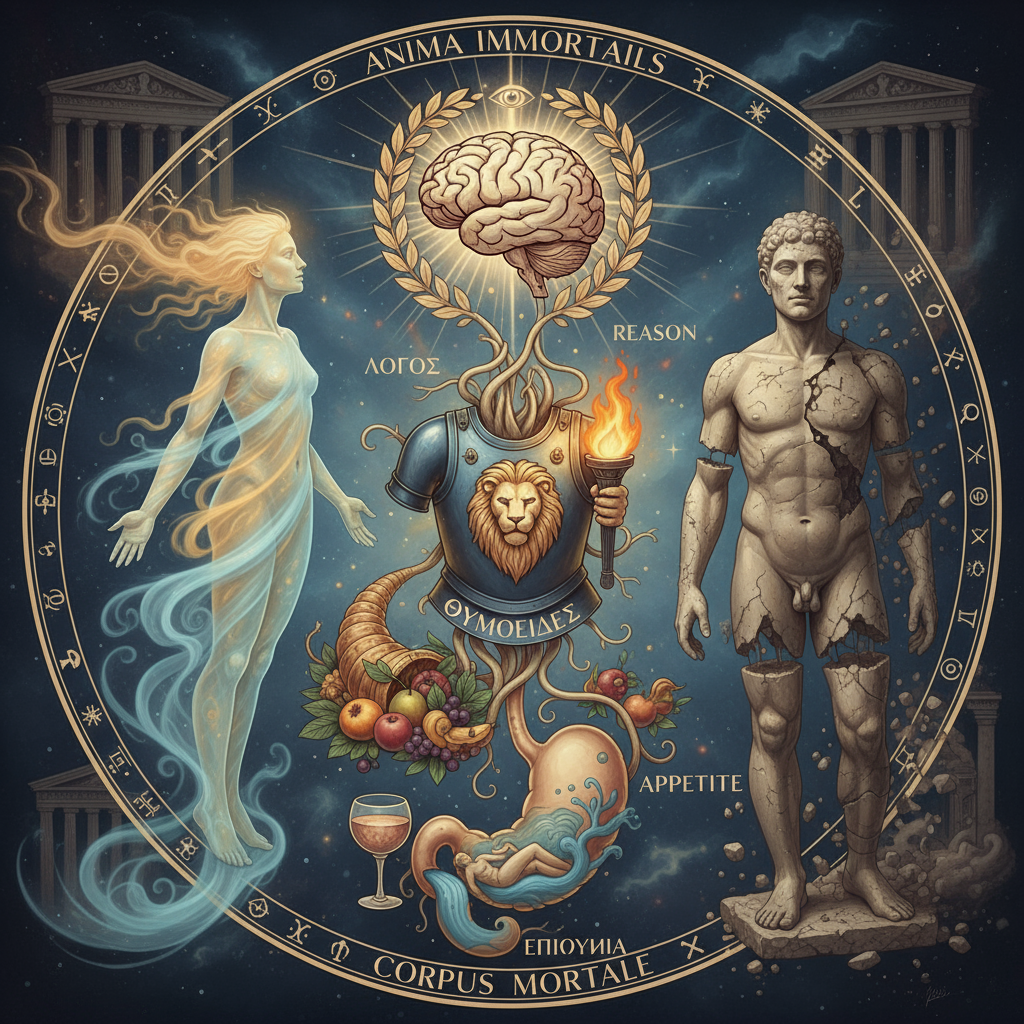
Plato believed that humans are made of two separate things: a physical body (which dies) and an immaterial soul (which lives forever). The soul is the real you—it's where your thinking, personality, and true self exist. The soul has three parts: reason (which thinks and seeks wisdom), spirit (which gives you courage and emotions), and appetite (which wants food, pleasure, and comfort). Before you were born, your soul existed in the world of Forms, and after your body dies, your soul continues to exist and may be reborn into another body.
Detailed Explanation
Dualism: Body and Soul Are Separate
Plato was a dualist, which means he believed that human beings are made of two completely different substances:
- The body – physical, material, visible, mortal, temporary
- The soul – immaterial, invisible, immortal, eternal
These are not the same thing. They are separate entities. The body is made of physical matter. It can be touched, seen, and weighed. It changes constantly—it grows, ages, gets sick, and eventually dies and decays.
The soul, by contrast, is immaterial. It has no physical substance. You can't see it, touch it, or measure it. But it's the real you—it's where your consciousness, your thoughts, your personality, and your true self exist.
For Plato, you are not your body. You are your soul. The body is just a temporary vessel that houses the soul during this life.
The Soul Is Immortal and Eternal
One of Plato's most important beliefs is that the soul is immortal—it cannot die. The word "immortal" means it cannot be destroyed. No matter what happens to the body, the soul continues to exist.
But Plato goes even further. He believed the soul is also eternal, which means it has always existed and always will exist. The soul didn't come into being when you were born, and it won't cease to exist when you die.
Why Plato Believed the Soul Is Immortal
Plato offered several arguments to prove the soul's immortality:
1. The Argument from Recollection (Innate Knowledge)
Plato noticed that we seem to know things we've never been taught in this life. We must have known the Forms before we were born. Our soul must have existed in the realm of Forms. When we learn in this life, we're actually remembering what our soul already knew.
2. The Affinity Argument
The soul is invisible, unchanging in its essence, and simple (not made of parts). Therefore, the soul belongs to the realm of eternal, indestructible things. Since the soul shares properties with eternal, divine things, it must itself be eternal and indestructible.
3. The Argument from Simplicity
Things that are made of parts can be destroyed by being broken apart. But the soul is simple—it has no parts. You can't break it apart because there's nothing to break. If the soul has no parts, it cannot be destroyed. Therefore, it's immortal.
4. The Argument from the Form of Life
The soul is what gives life to the body. Life is the very essence of the soul. But if life is essential to the soul, the soul cannot have the opposite property—death. Therefore, the soul is immortal—it cannot die.
The Tripartite Soul: Three Parts Working Together
Plato believed the soul has three parts:
1. Reason (Logistikon)
This is the rational, thinking part of the soul. It's located in the head. Reason seeks truth, wisdom, and knowledge. In a healthy soul, reason should rule the other two parts.
2. Spirit (Thymoeides)
This is the emotional, passionate part of the soul. It's located in the chest region. Spirit is the source of emotions like anger, courage, and honor. In a healthy soul, spirit should be the ally of reason.
3. Appetite (Epithymetikon)
This is the desiring part of the soul. It's located in the stomach/lower body. Appetite wants physical pleasures: food, drink, sex, comfort, money. In a healthy soul, appetite should be controlled by reason and spirit.
The Body as a Prison
Plato saw the body as a kind of prison for the soul. The body constantly demands attention: it gets hungry, thirsty, tired, sick. It craves pleasure. All of these bodily demands pull the soul away from contemplating the Forms. For Plato, the philosopher's goal is to separate the soul from the body as much as possible during life—to ignore bodily desires and focus entirely on reason and the pursuit of wisdom.
Reincarnation: The Cycle of Rebirth
Plato believed in reincarnation—the idea that the soul is repeatedly reborn into different bodies. After death, the soul is judged based on how it lived. If it lived a just, philosophical life focused on wisdom and virtue, it may escape reincarnation and return permanently to the realm of Forms. But most souls get reincarnated into a new body. This cycle continues until the soul finally purifies itself and achieves permanent liberation.
Scholarly Perspectives
"The soul is most like the divine, deathless, intelligible, uniform, indissoluble, always the same as itself, whereas the body is most like that which is human, mortal, multiform, unintelligible, soluble and never consistently the same."
"According to this theory, the soul has three parts: reason, spirit, and appetite. Reason is the rational part. Appetite and spirit are the nonrational parts."
Key Takeaways
- ✓Plato was a dualist—he believed body and soul are two completely different things
- ✓The soul is immaterial, invisible, and immortal—it cannot die
- ✓The soul is also eternal—it existed before birth and continues after death
- ✓The soul has three parts: reason, spirit, and appetite—and they must work in harmony
- ✓Reason should rule the soul, with spirit as its ally and appetite under control
- ✓The body is like a prison that traps and distracts the soul from seeking truth
- ✓Before birth, the soul lived in the realm of Forms—that's why we have innate knowledge
- ✓After death, souls are usually reincarnated into new bodies based on how virtuously they lived
- ✓The soul is divine and shares in the nature of eternal realities