Symbol
Summary
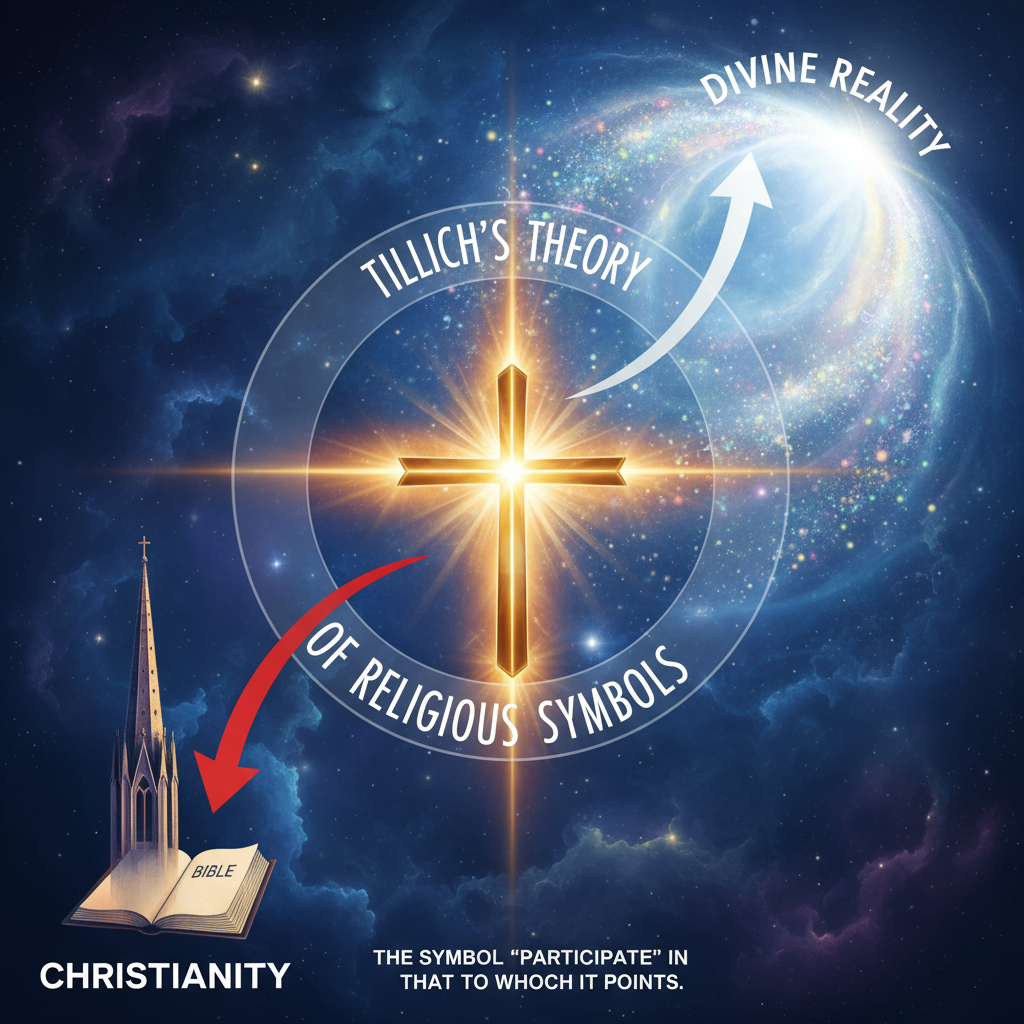
Paul Tillich (1886-1965) argued that religious language is symbolic, not literal. Symbols are different from signs: a sign (like a speed limit) just points to something arbitrarily, but a symbol participates in what it points to. For example, a national flag doesn't just point to a country—it evokes feelings of pride, loyalty, unity; it participates in the nation's power and dignity. Similarly, religious symbols like the cross don't just point to Christianity—they participate in God's love, forgiveness, and sacrifice. Tillich says symbols do four things: (1) point beyond themselves to ultimate reality, (2) participate in what they point to, (3) open up levels of reality otherwise closed, (4) open up dimensions of the soul. Religious language connects us spiritually to God without needing to literally describe or understand God—it's non-cognitive (not about factual truth) but still meaningful.
Detailed Explanation
Who Was Paul Tillich?
Paul Tillich (1886-1965) was a German-American Protestant theologian and philosopher.
His major work on religious language: Dynamics of Faith (1957).
The Core Problem Tillich Addresses
The Challenge:
- God is "beyond our understanding"—transcendent, infinite, ultimate.
- Literal language refers to finite objects and things we can experience.
- Therefore: We cannot use literal language about God because God transcends finite reality.
"That which is the true ultimate transcends the realm of finite reality infinitely. Therefore, no finite reality can express it directly and properly. Religiously speaking, God transcends his own name."
— Paul Tillich
Tillich's Solution: Symbolic Language
The Claim:
- All religious language is symbolic (except the statement "God is being-itself").
- Religious language doesn't try to describe God factually.
- Instead, religious language connects our minds and souls to God through symbolic participation.
"Whatever we say about that which concerns us ultimately, whether or not we call it God, has a symbolic meaning. It points beyond itself while participating in that to which it points. In no other way can faith express itself adequately. The language of faith is the language of symbols."
— Paul Tillich
Signs vs. Symbols: The Crucial Distinction
What Is a Sign?
Definition: A sign is something arbitrary that points to something else.
Signs are conventionally created—we agree what they mean.
Examples:
- Road signs (30 MPH speed limit)
- Mathematical symbols (+, =, ×)
- Words in a language (the word "dog" points to the animal)
Key Feature: No Participation
- Signs do not participate in what they point to.
- A "30 MPH" sign doesn't make you drive 30 mph—it just indicates the rule.
- The word "dog" doesn't bark or have fur—it just points to the animal.
- If you don't know what a sign means, it's meaningless to you.
What Is a Symbol?
Definition: A symbol is something that both points to AND participates in what it symbolizes.
Symbols are not arbitrary—they grow out of culture and collective experience.
Examples:
- National flag
- Wedding ring
- Cross
- Crown
- Dove (peace)
Key Feature: Participation
- Symbols participate in what they point to—they evoke the reality they represent.
Tillich's Flag Example:
- A national flag isn't just a random sign pointing to a country.
- It participates in the power, dignity, and identity of the nation.
- When you see your country's flag:
- You feel pride, loyalty, unity
- You're mentally and emotionally connected to your country
- The flag is part of what it points to
- Burning a flag is offensive not because you're destroying cloth, but because you're attacking what the flag participates in.
The Four Characteristics of Symbols
According to Tillich's "Theory of Participation"
1. Point Beyond Themselves
- Symbols point to something beyond themselves—to a deeper reality.
- The cross points to Christianity, to Jesus, to salvation
- Religious language points to God, to ultimate reality
2. Participate in What They Point To
- This is the defining characteristic of symbols.
- Symbols don't just indicate—they share in the reality they represent.
- The cross participates in God's love, forgiveness, sacrifice
- It's not just information about Christianity—it's part of Christianity
3. Open Up Levels of Reality
- Symbols reveal deeper meanings and spiritual dimensions of reality that would otherwise be closed to us.
- A crucifix opens up spiritual understanding of suffering, sacrifice, redemption
- Religious language opens up the "ultimate dimension" of existence
4. Open Up Dimensions of the Soul
- Symbols also open up corresponding levels of our soul/psyche that resonate with those levels of reality.
- When we engage with religious symbols, they awaken spiritual dimensions within us.
How Religious Symbols Work
The Crucifix Example
Consider what happens when a Christian looks at a crucifix.
It means something to them—not just factual information, but deep spiritual significance.
What the Crucifix Does:
- Points beyond itself: to Jesus, Christianity, God's plan
- Participates: in God's love, sacrifice, forgiveness
- Opens up reality: reveals spiritual truths about suffering, redemption, hope
- Opens up the soul: evokes feelings of gratitude, awe, repentance, love
The Function of Religious Language:
- Religious language works just like the crucifix.
- When someone says "God be with you", the words function symbolically:
- They don't literally describe God's location
- They create a spiritual connection between speaker, hearer, and God
- They evoke feelings, open up spiritual realities
God as Symbol
Tillich's Controversial Claim:
Even the word "God" is a symbol for "being-itself" or the "ground of being".
What This Means:
- "God" doesn't refer to a being (an entity that exists).
- Rather, "God" symbolizes ultimate reality—the ground and source of all existence.
"God does not exist. He is being itself beyond essence and existence. Therefore to argue that God exists is to deny him."
— Paul Tillich
This is difficult to understand but central to Tillich's view.
Symbols Are Not Arbitrary or Permanent
Symbols Grow Organically
How Symbols Are Created:
- Symbols are not invented arbitrarily by individuals.
- They grow out of the collective unconscious of a culture or religious tradition.
- They emerge from shared experience, history, and spiritual life.
"No one person can create a symbol or determine its meaning by themselves. Rather, symbols grow out of the collective unconscious."
— Paul Tillich
Symbols Can Die
Because symbols are tied to culture and collective experience, they can lose their meaning and die.
Example 1: The Swastika
- Originally a Hindu/Buddhist symbol of auspiciousness and good fortune.
- After Nazi adoption, the symbol lost its original meaning in Western culture and became associated with evil.
Example 2: "Lamb of God"
- When Jews practiced animal sacrifice, calling Jesus the "Lamb of God" was deeply meaningful.
- As the practice of sacrifice faded, the symbol lost its power for many people.
Example 3: Virgin Birth
- For Catholics, Mary's virgin birth symbolized her purity from sin.
- Protestants lost this meaning over time and abandoned many Marian prayers.
Strengths of Tillich's Symbolic Approach
Strength 1: Sidesteps the Meaning Problem
The Achievement: Tillich solves the difficulty of meaningfully talking about a God beyond our understanding.
- Religious language doesn't need to describe God—it connects us to God.
- We don't need to understand God to be connected to God through symbols.
- Religious language functions as a kind of religious experience.
- It connects human souls to God without requiring intellectual comprehension.
Strength 2: Captures Spiritual Dimension
Tillich's theory successfully captures the spiritual side of religious language and explains how it actually functions for believers.
- When Christians look at a crucifix or pray, they have deep spiritual feelings.
- This is often the most important thing to them—not cold factual beliefs.
- Tillich's theory honors this spiritual dimension.
Strength 3: Non-Cognitive But Meaningful
Symbols are non-cognitive (not about factual truth or empirical verification), but they're still meaningful because they:
- Arouse emotion and inspire action
- Stimulate community
- Express experiences that can't be expressed literally
- Clarify experience of the divine
Strength 4: Explains Symbol Power
Why "Never Say 'Only a Symbol'":
- Tillich famously said: "One should never say 'only a symbol,' but one should say 'not less than a symbol.'"
- Symbols have power that surpasses non-symbolic language.
- They evoke, inspire, transform, unite—they participate in ultimate reality.
Criticisms of Tillich's Symbolic Approach
Criticism 1: John Hick—"Participation" Is Unclear
Hick's Objection: John Hick criticized Tillich's idea of "participation" as unclear.
- What does it really mean for a symbol to "participate" in what it points to?
- If this is unclear, then there's little difference between a symbol and a sign.
- Both just point to something else.
Criticism 2: William Alston—Symbols Are Meaningless
William Alston argues symbols are meaningless because we don't know whether they're true or not.
- If symbols are non-cognitive (not about facts), how do we evaluate them?
- If we can't verify or falsify them, what meaning do they have?
Criticism 3: Paul Edwards—Cannot Be Verified or Falsified
Paul Edwards argues in "Professor Tillich's Confusions" that symbols are incomprehensible because they're subjective.
- Symbols "don't convey any facts".
- Edwards argues Tillich's view is circular: You can't understand symbols unless you already understand symbols.
- You can't comprehend symbols unless you already comprehend what they refer to.
Tillich's Response:
Tillich argues symbols are comprehensible because they work—they sustain faith for billions of believers. Comprehensibility doesn't require empirical verification. Symbols communicate through participation and experience, not logical definition.
Criticism 4: Still Risks Non-Realism
- If religious language is symbolic and doesn't refer to an objective reality, this implies non-realism.
- Non-realism: religious beliefs are subjective human constructs, not truths about external reality.
- Many religious believers are realists—they think religious statements do refer to an objective God who exists.
- Tillich's symbolic approach seems to undermine this.
Scholarly Perspectives
"Whatever we say about that which concerns us ultimately, whether or not we call it God, has a symbolic meaning. It points beyond itself while participating in that to which it points. In no other way can faith express itself adequately. The language of faith is the language of symbols... One should never say 'only a symbol,' but one should say 'not less than a symbol.'"
"Symbols are not arbitrary or created intentionally; no one person can create a symbol or determine its meaning by themselves. Rather, symbols grow out of the collective unconscious... Because the process of symbols being created, and dying away, is an organic one, symbols are meaningful and comprehensible to members of religious communities."
Key Takeaways
- ✓Tillich: religious language is symbolic, not literal—connects us to God without describing Him
- ✓Symbols ≠ signs: signs point arbitrarily; symbols participate in what they point to
- ✓Four characteristics: point beyond, participate, open reality, open soul
- ✓Flag example: participates in nation's dignity, evokes pride and loyalty
- ✓Cross: participates in God's love, sacrifice, forgiveness—not just information
- ✓Religious language functions like crucifix—creates spiritual connection, not factual description
- ✓'God' is symbol for 'being-itself' or 'ground of being'
- ✓Symbols grow from collective unconscious, not arbitrarily invented
- ✓Symbols can die when they lose cultural meaning (swastika, lamb of God)
- ✓'Never say 'only a symbol'—say 'not less than a symbol''—symbols have power
- ✓Strength: solves meaning problem; captures spiritual dimension; non-cognitive but meaningful
- ✓Criticism: 'participation' unclear (Hick); can't verify (Edwards); risks non-realism