Corporate Social Responsibility: Shareholder vs. Stakeholder
Summary
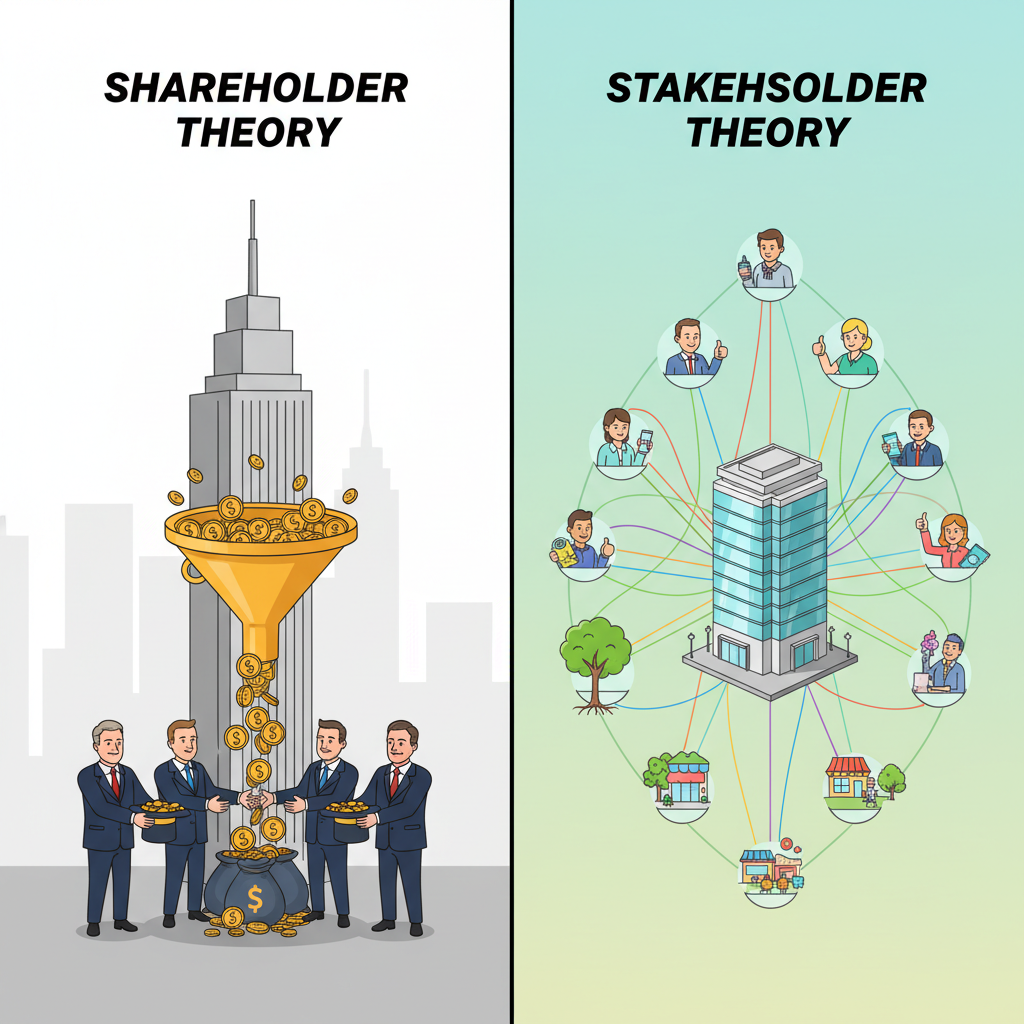
Corporate Social Responsibility (CSR) is the debate about who a business is responsible to. Milton Friedman (Shareholder Theory) argues that a business has only one responsibility: to make money for its owners (shareholders). He thinks spending company money on 'social causes' (like charity or extra eco-friendly measures) is stealing from the owners. Edward Freeman (Stakeholder Theory) argues that a business relies on many groups to exist (employees, customers, suppliers, the community), so it has a responsibility to all of them, not just the owners. Archie Carroll created a 'Pyramid' to show that businesses have four levels of duty: Economic (make profit), Legal (obey the law), Ethical (do what is right), and Philanthropic (give back).
Detailed Explanation
What is Corporate Social Responsibility (CSR)?
Definition
CSR is the idea that businesses have moral duties beyond just making a profit. It involves considering the impact of business decisions on society, the environment, and individuals.
Shareholder Theory (Milton Friedman)
'The Social Responsibility of Business is to Increase its Profits'
Core Argument
A corporation is an artificial person and cannot have 'moral' responsibilities. Only individuals (people) have morals.
The CEO's Role
The manager is an agent hired by the owners (shareholders) to do one thing: maximize their return on investment.
The 'Taxation' Argument
If a CEO spends company profits on charity or 'social good' (beyond what the law requires), they are effectively 'taxing' the shareholders without their consent.
Friedman's Conclusion
Businesses should focus only on profit, as long as they stay within the 'rules of the game' (no fraud or deception). Social problems should be fixed by governments or individuals using their own money.
Stakeholder Theory (R. Edward Freeman)
'Business is about how customers, suppliers, employees, financiers, communities and managers interact and create value.'
Core Argument
Friedman is wrong because businesses don't operate in a vacuum. They affect, and are affected by, many different groups (stakeholders).
Who is a Stakeholder?
Anyone who has a 'stake' in the company:
Employees
Need fair pay and safety.
Customers
Need safe, reliable products.
Suppliers
Need fair contracts.
Community
Needs the company not to pollute their air/water.
Shareholders
Need return on investment.
Kantian Connection
Freeman often uses Kantian ethics—treating stakeholders as ends in themselves, not just means to get profit.
Freeman's Conclusion
A business that ignores its stakeholders will fail in the long run. Creating value for all stakeholders leads to sustainable success.
Carroll's Pyramid of CSR
Archie Carroll organized these responsibilities into a hierarchy (pyramid), from bottom to top:
Economic Responsibility (The Foundation)
The business must make a profit to survive. Without this, nothing else matters.
Legal Responsibility
The business must obey the law. This is the minimum requirement.
Ethical Responsibility
The business should do what is right and fair, even if not required by law (e.g., paying above minimum wage).
Philanthropic Responsibility (The Top)
The business might contribute to the community (charity, volunteering). This is desirable but not mandatory.
Scholarly Perspectives
Milton Friedman
"There is one and only one social responsibility of business—to use its resources and engage in activities designed to increase its profits so long as it stays within the rules of the game."
This is the definitive statement of Shareholder Theory. It rejects CSR as 'socialism' and argues that the only moral duty of a business is to its owners.
R. Edward Freeman
"The 21st Century is one of Managing for Stakeholders. The task of executives is to create as much value as possible for stakeholders without resorting to tradeoffs."
This summarizes Stakeholder Theory. It counters Friedman by arguing that business is not a 'zero-sum game' (where shareholders win only if others lose). Instead, success comes from aligning the interests of all groups.
Key Takeaways
Friedman = Profit First
He isn't saying 'be evil.'He's saying 'be profitable and obey the law.' He thinks individuals should do charity, not companies.
Freeman = Connection First
He says you can't have a business without happy employees, customers, and communities.
Carroll's Pyramid
Remember the order! Economic → Legal → Ethical → Philanthropic. You can't be philanthropic ifyou're bankrupt (Economic).
Hypocrisy (Greenwashing)
A critical point in essays is whether companies do CSR because they care (Kantian duty) or just to look good and sell more (Utilitarian calculation).
Quick Reference: Friedman vs. Freeman
| Feature | Shareholder Theory (Friedman) | Stakeholder Theory (Freeman) |
|---|---|---|
| Primary Duty | To Shareholders (Owners) | To All Stakeholders |
| Goal | Maximize Profit | Create Value for Everyone |
| View on CSR | It's theft/taxation; undemocratic | It's essential for survival |
| Ethical Basis | Utilitarian/Egoist (Invisible Hand) | Kantian (Treat people as ends) |
| Example | Minimize costs, obey law only | Fair wages, eco-friendly, community aid |