Good Ethics is Good Business
Summary
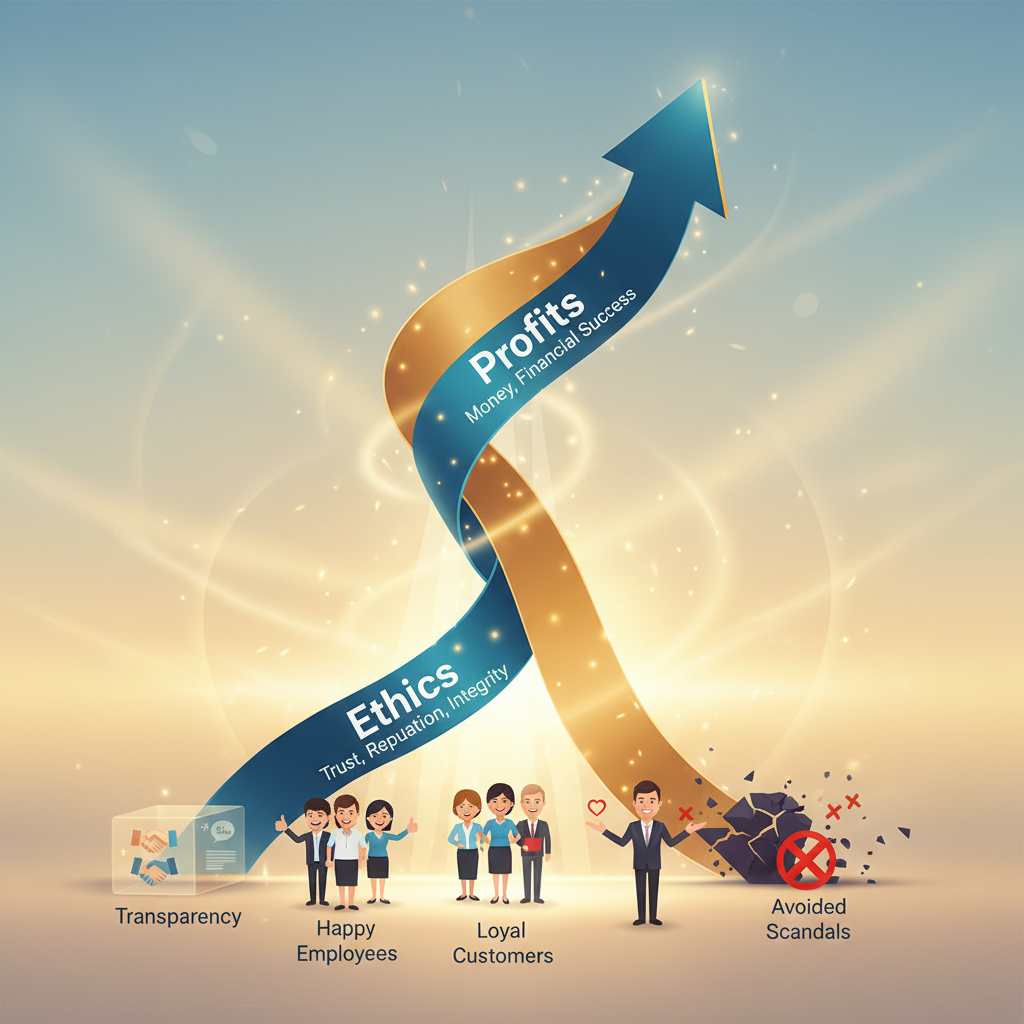
"Good Ethics is Good Business" is the argument that ethical practices are not just morally right but also financially profitable in the long term. Research shows that companies with strong ethical practices outperform competitors by building trust with customers, attracting better employees, reducing legal risks, and maintaining their reputation. Companies like Patagonia and Ben & Jerry's prove this: their commitment to sustainability and fair practices created loyal customers and strong financial returns. Conversely, Volkswagen's emissions scandal cost billions in fines and destroyed its reputation. The argument aligns with Stakeholder Theory (Freeman): companies that treat all stakeholders fairly create sustainable, long-term success.
Detailed Explanation
What Does "Good Ethics is Good Business" Mean?
Definition
This is the claim that adopting ethical practices—transparency, fairness, integrity, social responsibility—leads to long-term financial success and is therefore good business practice.
Key Assumption
Profit and ethics are not in conflict. In fact, they reinforce each other.
The Seven Ways Ethics Improves Profitability
1. Building Trust with Customers
Customers prefer to buy from businesses they trust. When a company is known for ethical practices, customers are more willing to buy from them and pay premium prices. Example: Patagonia can charge more because customers know their products are ethically made.
2. Enhancing Customer Retention
Ethical companies have higher customer loyalty. Customers are less likely to switch to competitors if they trust and value the company. Repeat customers are more profitable than constantly acquiring new ones.
3. Improving Employee Morale and Retention
Employees want to work for companies with strong values they can be proud of. Ethical companies have lower turnover and higher productivity. Recruiting passionate, values-driven employees creates a more motivated workforce.
4. Avoiding Scandals and Legal Costs
Unethical practices lead to whistleblowing, lawsuits, and fines. The Volkswagen scandal cost billions in fines and years of reputation damage. Ethical companies avoid these catastrophic costs.
5. Strengthening Brand Reputation and Market Position
A strong reputation is a valuable asset worth more than short-term profits. Ethical brands can charge higher prices and weather crises better. Negative publicity from unethical behavior can destroy decades of brand-building.
6. Driving Innovation
The pressure to be ethical and sustainable drives innovation. Example: Unilever's Sustainable Living Plan led to innovations in eco-friendly products and cost savings.
7. Building Better Stakeholder Relationships
Ethical companies have better relationships with suppliers, investors, regulators, and communities. This translates into preferential treatment, community support for expansion, and regulatory goodwill.
The Research Evidence
- Institute of Business Ethics Study: Companies with strong ethical cultures outperformed their peers by 10.5% in annualized returns.
- Ethisphere Institute Study: Companies recognized for ethical practices outperformed the S&P 500 by 3% annually.
- Harvard Business Review Study: Companies led by ethical leaders had higher financial performance over the long term.
Short-Term vs. Long-Term Thinking
The Key Distinction
- Shareholder Theory (Friedman): Focuses on short-term profit maximization.
- Stakeholder Theory (Freeman): Focuses on long-term sustainability.
The Problem with Short-Termism
A company might increase short-term profits by cutting R&D investment, paying employees poorly, or ignoring environmental damage. But these decisions damage the company long-term. Stakeholder Theory argues that treating stakeholders fairly creates sustainable, long-term profitability.
Famous Case Studies
Patagonia (Ethical Success)
- What They Do: Radical commitment to sustainability, fair trade, and environmental activism.
- Result: Built a loyal customer base, achieved impressive financial returns, and became a brand synonymous with integrity.
- Lesson: Ethical values can drive corporate performance.
Volkswagen (Unethical Failure)
- What They Did: Cheated on emissions tests to increase profits.
- Result: Billions in fines, years of reputation damage, loss of trust, declined stock price.
- Lesson: Unethical shortcuts destroy more value than they create.
Weaknesses in the Argument
1. Sometimes Unethical Practices Profit Short-Term
A company can increase short-term profits by cutting corners, polluting, or exploiting workers. The consequences (fines, reputation damage) come later. Example: Volkswagen profited from cheating on emissions tests until they were caught.
2. Not All Stakeholders Value Ethics Equally
Some customers prioritize price over ethics and will buy from the cheapest, least ethical option. In highly competitive markets, ethical companies may be undercut by unethical competitors.
3. The "Greenwashing" Problem
Some companies engage in superficial CSR (greenwashing) just for good PR, without genuine ethical commitment. This can confuse the relationship between ethics and profitability.
4. Difficult to Measure Causation
It's hard to prove that ethics caused financial success versus other factors like market conditions or product quality.
Scholarly Perspectives
Research Evidence
"Good ethics is good business. When customers know a company is ethical, they trust it more, buy from it more, and remain loyal longer. Employees want to work for ethical companies. Ethical practices reduce legal risks and scandals. The long-term financial performance of ethical companies outperforms their unethical peers."
This summarizes the empirical evidence that ethical practices correlate with financial success. Multiple studies consistently show that companies prioritizing ethical behavior achieve superior long-term financial performance.
Stakeholder Theory Perspective
"While some businesses see a conflict between ethics and profit, thinking they must choose one or the other, this is a false dilemma. In the long term, good ethics creates good business. The competitive advantage of ethical practices—trust, innovation, employee retention, reputation—far outweighs any short-term cost. Companies narrowly focused on short-term profits often make decisions that are detrimental to their long-run survival."
This counters the Friedman position by showing that ethics and profit are not opposed but aligned over time. Stakeholder Theory argues that sustainable success requires balancing the interests of all stakeholders, not just shareholders.
Theological and Philosophical Perspectives
Christian Perspective
"A good name is more desirable than great riches; to be esteemed is better than silver or gold."
This biblical wisdom suggests that reputation and virtue are more valuable than money, supporting the view that ethical behavior creates lasting value.
Kantian Perspective
Treat people as ends in themselves, not merely as means. This requires ethical business practices regardless of profit implications, but aligns with long-term business success.
Utilitarian Perspective
Good ethics maximizes the greatest happiness for the greatest number, which also benefits the business long-term through customer loyalty, employee satisfaction, and social license to operate.
Milton Friedman's Counterargument
Friedman's Position: A business' only responsibility is to maximize profit for shareholders, within the "rules of the game" (no fraud).
Friedman's Response: If ethics is profitable, then pursue it—but only because it increases profit, not because it's "the right thing". Do not spend company money on CSR that doesn't benefit the bottom line.
Counter-Critique: Modern research shows that ethics is profitable long-term, so Friedman's objection is undermined. Businesses can be simultaneously ethical and profitable—the two goals converge rather than conflict.
Key Takeaways
Evidence-Based
Multiple studies show ethical companies outperform unethical ones in long-term financial metrics, including returns on investment and stock performance.
Long-Term vs. Short-Term
The key is thinking long-term. Ethics improves sustainable profitability over time, while unethical shortcuts create expensive problems later.
Trust is Currency
In modern business, trust and reputation are as valuable as money in the bank. Building trust takes years; destroying it takes moments.
Seven Mechanisms
Ethics creates profit through: customer trust, customer retention, employee morale, avoiding scandals, reputation strength, innovation, and stakeholder relationships.
Famous Examples
Patagonia demonstrates that strong ethics drives loyalty and profit. Volkswagen shows that unethical shortcuts destroy value catastrophically.
Stakeholder Theory Alignment
Freeman's Stakeholder Theory supports this view: treating all stakeholders fairly creates sustainable, long-term business success.
Quick Reference: Ethical Practices and Financial Impact
| Ethical Practice | Financial Benefit | Example |
|---|---|---|
| Transparency & Trust | Higher customer loyalty and premium pricing power | Patagonia |
| Fair Employee Treatment | Lower turnover, higher productivity | Costco |
| Environmental Responsibility | Brand differentiation, innovation opportunities | Unilever |
| Honest Communication | Avoids scandals, maintains reputation | Johnson & Johnson (Tylenol recall) |
| Stakeholder Engagement | Better community relations, regulatory support | Interface Inc. |