Sanctity of Life: Religious Foundation
Summary
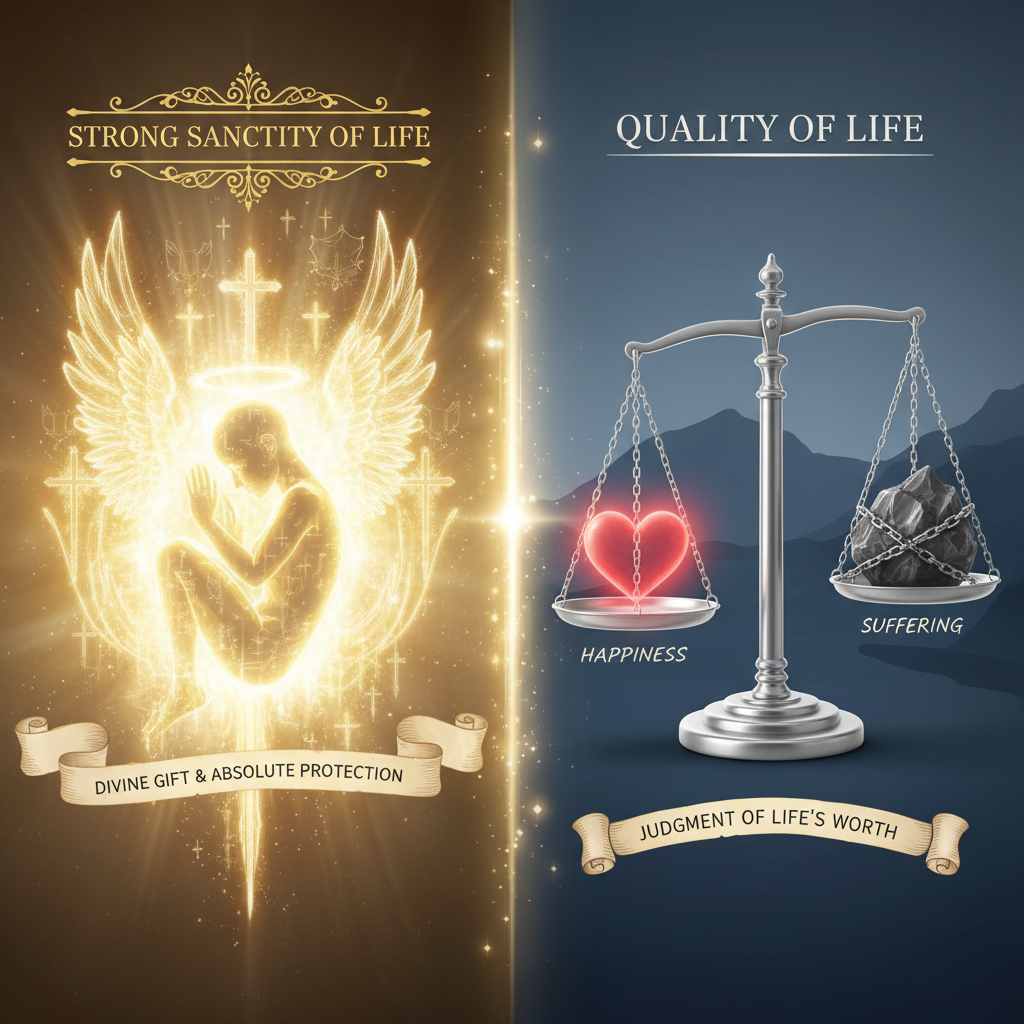
The Sanctity of Life is the religious idea that human life is sacred, holy, and a gift from God. Because God created life and made humans in His image (Imago Dei), only God has the right to give or take life. Therefore, ending a life prematurely (euthanasia or suicide) is seen as morally wrong, equivalent to murder or playing God. The Strong Sanctity of Life view (like the Catholic Church) says killing an innocent person is never justified, even to stop suffering. The Weak Sanctity of Life view (some Protestants) agrees life is sacred but accepts that in extreme suffering, compassion and quality of life might justify letting someone die. This contrasts with the secular Quality of Life view, which says life is only valuable if it has more happiness than suffering.
Detailed Explanation
What is the "Sanctity of Life"?
Definition
The belief that human life possesses an intrinsic, absolute value because it is sacred and God-given. It is valuable in itself, regardless of its "quality" or usefulness.
Biblical Foundations
Imago Dei (Image of God)
"So God created mankind in his own image" (Genesis 1:27). Humans are special and distinct from animals; destroying a human destroys a reflection of God.
Life is a Gift
"The Lord gave and the Lord has taken away" (Job 1:21). We are stewards, not owners, of our lives.
Thou Shalt Not Kill
The Sixth Commandment (Exodus 20:13) prohibits the intentional killing of innocent life.
Temple of the Holy Spirit
"Your body is a temple of the Holy Spirit... You are not your own" (1 Corinthians 6:19).
Strong vs. Weak Sanctity of Life
This is a crucial distinction for understanding different religious responses to euthanasia.
1. Strong Sanctity of Life (Absolutist)
Who holds this view?
Catholic Church, Conservative Evangelicals
- Position: All innocent human life must be preserved from conception to natural death.
- On Euthanasia: Active euthanasia is always wrong, regardless of suffering. It is murder.
- On Suffering: Suffering can have redemptive value (sharing in Christ's suffering) and does not justify killing.
- Exception: The Doctrine of Double Effect allows giving painkillers to relieve pain even if it shortens life (as a side effect), but the intention must never be to kill.
2. Weak Sanctity of Life (Relative)
Who holds this view?
Liberal Protestants (e.g., Church of England in some debates), Situation Ethicists
- Position: Life is sacred, but not absolute.
- On Euthanasia: In extreme cases (terminal illness, agony), the principle of love (agape) and compassion may override the strict rule against killing.
- Argument: God is love. Keeping someone alive in prolonged, undignified torture is not loving. Death can be a mercy.
Sanctity of Life vs. Quality of Life
Sanctity of Life (Religious)
- Value of life: Intrinsic (valuable because it is).
- Does not depend on health, intelligence, or happiness.
- A person in a persistent vegetative state (PVS) has the same value as a healthy athlete.
Quality of Life (Secular/Utilitarian)
- Value of life: Instrumental (valuable because of what it provides).
- Depends on the ability to reason, interact, and enjoy life.
- Peter Singer argues that if a life has zero quality (e.g., PVS) and no potential for future quality, it is not worth preserving.
Scholarly Perspectives
Sacred Congregation for the Doctrine of the Faith
"Intentionally causing one's own death, or suicide, is therefore equally as wrong as murder; such an action on the part of a person is to be considered as a rejection of God's sovereignty and loving plan."
This defines the official Roman Catholic (Strong Sanctity) position. It explicitly links the wrongness of euthanasia to the violation of God's sovereignty (His right to decide life and death).
The Bible
"Whoever sheds the blood of man, by man shall his blood be shed; for in the image of God has God made man."
This is the primary biblical text used to justify the Sanctity of Life. It connects the prohibition of killing directly to the status of humans being made in the Imago Dei (Image of God). Killing a human is an attack on God himself.
Key Takeaways
Imago Dei Foundation
Humans are made in God's image (Genesis 1:27), giving life intrinsic, sacred value regardless of quality or usefulness.
Strong vs. Weak Sanctity
Strong (Catholic): Life must always be preserved; euthanasia is never justified. Weak (Liberal Protestant): Life is sacred but compassion/love might justify ending extreme suffering.
Intrinsic vs. Instrumental Value
Sanctity of Life: Life is valuable in itself. Quality of Life: Life is valuable for what it allows you to do (happiness, autonomy, relationships).
Divine Sovereignty
The core religious objection to euthanasia is "playing God"—only God has the authority to give and take life.
Redemptive Suffering
Strong Sanctity believers argue suffering can have spiritual meaning (sharing in Christ's suffering) and should be addressed through care, not killing.
Slippery Slope Warning
Religious ethics warn that abandoning Sanctity for Quality of Life risks devaluing the disabled, elderly, and vulnerable members of society.
Quick Reference: Key Concepts
| Concept | Definition |
|---|---|
| Imago Dei | "Image of God" – Humans have unique sacred value |
| Strong Sanctity | Life must always be preserved; euthanasia is never justified |
| Weak Sanctity | Life is sacred, but compassion/love might justify ending suffering |
| Quality of Life | Life's value depends on happiness/autonomy, not sacredness |
| Divine Sovereignty | Only God has the authority to give and take life |
| Intrinsic Value | Valuable in itself (Sanctity view) |
| Instrumental Value | Valuable for what it allows you to do (Quality view) |