Bonhoeffer's Teaching on the Cost of Discipleship
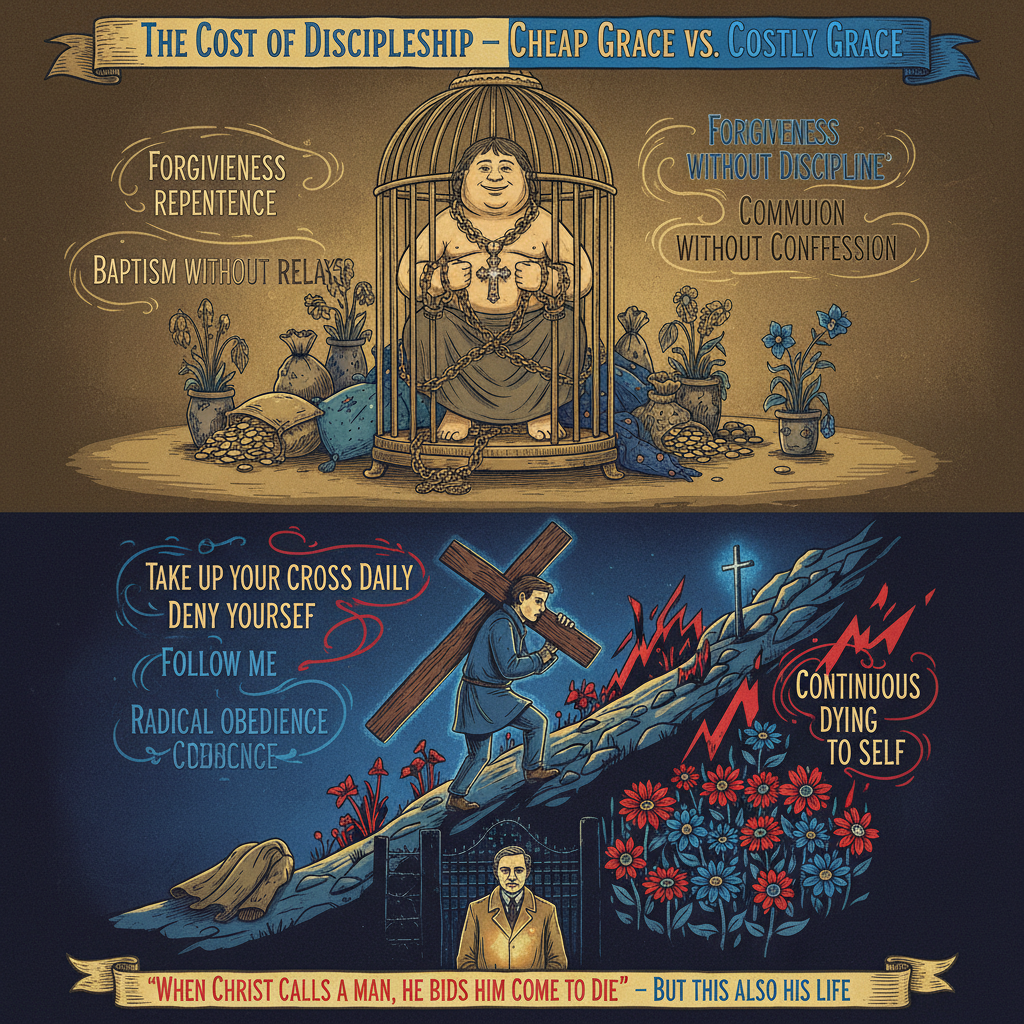
The Cost of Discipleship - Cheap Grace vs. Costly Grace: The top panel depicts cheap grace—a figure comfortable in a gilded cage, surrounded by wealth and luxury, with labels showing "Forgiveness without Repentance," "Baptism without Discipline," "Communion without Confession." The bottom panel shows costly grace—a man carrying his cross up a difficult path, with imperatives "Take up your cross daily," "Deny yourself," "Follow me," "Radical obedience," and "Continuous dying to self." The banner at the bottom declares Bonhoeffer's famous words: "When Christ calls a man, he bids him come to die"—but this is also his life.
Summary
The Cost of Discipleship is Bonhoeffer's central teaching: following Jesus demands total sacrifice, radical obedience, and willingness to suffer—not comfortable belief without transformation.
Core Contrast:
Cheap Grace
Grace that forgives sin without demanding repentance or life change. It says "God loves you, so relax. You don't have to change or sacrifice anything."
Costly Grace
Grace that is freely given but demands a response: obedience, discipleship, sacrifice, and action. It says "God's grace is priceless, so be willing to give up everything to follow Jesus."
The Central Claim:
"When Christ calls a man, he bids him come and die"
Not necessarily physical death, but death to self-will, to comfort, to safety, to worldly attachments.
Key Elements:
- Radical Obedience: Complete surrender to God's will, not selective obedience
- Suffering is Central: Bonhoeffer believed Christians must expect persecution and suffering as part of following Jesus
- Daily Dying: Discipleship is not a one-time decision but a continuous, daily choice to die to yourself and follow Christ
- Love Expressed Through Obedience: True love of God is shown by obedient action, not just emotional belief
- Bonhoeffer Embodied It: He lived what he taught—executed by the Nazis in 1945 for his resistance and faith
Detailed Explanation
The Problem: Cheap Grace in the Church
By the 1930s, Bonhoeffer saw the Church had become comfortable with "cheap grace"—a distortion of the Gospel message.
What Cheap Grace Looks Like:
- Forgiveness without repentance: "God forgives you, so don't worry about your sins"
- Baptism without discipline: The ritual itself saves you; it doesn't require life change
- Communion without confession: Eating bread and drinking wine are grace; they don't require examining your heart
- Belief without action: "Just believe in Jesus and you're saved; what you do doesn't matter"
- Comfort without transformation: Christianity becomes a spiritual cushion that lets you keep your comfortable, worldly life
The Result:
- Christians feel absolved without being transformed
- The Church becomes complicit with evil (as in Nazi Germany) because faith makes no ethical demands
Bonhoeffer's famous line: "Cheap grace has been the downfall of more Christians than anything else"
Costly Grace: The True Gospel
Costly grace is grace that is freely given by God but demands a costly response from the believer: total surrender, obedience, discipline, and willingness to suffer.
Why It's Called "Costly":
- God paid a price: Jesus's incarnation, death, and resurrection cost God everything
- Believers must respond: If God paid such a price for our salvation, we should be willing to pay a price in discipleship
- It demands sacrifice: Costly grace is not comfortable; it calls us to give up worldly attachments, security, and ease
Bonhoeffer's Formula:
"Only the believer is obedient, and only those who are obedient believe."
What This Means:
- Faith and obedience are inseparable: You cannot have true faith without obedience
- Obedience is not earning salvation: It is the natural response of a heart that has encountered Christ's grace
- Justification by faith is restored: Bonhoeffer wanted to rescue Luther's teaching from distortion; faith is real, but it is never passive or inactive
Taking Up the Cross: Daily Dying to Self
The Key Biblical Image:
Mark 8:34-35: "Whoever wants to be my disciple must deny themselves and take up their cross and follow me".
What the Cross Means:
The cross is not chosen suffering (self-imposed hardship). Rather, it is the suffering that comes as a natural consequence of following Christ in a hostile world.
Bonhoeffer teaches that Jesus says "every Christian has his own cross waiting for him, a cross destined and appointed by God".
Examples of Taking Up the Cross:
- Leaving worldly attachments: The rich young man was called to "die" to his wealth
- Denying selfish desires: Every command of Jesus is a call to "die" to lust, greed, pride
- Facing persecution: In a world that opposes God, being a Christian means facing opposition and suffering
- Living counter-culturally: The world cannot coexist with Christians because Christian obedience implicitly condemns the world's values
"When Christ Calls a Man, He Bids Him Come and Die":
- This doesn't necessarily mean physical death
- But it means dying to the old self, to self-will, to comfort, to security
- It is a continuous, daily process, not a one-time event
The Paradox:
- The cross is the terrible end to an otherwise happy life
- BUT it is also the beginning of new life in Christ
- "When Christ calls a man, he bids him come and die—but this is also his life"
Radical Obedience
Obedience as Love:
For Bonhoeffer, love is expressed through obedience. It is not sentimental feeling but concrete, sacrificial action.
Example: Bonhoeffer's Own Life:
- Bonhoeffer's love of God and neighbor was expressed through obedience to God in resistance to Nazi idolatry
- He could not love God while remaining silent about genocide
- His obedience meant defying the state and risking his life, but it was an expression of love
The Cost of Obedience:
Bonhoeffer believed that living a godly life inevitably leads to persecution:
2 Timothy 3:12: "Anyone who wants to live a godly life will be persecuted"
"The world cannot live side-by-side with us because what we say and do, whether we intend it to or not, is perceived by the world as condemnation on them"
This is Not Pessimism:
It is realistic Christianity. Bonhoeffer is not saying "wallow in suffering," but rather: expect it, prepare for it, and embrace it as part of following Christ.
Suffering as Central to Discipleship
Bonhoeffer's Bold Claim:
Suffering is not an accident of the Christian life or a punishment for sin. It is a necessary component of discipleship.
Why Suffering is Central:
- Jesus suffered: The Cross is central to the Gospel
- Disciples follow their Master: If Jesus suffered, disciples must expect to suffer
- Suffering deepens understanding: "We can only understand God's revelation and obtain grace by embracing [suffering]"
- Suffering purifies discipleship: It strips away false motivations and reveals true commitment
Spiritual Discipline as Sacrifice:
- Prayer, fasting, meditation, and self-examination are forms of sacrifice
- They help believers overcome worldly temptations and accept suffering as Jesus did
- This is not masochism (enjoying pain) but training for discipleship
The Specific Cost for Bonhoeffer:
His theology of suffering was not abstract:
- Imprisonment by the Nazis
- Torture and interrogation
- Execution by hanging in April 1945, just days before the Allies liberated the camp
Yet his letters from prison show he maintained peace and faith, embodying his own teaching about costly grace.
Discipleship as Living the Sermon on the Mount
For Bonhoeffer, authentic discipleship is living out the Sermon on the Mount (Matthew 5-7).
What the Sermon Demands:
- Love your enemies (Matthew 5:44)
- Turn the other cheek (Matthew 5:39)
- Give to the poor (Matthew 5:42)
- Do not judge others (Matthew 7:1)
- Seek first the kingdom of God (Matthew 6:33)
The Problem with Cheap Grace:
Many Christians treat the Sermon on the Mount as "counsels of perfection" that are optional or for a spiritual elite.
Bonhoeffer's Claim:
These are not optional; they are the very heart of Christian ethics.
Practical Implications:
- You cannot be a Christian and refuse to love your enemies
- You cannot claim to follow Jesus while seeking wealth and comfort
- You must be willing to suffer loss rather than compromise these commands
Death and Resurrection: The Daily Pattern
Baptism as the Model:
Bonhoeffer taught that baptism symbolizes the Christian life: death (in the water) and resurrection (rising from the water).
Discipleship as Continuous Pattern:
- Every day, the Christian dies to self-will and selfish desires
- Every day, the Christian rises to obey God and serve others
- This is not a one-time conversion but a lifelong pattern
Quote:
"The cross is not the terrible end to an otherwise god-fearing and happy life, but it meets us at the beginning of our communion with Christ."
This means:
- The cost of discipleship is not some future trial but immediate and ongoing
- From the moment you encounter Christ, you begin dying to your old life
- But this death is also liberation and resurrection
Bonhoeffer's Critique of Cheap Grace in Nazi Germany
The Historical Context:
Many German churches preached cheap grace while the Nazis committed genocide.
The False Doctrine:
- "Just believe in Jesus and you're fine; the state is not your concern"
- "God forgives, so Nazi atrocities don't affect your salvation"
- "Private faith; public silence"
Bonhoeffer's Response:
- Costly grace demands action against evil
- Discipleship requires prophetic witness, even when it costs everything
- Silence is complicity; faithful disciples must speak and act
His life and death were a living sermon against cheap grace.
Scholarly Perspectives
Key Academic Quotes
Quote 1 (Cheap Grace vs. Costly Grace):
"Cheap grace is the preaching of forgiveness without requiring repentance, baptism without church discipline, Communion without confession, absolution without contrition. Cheap grace is grace without discipleship, grace without the cross, grace without Jesus Christ, living and incarnate. Costly grace is the treasure hidden in the field; for the sake of it a man will gladly go and sell all that he has. Costly grace is the call of Jesus Christ at which the disciple leaves his nets and follows him."
— Dietrich Bonhoeffer, The Cost of Discipleship (1937)
Context: This is the foundational distinction of Bonhoeffer's entire theology. It shows why cheap grace is spiritually destructive and why costly grace is the authentic gospel.
Quote 2 (The Demand of Discipleship):
"When Christ calls a man, he bids him come and die. It may be a death like that of the first disciples who had to leave home and work to follow him, or it may be a death like Luther's, who had to leave the monastery and go out into the world. But it is the same death every time—death in Jesus Christ, the death of the old man at his call. Jesus' summons to the rich young man was calling him to die, because only the man who is dead to his own will can follow Christ. Every command of Jesus is a call to die, with all our affections and lusts."
— Dietrich Bonhoeffer, The Cost of Discipleship
Context: This captures Bonhoeffer's understanding of discipleship as radical death to self and willingness to suffer—not as punishment, but as the necessary response to encountering Christ.
Quick Reference: Cost of Discipleship Concepts
| Concept | Meaning |
|---|---|
| Cheap Grace | Grace without repentance, transformation, or obedience; comfortable but spiritually empty |
| Costly Grace | Grace freely given by God but demanding total surrender, obedience, and sacrifice from the believer |
| Taking Up the Cross | Accepting the suffering and rejection that comes from faithful discipleship |
| Daily Dying to Self | Continuous, daily choice to deny selfish desires and obey God's will |
| Radical Obedience | Complete, unconditional surrender to God's will; obedience even when costly |
| Suffering as Discipleship | Suffering is not accidental but central to following Christ |
| The Sermon on the Mount | Jesus's ethical demands (love enemies, serve poor, forgive) are the heart of discipleship |
| Death and Resurrection | The pattern of continuous dying to self and rising to Christ's life |
| Obedience is Faith | True faith is inseparable from obedient action; faith is never passive |
Key Takeaways for Your Exam
- Always contrast cheap vs. costly grace: This is the organizing principle of Bonhoeffer's entire ethics. Never discuss one without the other
- Connect to historical context: Bonhoeffer's teaching was forged in Nazi Germany. Cheap grace was the Church's sin that enabled genocide
- It's not just about suffering: Expensive/costly grace is not masochism or seeking hardship. It is willingness to sacrifice for obedience to Christ
- Link to his life: Bonhoeffer embodied his teaching. His execution is not a tragedy but a fulfillment of his theology. This makes his work prophetic, not academic
- The paradox: "Come and die" is also "come and live." Costly grace brings true freedom and joy, not burden
- Evaluate: Is Bonhoeffer's standard realistic for most Christians? Or is it necessary prophetic critique of comfortable Christianity?