Bonhoeffer's Teaching on the Church as Community
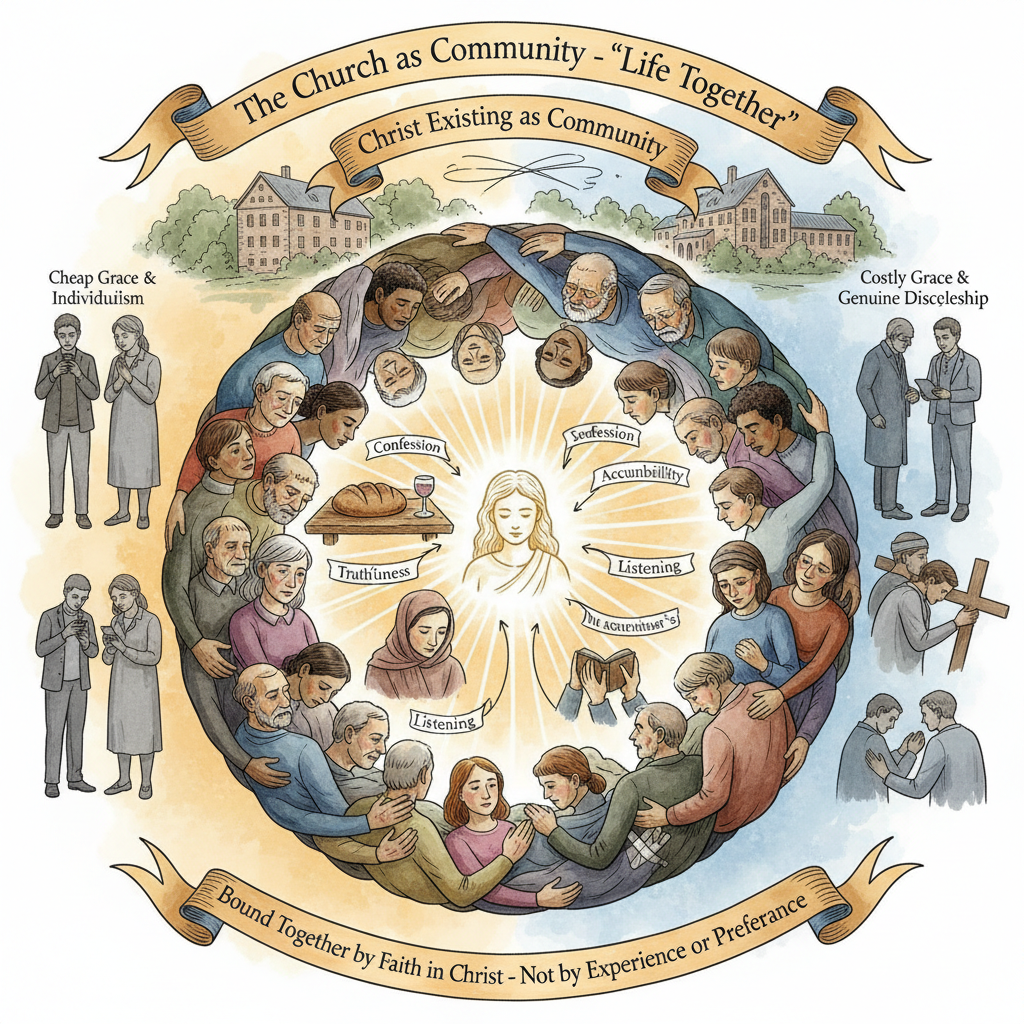
Bonhoeffer's Church as Community: The Church is a living body with Christ at the center, where diverse members are bonded together through confession, accountability, and mutual support, embodying costly grace through shared discipleship and concrete acts of love. This illustration depicts Bonhoeffer's Church as Community: A diverse group of people physically connected, supporting and surrounding one another. Christ is shown at the center, radiating light into each member. Arrows show the flow of confession, accountability, listening, and mutual bearing of burdens. The scene includes Communion/Sacraments and Scripture study, showing the embodied, concrete practices of community. The contrast shows isolation and individualism on one side, and the bonded, vibrant community on the other, illustrating how "Christ existing as community" creates transformation through costly grace lived together.
Summary
For Bonhoeffer, the Church is not just an institution or a collection of individuals. It is a living, embodied community where Christ is present as the head, and believers are bonded together through confession, accountability, and mutual support.
Key Principles:
- Christ at the Center: The Church is not a voluntary association of like-minded people; it is founded solely on Christ and His grace
- "Christ Existing as Community": Christ is present and active in the gathered community, not as an absent or distant figure
- Embodied Fellowship: Christianity is not private or individual. It requires physical presence, mutual support, confession, and shared practices (Word, Sacraments, prayer)
- Costly Discipleship in Community: True Christian life happens within community, where members help each other live out costly grace
- Confession and Accountability: Members are called to confess sins to one another and hold each other accountable to Christ
- Life Together (Gemeindliches Leben): Bonhoeffer wrote a practical guide (Life Together, published 1938) describing how Christians should actually live in community
The Contrast:
Cheap Grace
Individual belief without community accountability; no shared discipline or costly living
Costly Grace
Lived out in concrete community where members sacrifice for each other and grow in discipleship together
Detailed Explanation
The Problem Bonhoeffer Addressed
Individualism in the Church
By the 1930s, Bonhoeffer saw that Christianity had become increasingly private and individualistic:
- People believed in Jesus privately but didn't live differently in community
- The Church was just a Sunday gathering, not a transformative community
- Christians had no real accountability to one another
German Church Complicity
Most German churches submitted to Nazi ideology because they lacked the prophetic community needed to resist. Individual believers, without community support, were easily intimidated.
Bonhoeffer's Response
He founded Finkenwalde Seminary (1935-1937), an underground theological seminary where he created an intentional Christian community to train pastors in the Confessing Church. This was not theoretical; it was lived practice of what he believed the Church should be.
Christ Existing as Community
Bonhoeffer taught that Christ is not absent from the Church but present as the Church. This is expressed in the phrase: "Christ existing as community" (Christus als Gemeinde).
What This Means:
- Christ is not just the Church's founder or teacher; He is the living head of the body
- When believers gather and worship, Christ is physically present through the Word and Sacraments
- The Church is the extension of Christ's incarnation—it is His body in the world
- Individual believers are not separate from Christ; they are members of Christ's body
Implications:
- You encounter Christ through the community, not just in private prayer
- The Church is not a means to an end; meeting Christ in community is itself the goal
- Therefore, withdrawing from community is withdrawing from Christ
Life Together: Practical Christian Community
Published in 1938, Life Together (Gemeinsames Leben) is Bonhoeffer's practical guide to Christian community. He draws from his experience at Finkenwalde.
1. Shared Silence and Solitude
Silence is not isolation. Christians need both time together and time alone. But even solitude is lived in the context of community—you are apart physically but spiritually connected.
2. Bible Study Together
Listening to God's Word as a community. Not individual private interpretation, but the community hearing and interpreting together. The community holds individuals accountable to Scripture.
3. Prayer Together
Corporate prayer is essential; it binds the community together. Praying for one another's specific struggles.
4. The Sacraments
Baptism incorporates a person into the body of Christ. Communion is the living presence of Christ among the gathered community. Both are not private acts but communal events.
Confession and Accountability
One of Bonhoeffer's boldest practices: mutual confession between Christians—confessing sins not just to God privately, but to a trusted brother or sister in Christ.
Why Confession Matters:
- Breaks isolation: "Only when Christ has broken through the solitude of human beings will they know themselves placed in truth"
- Enables healing: Confession to another human breaks the power of shame and secrecy
- Creates accountability: If you know others will ask about your struggles, you are more motivated to change
Bonhoeffer's Framework:
Members of the community develop:
- A truthful tongue (honesty about struggles)
- A humble heart (willingness to admit failure)
- A listening ear (hearing others' confessions without judgment)
- A helping hand (practical support)
- A bearing shoulder (empathy and shared grief)
The Church as Body of Christ
For Bonhoeffer, calling the Church the "body of Christ" is not mere poetry. It is literal theological truth.
Implications:
- Just as a physical body has many members with different functions, the Church has different gifts that must work together
- You cannot be a "lone Christian." You need the body; the body needs you
- Suffering is shared: When one member suffers, the whole body suffers (1 Corinthians 12:26)
- Joy is shared: Victories belong to the whole community
The Role of Diverse Gifts:
Bonhoeffer saw the Church as deliberately diverse:
- Different social classes (rich and poor together)
- Different educational levels
- Different temperaments and gifts
This diversity is intentional and good—it prevents the Church from becoming a club of similar people.
"Meeting One Another as Bringers of Salvation"
Bonhoeffer taught that when Christians gather, they should see each other "as bringers of the message of salvation".
What This Means:
- You are not meeting to socialize or network
- You are meeting as agents of God's grace to one another
- Each member is an instrument through which Christ ministers to others
- Your presence in the community is itself a proclamation of the Gospel
Implications:
- The bond between Christians is not natural (liking each other) but supernatural (Christ)
- This is why Bonhoeffer could embrace community even in danger (Finkenwalde under Nazi pressure)
Bonhoeffer's Critique of Individualism
Bonhoeffer criticized a "Christianity" that is:
The False Christian Life:
- Private and invisible: Only happens in your heart
- Without discipline: No accountability to anyone
- Without sacrifice: You keep your comfort and security
- Without community: You can believe Jesus alone in your room
This is "Cheap Grace":
- Grace without repentance
- Baptism without church discipline
- Communion without confession
- Salvation without transformation
The Church's Prophetic Role in Community
From the first topic (Duty to God and State), Bonhoeffer argued that the Church must be prophetic. Community is essential for this.
Why Community Matters for Prophecy:
- Alone, you are weak: One person resisting tyranny can be easily silenced
- In community, you are strong: A gathered community of faith can speak truth to power
- Community provides accountability: You cannot claim to hear God's voice if the community contradicts you
- Community provides courage: Others' faith strengthens yours when you face persecution
Bonhoeffer's Example:
The Confessing Church (the community Bonhoeffer was part of) could resist Nazi ideology in ways individual Christians could not.
Bonhoeffer's Warning: The Church Can Fail
Bonhoeffer does not idealize the Church. He knew communities are imperfect and fallen.
The Reality:
- Most German churches failed to resist the Nazis
- Communities can become self-serving or corrupt
- Members can be judgmental instead of merciful
The Standard:
However, the problem is not the concept of community itself, but when communities fail to center on Christ. A community centered on Christ, not human preference, has the power to transform.
Community and Discipleship
For Bonhoeffer, you cannot be a disciple alone.
Costly Discipleship in Community:
- Individually: You encounter Jesus Christ and are called to follow
- Corporately: Your discipleship is lived out in the community of faith
- Together: You learn what it means to carry your cross, forgive, love enemies—in the context of real relationships
The Community of the Cross:
Bonhoeffer called the Church "the community of the cross"—meaning:
- A community where members suffer together and for each other
- A community willing to sacrifice for the sake of the Gospel
- A community where costly grace is not an ideal but a lived reality
Scholarly Perspectives
"The church is the meeting place of Christianity. God permits it to meet together and gives it community. Their fellowship is founded solely upon Jesus Christ and this 'alien righteousness.' All we can say is: the community of Christians springs solely from the Biblical and Reformation message of the justification of man through grace alone. Christ existing as community—when Christ is present in the assembled community, this is the church."
Dietrich Bonhoeffer, Life Together and Sanctorum Communio — This defines Bonhoeffer's central ecclesiology: the Church is not a voluntary association but a supernatural reality where Christ is present as the community's head.
"The individual meets Jesus Christ and enters discipleship alone, but the individual's discipleship takes place in the context of the church, the 'community of the cross.' The Christian life is life together in discipleship in the church-community. Christians meet one another as bringers of the message of salvation. Their longing for one another is based not on human preference but on being chosen together by Christ. The community practices confession, accountability, and mutual bearing of burdens. This costly discipline is not burdensome but liberating."
Dietrich Bonhoeffer, Life Together (1938); The Cost of Discipleship — Shows how authentic discipleship requires community, where members support each other in costly grace through concrete practices of confession and accountability.
Key Takeaways
Quick Reference: Key Terminology
| Concept | Meaning |
|---|---|
| Christ Existing as Community | Christ is present and active in the gathered Church; the Church is Christ's body |
| Life Together (Gemeinsames Leben) | Bonhoeffer's vision of intentional Christian community with shared practices |
| Finkenwalde Seminary | The underground seminary where Bonhoeffer lived his ecclesiology in practice |
| Confession and Accountability | Members confess sins to each other; the community holds people accountable to Christ |
| Body of Christ | The Church is literally Christ's body; members are interdependent |
| Community of the Cross | A community willing to sacrifice and suffer together for the Gospel |
| Bringers of Salvation | Members meet each other as agents of God's grace |
| Costly Grace in Community | True discipleship is lived out together, not privately |
| Embodied Presence | Christianity is physical and concrete, not just spiritual theory |
Key Takeaways for Your Exam
- 1.It's not voluntary; it's supernatural: Bonhoeffer rejects the idea that the Church is just people with shared interests. It is Christ's body, founded on His grace alone
- 2.Practical, not theoretical: Don't just say "community is good." Discuss Bonhoeffer's actual practices: confession, accountability, shared Bible study, prayer, sacraments
- 3.Link to Costly Grace and Duty: His teaching on community directly supports his earlier teaching on duty to God and the state. A strong community is necessary to resist evil
- 4.Embodied presence matters: For Bonhoeffer, you cannot be a real Christian online or alone. Physical presence, touch, and relationship are essential
- 5.The Church is not perfect: Bonhoeffer knew communities fail. But when centered on Christ, they have redemptive power
- 6.Evaluate: Is Bonhoeffer too idealistic about community? Can real communities truly embody "Christ existing as community"? Or is this a beautiful vision that humans inevitably corrupt?