Bonhoeffer's Teachings on Duty to God and the State
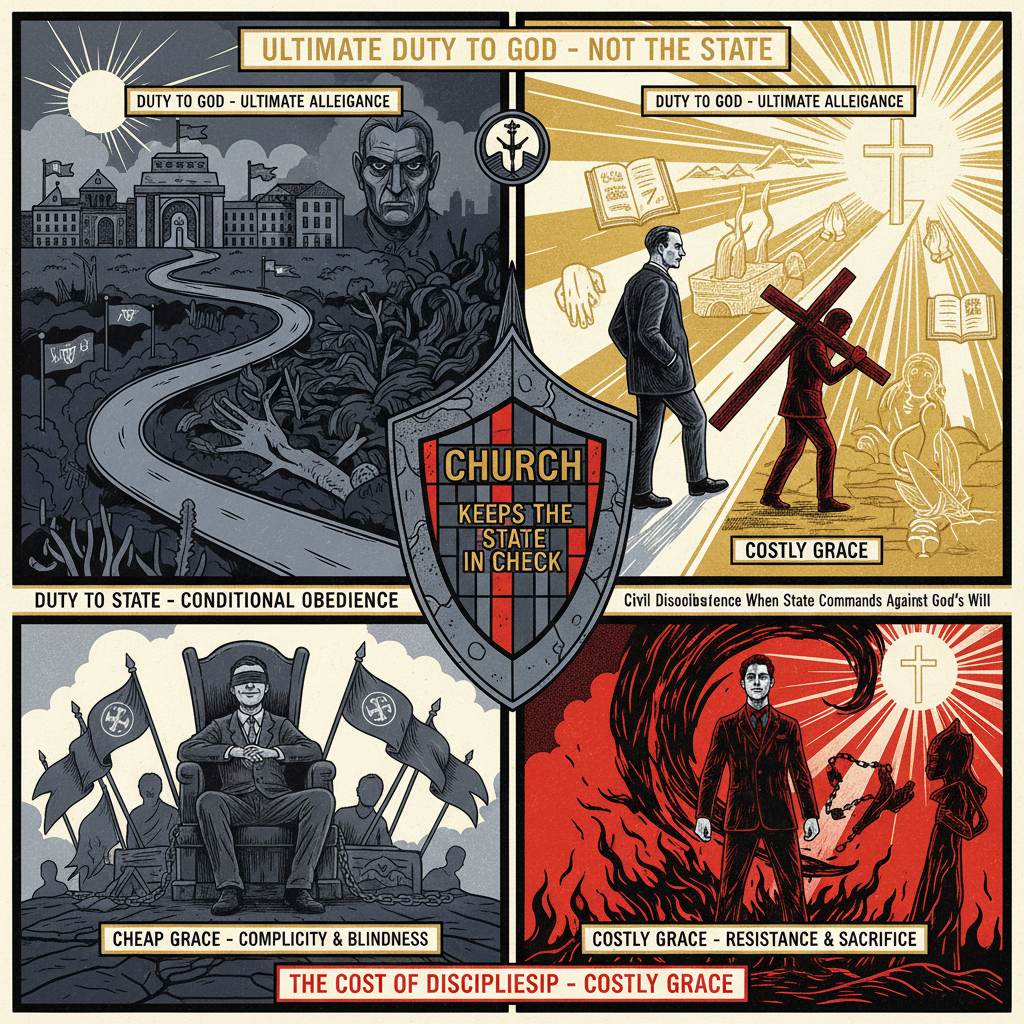
This illustration depicts Bonhoeffer's teaching on duty to God and the state: A figure stands at a crossroads where the path to God (upward, light-filled) diverges from the path to the state (horizontal, institutional). When the state becomes tyrannical (dark, corrupt), the figure must turn away from state obedience and follow God instead, embracing costly grace through responsible action. The Church stands as a prophetic shield between God and state, holding the government accountable. The contrast between cheap grace (complicit, comfortable) and costly grace (sacrificial, courageous) shows the moral courage required to resist evil.
Summary
Dietrich Bonhoeffer (1906–1945) was a German Lutheran theologian who actively resisted the Nazi regime. His teachings on the relationship between duty to God and duty to the state are central to Christian ethics, particularly regarding when civil disobedience becomes a moral obligation.
Core Argument:
- God's authority is ultimate: The state has legitimate authority, but only under God. When the state commands something contrary to God's will, Christians must disobey.
- The Church must act: The Church has a responsibility to challenge the state when it becomes unjust or tyrannical.
- Costly Grace demands action: True discipleship requires sacrifice and may include resisting evil, even at the cost of one's life.
- Cheap Grace enables evil: Grace without discipleship allows Christians to be complicit in injustice.
Detailed Explanation
Historical Context
Bonhoeffer lived through the rise of Nazi Germany. Many German Christians (the "German Christians" movement) supported Hitler, believing obedience to the state was a Christian duty. Bonhoeffer rejected this.
The Confessing Church
Bonhoeffer helped found the Confessing Church, which opposed the Nazi-aligned German Christians. He argued the Church must be independent of the state.
The Plot Against Hitler
Bonhoeffer was involved in a conspiracy to assassinate Hitler. He was arrested, imprisoned, and executed by the Nazis in April 1945.
Church and State Relationship
Bonhoeffer outlined three ways the Church must respond to the state:
1. Question the State
The Church must ask whether the state's actions are legitimate and just.
2. Aid the Victims
The Church must help those who suffer under unjust state policies, regardless of their faith.
3. "Jam the Wheel"
If necessary, the Church must directly oppose the state—putting "a spoke in the wheel" of injustice.
Obedience to God vs. Obedience to State
Bonhoeffer drew on Romans 13 (which commands obedience to governing authorities) but argued it has limits.
Legitimate Authority
The state has God-given authority to maintain order and justice. Christians should generally obey.
When to Disobey
When the state commands what God forbids (or forbids what God commands), Christians must disobey. "We must obey God rather than men" (Acts 5:29).
Cheap Grace vs. Costly Grace
This is one of Bonhoeffer's most famous distinctions, from The Cost of Discipleship (1937).
Cheap Grace
"Grace without discipleship, grace without the cross, grace without Jesus Christ, living and incarnate."
- Forgiveness without repentance
- Communion without confession
- Absolution without personal change
- Grace that costs us nothing
Costly Grace
"The treasure hidden in the field; for the sake of it a man will go and sell all that he has."
- Grace that calls us to follow Christ
- Demands our whole life
- Cost God the life of His Son
- Must cost us our life too
Solidarity and Collective Guilt
Bonhoeffer emphasized that Christians share responsibility for the sins of their community.
Key Insight
Silence in the face of evil is itself evil. God will not hold us guiltless. Not to speak is to speak. Not to act is to act. German Christians who remained silent about Nazi atrocities were complicit in those atrocities.
Civil Disobedience and Tyrannicide
Bonhoeffer ultimately concluded that active resistance—even violence—could be morally necessary.
Responsible Action
Christians must take "responsible action" even when it involves moral ambiguity. Sometimes all available choices involve sin—but inaction is also a choice.
Accepting Guilt
Bonhoeffer accepted that participating in the plot against Hitler made him guilty. But he believed it was better to become guilty by acting against evil than to remain "innocent" through inaction.
Scholarly Perspectives
"Cheap grace is the deadly enemy of our Church. We are fighting today for costly grace."
Dietrich Bonhoeffer, The Cost of Discipleship (1937) — This is perhaps Bonhoeffer's most famous line. It criticizes a Christianity that offers forgiveness without demanding transformation.
"Silence in the face of evil is itself evil: God will not hold us guiltless. Not to speak is to speak. Not to act is to act."
Attributed to Dietrich Bonhoeffer — This encapsulates Bonhoeffer's rejection of passive Christianity. Failing to oppose injustice makes one complicit in it.
"The Church is the Church only when it exists for others... not dominating, but helping and serving."
Dietrich Bonhoeffer, Letters and Papers from Prison (1944) — Written from prison, this shows Bonhoeffer's vision of a Church that serves the oppressed rather than aligning with power.
Key Takeaways
Quick Reference: Key Terminology
| Term | Definition |
|---|---|
| Cheap Grace | Grace without discipleship—forgiveness that demands no change or sacrifice |
| Costly Grace | Grace that calls us to follow Christ, costing us our whole life as it cost God His Son |
| Confessing Church | The movement opposing Nazi influence in German Christianity, which Bonhoeffer helped found |
| Responsible Action | Acting ethically even when all choices involve moral compromise; accepting guilt to prevent greater evil |
| Tyrannicide | The killing of a tyrant—which Bonhoeffer concluded could be morally justified |
| Solidarity | Sharing in the guilt and suffering of one's community; Christians are not innocent bystanders |
Exam Application Tips
For "Explain" Questions
- Clearly distinguish cheap grace from costly grace
- Explain the three ways the Church must respond to the state
- Use Bonhoeffer's historical context (Nazi Germany) as illustration
For "Evaluate" Questions
- Consider whether Romans 13 supports or limits Bonhoeffer's view
- Evaluate whether violence can ever be justified by Christian ethics
- Compare with other views on Church-state relations