Agape as the Only Christian Ethical Principle
Summary
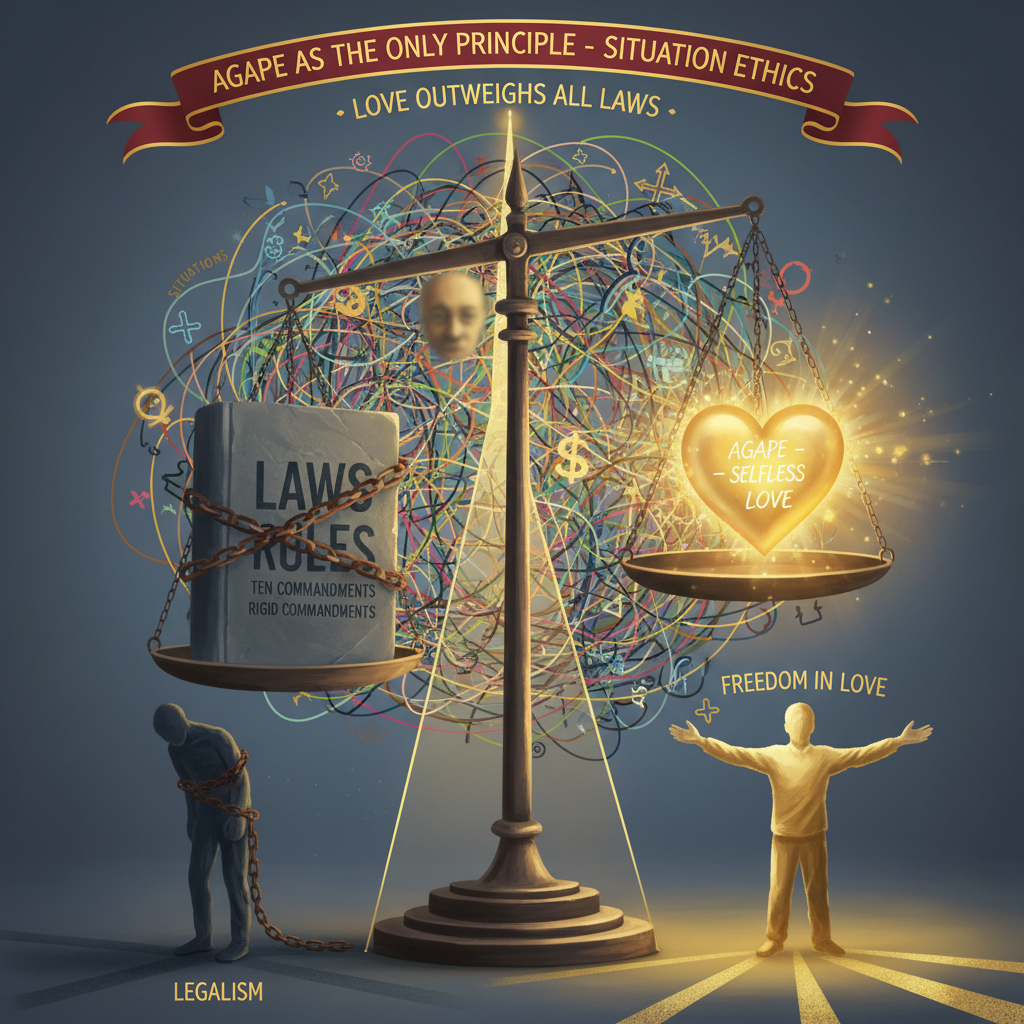
Agape (selfless, unconditional love) is often argued to be the single, ruling principle of Christian ethics, superseding all other laws. This view is famously associated with Situation Ethics and Joseph Fletcher.
Core Argument:
- Love is the only intrinsic good: Laws (like "do not lie") are only good if they serve love. If lying saves a life (e.g., hiding Jews from Nazis), then lying is the "good" thing to do because it is the "loving" thing to do.
- Jesus and Paul: Proponents point to Jesus breaking Sabbath laws to heal people (Mark 2:27) and St. Paul saying "Love is the fulfilling of the law" (Romans 13:10).
- Relativism: There are no absolute rules except "do the most loving thing."
- Justice = Love Distributed: Justice is simply love applied to many people.
Detailed Explanation
What is Agape?
Agape is a Greek word for love used in the New Testament. It is distinct from Eros (sexual/romantic love) and Philia (friendship).
Characteristics
It is selfless, sacrificial, and unconditional. It is the love God has for humanity and the love Christians are commanded to show neighbors (even enemies).
The Argument
Since God is love (1 John 4:8), the only way to be "godly" is to act lovingly. Therefore, any rule that stops you from loving is ungodly.
Joseph Fletcher and Situation Ethics
Fletcher is the main scholar for this topic. He proposed Situation Ethics in the 1960s as a rejection of rigid Christian legalism.
The Six Propositions
These define how Agape works:
1. Love is the only intrinsic good
(Everything else is only instrumentally good)
2. Love is the ruling norm
(It replaces the Ten Commandments)
3. Love and Justice are the same
(Justice is just love shared among many)
4. Love is not liking
(It's an act of will, not a feeling)
5. Love justifies the means
(If the outcome is loving, the action is right)
6. Love decides there and then
(You can't make rules in advance)
The Four Working Principles
Pragmatism
Does it work?
Relativism
No absolute rules (except love)
Positivism
You choose to believe in love (faith first)
Personalism
People come before laws
Paul Tillich: Love as the Ultimate Law
Tillich is often used to support the idea that love transcends moralism.
Love vs. Moralism
Moralism (following rules) is cold and rigid. Love is "creative" and "participates" in the situation.
Justice
Tillich argued that "Love is the backbone of justice." You cannot have true justice without love, because justice without love becomes cruel (e.g., executing a starving man for stealing bread is "just" but not loving). Love transforms justice into something creative that fixes the problem rather than just punishing it.
Rudolf Bultmann: Radical Obedience
Bultmann was an existentialist theologian.
Jesus as Radical
He viewed Jesus not as a law-giver (like Moses) but as a liberator who freed people from the law.
The "Now"
For Bultmann, God meets you in the "Here and Now." You don't look up a rule in a book; you respond to the specific person in front of you with love. This is "Radical Obedience" to the moment.
The Critique: William Barclay
William Barclay is the standard counter-argument in the OCR syllabus.
"The Crutch of the Law"
Barclay argued that Fletcher is too optimistic. If everyone were like Jesus, Situation Ethics would work. But humans are selfish. We need laws ("crutches") to help us walk straight.
Freedom is Terrifying
Giving people total freedom to "decide there and then" is overwhelming. Most people need guidance.
Love Can Be Distorted
Without rules, people might justify adultery or theft by claiming they did it "for love." The law protects society from our "loving" mistakes.
Scholarly Perspectives
"The situationist follows a moral law or violates it according to love's need. For the situationist there are no rules—none at all."
Joseph Fletcher, Situation Ethics: The New Morality (1966) — This sums up the "Agape Only" approach. It explicitly states that even valid laws (like "do not lie") must be broken if the specific situation ("love's need") demands it.
"If all men were angels, situation ethics would be the perfect ethics; but man has not yet come of age. Man, therefore, still needs the crutch and protection of law."
William Barclay, Ethics in a Permissive Society (1971) — This is the essential evaluation point. It accepts that Agape is the ideal, but argues it is dangerous as a practical system because humans are flawed/sinful.
Key Takeaways
Quick Reference: Key Terminology
| Term | Definition |
|---|---|
| Agape | Selfless, unconditional Christian love (distinct from Eros/Philia) |
| Situation Ethics | The ethical theory that the right action is whatever produces the most loving result in that specific context |
| Intrinsic Good | Something good in itself (Fletcher says only Love fits this) |
| Antinomianism | The belief that there are no laws/rules at all (Fletcher tried to avoid this but is often accused of it) |
| Legalism | An over-reliance on rules and regulations (what Fletcher opposed) |
| Personalism | The principle that ethics is about benefiting people, not obeying abstract laws |
| "The Crutch of the Law" | Barclay's metaphor for why humans need rules (because we are morally weak) |
Exam Tips
- It's a "Middle Way": Don't just say Fletcher rejected laws. He rejected legalism (worshiping laws). He respected laws as "guidelines" (sophia) but insisted they must be broken if love demands it.
- Connect to Jesus: Always link this to Jesus's conflicts with the Pharisees (e.g., healing on the Sabbath). This grounds the theory in Christian theology, not just liberal philosophy.
- The "Justice" Point: A common mistake is thinking Agape ignores justice. Use Tillich or Fletcher to explain that Justice IS Love (Love distributed to the whole community).
- Evaluation: Is Agape too vague? "Love" can mean anything. Does it lead to individualism? (Barclay). Or is it the only way to be truly Christ-like in a complex world?
Key Thinkers Summary
Joseph Fletcher
The father of Situation Ethics. He argued for a "middle way" between Legalism (following rules blindly) and Antinomianism (having no rules).
Paul Tillich
Argued that love is the "ultimate law" because it has the power to unite people, whereas strict justice can divide them.
Rudolf Bultmann
Argued that Jesus taught "radical obedience" to the demand of love in the moment, rather than following a static set of rules.
William Barclay
A key critic. He argued that while love is great, humans are too selfish to use it as their only guide. We need laws (the "crutch" of the law) to stop us from misinterpreting "love" as "lust" or "selfishness."